MISSIONARY ACTIVITY AND CONVERSION DEBATES IN SOUTH INDIA
TOPIC 40 MISSIONARY ACTIVITY AND CONVERSION DEBATES IN SOUTH INDIA Religious Freedom versus Anti-Conversion Enforcement In March 2026, the Chhattisgarh Legislative Assembly passed the Freedom of Religion Bill, 2026, one

TOPIC 40
MISSIONARY ACTIVITY AND CONVERSION DEBATES IN SOUTH INDIA
Religious Freedom versus Anti-Conversion Enforcement
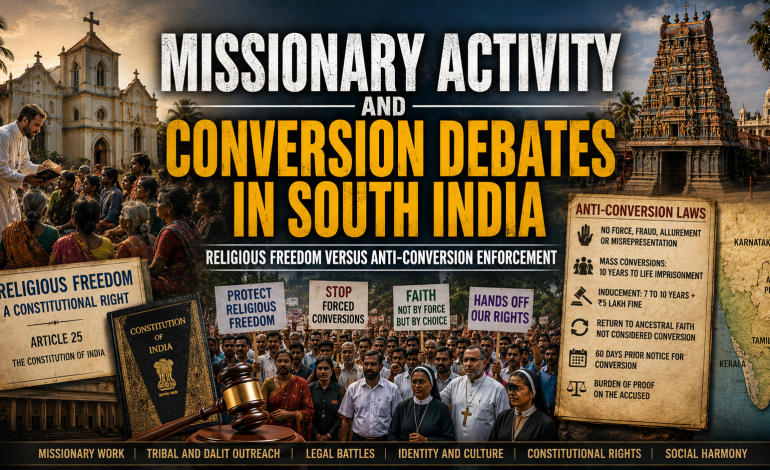
In March 2026, the Chhattisgarh Legislative Assembly passed the Freedom of Religion Bill, 2026, one of the most stringent anti-conversion laws in India. While Chhattisgarh is geographically in central India, the debates animating this law—and the legal battles that followed—resonate powerfully across South India, where missionary activity has historically been concentrated and where anti-conversion sentiment has become increasingly pronounced. The new law criminalizes conversions carried out through force, fraud, allurement, or misrepresentation, including through digital means. Mass conversions attract imprisonment of ten years to life, while any attempt to convert through inducement carries seven to ten years and a fine of ₹5 lakh. The legislation explicitly states that returning to one’s “original or ancestral religion” does not constitute conversion under the law .
Just weeks earlier, in February 2026, the Supreme Court had dismissed a plea challenging restrictions imposed on Christian missionaries and pastors seeking to enter certain tribal villages in Chhattisgarh . The Court upheld a High Court order that had made sweeping observations about religious conversions allegedly carried out through “inducement” and “manipulation,” and the impact of such conversions on social harmony and tribal cultural identity. Archbishop Victor Henry Thakur of Raipur called the ruling “very discriminatory, as it violates the constitutional rights of citizens to free movement and right to propagate religion” .
Simultaneously, in Kerala, the Foreign Contribution (Regulation) Act (FCRA) amendment bill introduced in March 2026 triggered sharp opposition from Christian denominations. Mar Baselios Cleemis, head of the Syro-Malankara Church and president of the Kerala Catholic Bishops Conference, warned that the bill creates “an authoritarian framework and authority,” granting the government “limitless power to seize the assets of an organisation receiving foreign funds” even before courts could intervene . Archbishop Thomas Tharayil noted that under his diocese alone, 109 “karunya bhavans” run by nuns for the destitute and elderly—serving people of all faiths—depend on foreign aid. The bill, he argued, could upend welfare initiatives in education and health sectors across rural Kerala .
In Maharashtra, Chief Minister Devendra Fadnavis defended that state’s proposed Freedom of Religion Bill, 2026, asserting it is “designed to curb fraudulent religious conversions, especially those linked to coercion, inducement and marriage, and does not single out any particular community” . The bill requires 60 days’ advance notice for conversions, allows relatives to file complaints, shifts the burden of proof onto the accused, and makes unlawful conversion a cognizable, non-bailable offense.
This article examines the complex landscape of missionary activity and conversion debates across South India. It explores the legal framework of anti-conversion laws in southern states, the constitutional questions they raise, the social tensions surrounding missionary work among tribal and Dalit communities, the phenomenon of “faith without conversion” emerging in states like Punjab and spreading southward, and the fundamental tension between religious freedom as guaranteed by Article 25 and state efforts to regulate religious change.
WHAT – The missionary activity and conversion debate encompasses the legal, social, and political tensions surrounding religious conversion, particularly from Hinduism, Sikhism, and tribal religions to Christianity (and sometimes Islam). Key issues include whether conversions are voluntary and informed or induced through coercion, fraud, or material allurement; whether anti-conversion laws protect vulnerable communities or violate religious freedom; and how the state balances its constitutional commitment to secularism with its regulatory authority over religious practices.
WHO – Key actors include Christian missionary organizations (Catholic, Protestant, and independent ministries) operating across South India; state governments in Tamil Nadu, Karnataka, Kerala, Andhra Pradesh, Telangana, and Maharashtra that have enacted or are considering anti-conversion laws; the Supreme Court and High Courts that adjudicate constitutional challenges; Dalit and tribal communities who are often the subjects of conversion efforts; political parties (BJP, Congress, DMK, and regional parties) that take varying positions on conversion; and the judiciary, which interprets constitutional religious freedom guarantees.
WHEN – The debate has intensified between 2020 and 2026, with major developments including the Supreme Court’s February 2026 ruling upholding restrictions on missionaries in Chhattisgarh tribal villages , the passage of the Chhattisgarh Freedom of Religion Bill (March 2026) , the introduction of the Maharashtra Freedom of Religion Bill (March 2026) , the FCRA amendment bill debate in Kerala (March-April 2026) , and the Supreme Court’s March 2026 ruling in Chinthada Anand reaffirming that Dalit Christians do not retain SC status under the 1950 Presidential Order .
WHERE – Across South India, with particular focus on Tamil Nadu (with its long history of Christian missionary education and Dalit conversion), Karnataka (which enacted an anti-conversion law in 2022), Kerala (with its large Christian population and recent FCRA controversy), Andhra Pradesh and Telangana (where missionary activity among tribal communities is significant), and Maharashtra (which passed its Freedom of Religion Bill in 2026).
WHY – Proponents of anti-conversion laws argue that missionary activity often exploits vulnerable communities through material inducements—education, healthcare, employment—that amount to coercion of the poor and illiterate. They contend that mass conversions disturb social harmony and threaten the cultural identity of indigenous tribal communities. Opponents argue that these laws violate the constitutional right to “propagate” religion under Article 25, that they are selectively enforced against minority communities, and that they serve electoral mobilization by majoritarian parties.
HOW – Through anti-conversion statutes that require prior notice of conversion, shift the burden of proof to the accused, allow third-party complaints, impose severe penalties (including life imprisonment for mass conversions), and create special courts for speedy trial; through FCRA regulations that restrict foreign funding to Christian charitable organizations; through Gram Sabha resolutions in tribal areas banning entry of missionaries; and through judicial rulings that interpret the scope of religious freedom.
THE CONSTITUTIONAL FRAMEWORK – RELIGIOUS FREEDOM AND ITS LIMITS
The debate over missionary activity and conversion in India is rooted in a fundamental tension within the Constitution itself.
Article 25: The Right to Propagate Religion
Article 25 of the Constitution guarantees “freedom of conscience and the right freely to profess, practise and propagate religion.” The inclusion of the word “propagate” was deliberate and controversial. During Constituent Assembly debates, some members argued that the right to propagate would allow proselytization, which they viewed as threatening to India’s religious fabric. Others argued that propagation is an essential aspect of religious freedom—that the right to hold a belief includes the right to share it with others.
The Supreme Court has interpreted “propagate” as the right to “transmit or spread one’s religion by an exposition of its tenets.” However, the Court has consistently held that this right does not include the right to “forcibly convert” or to convert through “fraud, misrepresentation, or allurement.”
Article 25’s Limitations Clause
Crucially, Article 25 itself is subject to “public order, morality and health” and to the other provisions of the Constitution. This limitation has allowed states to enact legislation regulating conversion when it is alleged to threaten public order.
Article 27: The Prohibition on Religious Funding
As discussed in the previous topic on state funding of pilgrimage, Article 27 prohibits using tax revenues for the “promotion or maintenance of any particular religion.” Critics of missionary activity argue that foreign funding of Christian charitable institutions—schools, hospitals, orphanages—amounts to religious promotion using foreign resources, a practice they contend violates the spirit of Article 27 and justifies FCRA regulation.
Article 25(2)(b) and the SC Status Question
The Constitution (Scheduled Castes) Order, 1950, issued under Article 341, restricts Scheduled Caste status to persons professing Hinduism, Sikhism, or Buddhism. This means that Dalits who convert to Christianity or Islam lose their SC status—and with it, access to reservation benefits, protection under the SC/ST (Prevention of Atrocities) Act, and other affirmative action provisions.
On March 24, 2026, the Supreme Court in Chinthada Anand v. State of Andhra Pradesh reaffirmed this position. The Court ruled that a Dalit Christian pastor could not invoke the protections of the SC/ST Atrocities Act because, under the 1950 Order, SC status is limited to Hindus, Sikhs, and Buddhists .
However, as social activists Hamid Masih and Tarsem Peter clarified, this ruling “is being blown out of proportion. It is not something new. The legal position has been the same for decades. The court has only reiterated what already exists under the law” . More importantly, they noted that the larger issue—whether Dalit Christians should be granted SC status—”is still pending before the Supreme Court. Multiple petitions challenging the 1950 order are under hearing. No final judgment has been delivered on that matter” .
The exclusion of Christians and Muslims from SC status creates a powerful structural incentive against conversion. For a Dalit family, converting to Christianity means losing access to reservations in education, government employment, and legislative representation—a material cost that critics of anti-conversion laws argue constitutes state-imposed coercion against religious choice.
ANTI-CONVERSION LAWS IN SOUTH INDIA
South India has seen significant legislative activity around conversion regulation. While the most stringent laws have been passed in central and northern states, southern states have either enacted their own laws or are debating them.
Karnataka’s Anti-Conversion Law (2022)
Karnataka enacted the Karnataka Protection of Right to Freedom of Religion Act, 2022, which prohibits conversions through force, fraud, coercion, allurement, or by marriage. The law requires individuals wishing to convert to give prior notice to the District Magistrate, and it makes unlawful conversion a cognizable and non-bailable offense. Penalties include imprisonment of up to five years and fines up to ₹25,000.
Maharashtra Freedom of Religion Bill, 2026
In March 2026, the Maharashtra Assembly passed the Maharashtra Freedom of Religion Bill, 2026, which Chief Minister Devendra Fadnavis defended as “not directed against any particular religion” and “designed to curb fraudulent religious conversions, especially those linked to coercion, inducement and marriage” .
Key provisions of the Maharashtra law include:
Advance Notice Requirement: Individuals or institutions proposing to convert must give 60 days’ advance notice to authorities. Details will be displayed publicly to invite objections .
Penalties: Unlawful conversion carries imprisonment of up to seven years and fines. Violations involving minors, persons of unsound mind, women, or SC/ST individuals carry seven years’ imprisonment and fines of ₹5 lakh .
Mass Conversions: Mass conversions carry seven years’ imprisonment and a fine of ₹5 lakh. Repeat offenders face ten years and a fine of ₹5 lakh .
Marriage Provisions: Conversions on the pretext of marriage are explicitly covered, with seven years’ imprisonment and a ₹1 lakh fine .
Burden of Proof: The bill shifts the burden of proof onto the person accused of facilitating an unlawful conversion .
Third-Party Complaints: Relatives are allowed to file complaints that police must register as FIRs .
Fadnavis emphasized that the bill “applies to all religions equally” and that its intent “is to prevent coercion or inducement in religious conversion while safeguarding Constitutional rights” . He noted that several states, including Odisha, Gujarat, Uttar Pradesh, Madhya Pradesh, Haryana, Karnataka, and Jharkhand, have already enacted similar laws .
Tamil Nadu: The Absence of an Anti-Conversion Law
Notably, Tamil Nadu—which has one of India’s largest Christian populations and a long history of missionary education—has not enacted an anti-conversion law. The DMK government, which came to power in 2021, has resisted calls for such legislation. Tamil Nadu’s Christian population (approximately 6% of the state’s population) has been able to practice and propagate its faith without the legal restrictions found in neighboring states.
However, this does not mean Tamil Nadu is free from conversion-related tensions. The state has seen periodic controversies over missionary activity among Dalit communities, and allegations of forced conversion have surfaced during election campaigns.
Kerala: No Anti-Conversion Law, But FCRA Battles
Kerala, with India’s largest Christian population as a percentage of state population (approximately 18%), has also not enacted an anti-conversion law. The state’s Christian community—divided into Catholic, Orthodox, Mar Thoma, and various Protestant denominations—is deeply integrated into Kerala’s social, educational, and political fabric. Christian-run schools, colleges, and hospitals are ubiquitous across the state.
Instead of an anti-conversion law, the central government’s FCRA amendment bill has become the primary site of contestation in Kerala. The bill, introduced in the Lok Sabha on March 25, 2026, aims to regulate foreign funds to NGOs to ensure they do not adversely affect “national interest, public order or national security” .
The bill creates a “designated authority” that will manage the assets of an organization if its FCRA certificate is cancelled or surrendered. In the case of a place of worship, the designated authority can entrust asset management “in a manner in which the religious character of the place of worship is maintained” .
Christian leaders in Kerala have expressed alarm. Mar Baselios Cleemis, head of the Syro-Malankara Church and president of the Kerala Catholic Bishops Conference, warned: “Through the amendment bill, an authoritarian framework and authority is being created. Even before the courts could intervene, the bill allows the government limitless power to seize the assets of an organisation receiving foreign funds. It could lead to misuse of power by central agencies and rights of citizens being violated” .
Archbishop Thomas Tharayil noted the concrete impact on charitable work: “Under our diocese alone, there are 109 ‘karunya bhavans’ run by our nuns for the destitute and elderly. People of all castes and faiths live in these bhavans. We are able to run these centres due to the help extended by people which also includes aid from foreign countries” .
The BJP, which is seeking to expand its electoral footprint in Kerala with the support of the Christian population alongside its core Hindu vote, moved quickly to contain the anger. Union Minority Affairs Minister Kiren Rijiju clarified that “only illegal FCRA accounts would be affected, not any religion or caste” . BJP state vice-president Shone George added that the party’s state president Rajeev Chandrasekhar has held talks with central leadership, and Union Home Minister Amit Shah assured that the government would “move ahead with the bill only after clearing all concerns over it” .
The All Indian Christian Council, in a memorandum to Telangana Chief Minister A. Revanth Reddy, termed the bill “constitutionally flawed” and warned that provisions allowing a “designated authority” to act without judicial oversight could enable the takeover of Christian and minority institutions whose FCRA licences are not renewed. They cited the temporary cancellation of the Missionaries of Charity’s licence in 2021 as precedent .
THE SUPREME COURT AND THE CHHATTISGARH VILLAGE RESTRICTIONS
While the legislative battles over anti-conversion laws continue, the Supreme Court’s February 2026 ruling on restrictions imposed on Christian missionaries entering tribal villages in Chhattisgarh has profound implications for South India as well .
The High Court’s Observations
The case arose from a Chhattisgarh High Court order rejecting a plea concerning resolutions passed by certain Gram Sabhas in tribal areas allegedly banning the entry of Christian pastors and converted tribals into villages . Hoardings had reportedly been put up in some villages stating that entry of pastors and priests was prohibited under the Panchayat (Extension to Scheduled Areas) Act .
The High Court made extensive observations about missionary activity that are worth quoting at length:
“Religious conversion has long been a sensitive issue in India’s socio-political landscape. Among the various forms of conversion, those allegedly carried out by Christian missionaries among poor and illiterate tribal and rural populations have generated particular controversy. While the Constitution guarantees every citizen the freedom to profess, practice, and propagate religion, the misuse of this liberty through coercion, inducement, or deception has become a matter of grave concern. The phenomenon of mass or motivated conversions not only disturbs social harmony but also challenges the cultural identity of indigenous communities” .
The High Court provided a historical narrative:
“Missionary activity in India dates back to the colonial period, when Christian organizations established schools, hospitals, and welfare institutions. Initially, these efforts were directed at social upliftment, literacy, and health care. However, over time, some missionary groups began using these platforms as avenues for proselytization. Among economically and socially deprived sections, especially Scheduled Tribes and Scheduled Castes, this led to gradual religious conversion under the promise of better livelihoods, education, equality. What was once seen as service became, in many cases, a subtle instrument of religious expansion” .
The Court then articulated the legal concern:
“The menace arises when conversion ceases to be a matter of personal faith and becomes a result of inducement, manipulation, or exploitation of vulnerability. In remote tribal belts, missionaries are often accused of targeting illiterate and impoverished families, offering them monetary aid, free education, medical care, or employment in exchange for conversion. Such practices distort the spirit of voluntary faith and amount to cultural coercion. This process has also led to deep social divisions within tribal communities. Tribals converted to Christianity often adopt new cultural practices, distancing themselves from traditional rituals and communal festivals. As a result, villages become polarized, leading to tension, social boycotts, and sometimes even violent clashes” .
The Supreme Court’s Ruling
The Supreme Court bench of Justices Vikram Nath and Sandeep Mehta dismissed the plea challenging the High Court’s order . The Court noted that the petitioner had been directed to approach the individual Gram Sabhas for relief—a procedural rather than substantive resolution.
Senior Advocate Colin Gonsalves, appearing for the petitioner, argued that the High Court had made “sweeping remarks without any supporting material.” He submitted that over 700 attacks on pastors during prayer meetings were pending before the Supreme Court in another case and pointed to instances where tribals converted to Christianity were not allowed to bury their dead in their villages .
He further argued that “there is not a single conviction under conversion law for the last 10 years in Chhattisgarh,” challenging the factual basis for the High Court’s observations about widespread coercive conversion .
The Court, however, was “not persuaded to interfere and dismissed the petition” .
Implications for South India
The Supreme Court’s ruling—even if procedurally narrow—has significant implications for South India. The High Court’s observations about missionary activity among tribal communities could be cited in other jurisdictions. The Court’s willingness to endorse restrictions on entry of missionaries into tribal villages sets a precedent that could be followed by Gram Sabhas in tribal areas of Andhra Pradesh, Telangana, Karnataka, and Tamil Nadu.
Archbishop Victor Henry Thakur of Raipur told Crux that the ruling was “unfortunate” and “very discriminatory, as it violates the constitutional rights of citizens to free movement and right to propagate religion” . However, he noted that the dismissal appeared to be “partly procedural rather than substantive”—that the petitioners had “not first exhausted statutory remedies available” .
THE “FAITH WITHOUT CONVERSION” PHENOMENON
One of the most significant developments in India’s religious landscape—with particular relevance to South India—is the phenomenon of “faith without conversion,” where individuals practice Christian faith without formally converting on official documents.
The Punjab Model
As the Indian Express reported, in Punjab there is a growing phenomenon of Dalit people attending Christian church services and participating in “faith healing” sessions without formally changing their religion . “I am the same on paper, but my faith has changed,” is a commonly heard sentiment in Punjab .
Albert Dua, president of the Christian United Federation, explained: “In Punjab, faith is often practiced but not declared, identity is retained rather than replaced, and belief operates in a private, internal space. Laws can regulate formal declarations, but not personal belief” .
Why Does This Matter for South India?
The Punjab phenomenon is relevant to South India for several reasons. First, the same structural incentives exist: Dalit Christians lose SC status and reservation benefits upon formal conversion. The Supreme Court’s reaffirmation of this in Chinthada Anand has made the cost of formal conversion even clearer .
Second, independent “ministry churches”—operating outside traditional Catholic and Protestant structures—are growing across South India. These churches often emphasize faith healing and personal spiritual experience over formal membership and institutional affiliation. For families attending such churches, remaining Hindu or Sikh on official documents while practicing Christian faith privately allows them to retain SC status while changing their spiritual orientation.
Third, the “faith without conversion” phenomenon represents a strategic adaptation to anti-conversion laws. If conversion is not formally declared, anti-conversion statutes—which regulate the process of formal conversion—may not apply. This creates a legal gray area that protects individuals from prosecution while allowing religious change.
The Supreme Court’s ruling in Chinthada Anand has “reignited a debate in Punjab” . The same debate is likely to emerge in South India as the phenomenon spreads.
THE FCRA CONTROVERSY IN KERALA
The Foreign Contribution (Regulation) Act amendment bill has become the most significant flashpoint regarding missionary activity in South India, particularly in Kerala.
The Scale of Church-Run Welfare in Kerala
The Catholic Church in Kerala runs thousands of educational institutions, hospitals, orphanages, and homes for the elderly and destitute. As Archbishop Thomas Tharayil noted, under his diocese alone, there are 109 “karunya bhavans” run by nuns for the destitute and elderly, serving people of all castes and faiths . These institutions are funded in part by foreign contributions from the global Catholic diaspora and international charitable organizations.
The Concerns Raised
The FCRA amendment bill, introduced by Union Minister of State (Home Affairs) Nityanand Rai on March 25, 2026, creates a “designated authority” with the power to manage assets if an organization’s FCRA certificate is cancelled or surrendered . Christian groups raised three primary concerns:
Asset Seizure Without Judicial Review: Mar Baselios Cleemis warned that the bill “allows the government limitless power to seize the assets of an organisation receiving foreign funds” even before courts could intervene, creating “an authoritarian framework and authority” .
Partial Foreign Funding: Archbishop Tharayil noted that “even if an asset is built partially using foreign funds, it could be usurped by the designated authority” in case of certificate lapses, calling this provision “draconian” .
Impact on the Poor: The bill “concerns not only a few NGOs or Christian groups,” Tharayil argued. “It fundamentally affects the poor”—the destitute, elderly, and sick who depend on Church-run charitable institutions .
The Catholic Bishops Conference of India termed the legislation “dangerous” and “alarming” in its implications and urged the government to reconsider .
The Political Response
The BJP’s Kerala unit, which is seeking to expand its electoral footprint with the support of the 19% Christian population, moved quickly to contain the anger . Union Minister Kiren Rijiju accused the Congress and Communist parties of spreading “lies” about the bill’s intent, clarifying that “only illegal FCRA accounts would be affected” and that the government is “not to work against any religion or caste” .
BJP state vice-president Shone George assured that “only those who engage in fraud over foreign contributions need worry” and that Union Home Minister Amit Shah had “assured that the government will move ahead with the bill only after clearing all concerns” .
The central challenge for the BJP in Kerala is balancing its Hindutva base—which is skeptical of Christian missionary activity—with its electoral ambitions that require Christian support. The FCRA controversy represents this tension in sharp relief.
The Telangana Dimension
The All Indian Christian Council, in a memorandum to Telangana Chief Minister A. Revanth Reddy, joined the criticism, terming the bill “constitutionally flawed” and warning that the “designated authority” provisions could enable the takeover of Christian and minority institutions whose FCRA licences are not renewed. They cited the temporary cancellation of the Missionaries of Charity’s licence in 2021 as a precedent for arbitrary administrative action .
THE DALIT AND TRIBAL QUESTION
At the heart of the conversion debate in South India is the question of why people convert—and whether those reasons constitute legitimate religious choice or illegitimate inducement.
The Failure of Caste-Based Emancipation
For Dalits and Adivasis, conversion to Christianity has historically been motivated by the failure of Hinduism to deliver on its promise of spiritual equality. The caste system—with its practices of untouchability, social exclusion, and ritual discrimination—has driven many Dalits to seek dignity and equality in other religious traditions.
Archbishop Thakur’s characterization of the Chhattisgarh High Court’s ruling as “discriminatory” reflects a broader concern among Christian leaders that anti-conversion laws protect a caste-based social order that denies Dalits and Adivasis basic dignity.
The “Inducement” Debate
The central legal question in anti-conversion cases is: what constitutes “inducement”? If a missionary offers free education to a Dalit child, and that child later converts—was the conversion induced by the education? Or was the child able to access education only through the missionary, and converted freely as a result of exposure to Christian teachings?
Anti-conversion law proponents argue that offering education, healthcare, or employment in exchange for conversion is coercion of the vulnerable. Opponents argue that this logic criminalizes charity and social service, and that it is precisely the absence of state-provided education and healthcare in tribal areas that makes missionary services attractive in the first place.
The High Court’s Narrative of Exploitation
The Chhattisgarh High Court’s observations reflect the pro-regulatory position: “In remote tribal belts, missionaries are often accused of targeting illiterate and impoverished families, offering them monetary aid, free education, medical care, or employment in exchange for conversion. Such practices distort the spirit of voluntary faith and amount to cultural coercion” .
The Court further argued that this process “has also led to deep social divisions within tribal communities. Tribals converted to Christianity often adopt new cultural practices, distancing themselves from traditional rituals and communal festivals. As a result, villages become polarized, leading to tension, social boycotts, and sometimes even violent clashes” .
The Constitutional Rights Framework
Senior Advocate Colin Gonsalves, representing the petitioners, offered a counter-narrative: he pointed to “instances where tribals converted to Christianity were not allowed to bury their dead in their villages” —a fundamental violation of dignity and religious freedom. He also noted that “there is not a single conviction under conversion law for the last 10 years in Chhattisgarh,” suggesting that the alleged epidemic of coercive conversion may not be supported by evidence .
The Supreme Court’s refusal to entertain the plea, while procedurally narrow, left the High Court’s sweeping observations undisturbed—a fact that Christian leaders find deeply troubling.
THE POLITICAL DIVIDE IN SOUTH INDIA
The conversion debate in South India is shaped by distinctive regional political dynamics.
Kerala: The BJP’s Christian Outreach
Kerala presents the most complex political landscape. The BJP, traditionally weak in Kerala, has made a strategic decision to court the Christian vote. The party fielded several prominent Christian leaders in the 2026 Assembly elections, including Shone George in Pala, Union Minister George Kurien in Kanjirappilly, and party general secretary Anoop Antony in Thiruvalla .
This Christian outreach strategy is directly at odds with the BJP’s Hindutva base, which is skeptical—if not hostile—to Christian missionary activity. The FCRA controversy has exposed this tension: the central government pushing amendments that Christian leaders view as threatening, while the state BJP unit tries to assure them that their concerns will be addressed.
Tamil Nadu: DMK’s Secularism
The DMK government in Tamil Nadu has maintained a stance of secular equidistance, resisting calls for an anti-conversion law while not actively promoting Christian missionary activity. Tamil Nadu’s political culture, shaped by the Dravidian movement’s rationalist and anti-Brahminical ideology, has historically been more accommodating of religious diversity—including Christianity—than the Hindutva-dominated politics of northern and central India.
Karnataka: Congress vs. BJP on Conversion
Karnataka’s politics around conversion have seen sharp shifts. The BJP government passed the state’s anti-conversion law in 2022. The Congress government that came to power afterward has not repealed the law—perhaps recognizing its popularity among Hindu voters—but has not aggressively enforced it either. The law remains on the books, a testament to the political difficulty of reversing anti-conversion legislation once enacted.
Maharashtra: The Fadnavis Defense
Maharashtra Chief Minister Devendra Fadnavis has vigorously defended his state’s Freedom of Religion Bill, challenging the opposition to “read the bill’s provisions carefully” and accusing them of “trying to politicise the issue for votebank gains” . He has positioned the bill as a protective measure for vulnerable women: “We have seen several cases where women are lured, they elope and later are left alone. This raises serious questions about their future and that of their children. The bill is intended to address these problems” .
THE INTERNATIONAL DIMENSION
The missionary activity and conversion debate in South India cannot be understood without its international dimension.
Foreign Funding and Sovereignty
India has long been sensitive about foreign funding of religious activities. The Foreign Contribution (Regulation) Act was first enacted in 1976 to ensure that foreign funds do not “adversely affect the national interest” or “influence the socio-political scene in the country.”
Proponents of FCRA restrictions argue that foreign funding of missionary activity is a form of neo-colonial intervention—that international Christian organizations use charitable work as cover for proselytization aimed at undermining India’s Hindu cultural identity. The Supreme Court’s observations about missionary activity dating “back to the colonial period” reflect this concern about the historical entanglement of missionary work with Western imperialism.
Opponents argue that the vast majority of foreign funds received by Christian organizations in India support legitimate charitable activities—education, healthcare, disaster relief, care for the destitute—that the Indian state has been unable or unwilling to provide at adequate scale. The Catholic Church runs thousands of schools and hospitals across South India that serve people of all faiths, often in areas where government services are absent or inadequate.
The Diaspora Factor
The global Christian diaspora—particularly from Kerala—plays a significant role in funding church activities in India. Syrian Christian communities in the United States, the United Kingdom, the Gulf, and Australia send substantial remittances to support church-run institutions in their home regions. The FCRA amendment bill, by imposing greater scrutiny on foreign contributions, could disrupt this flow of diaspora funding.
THE CENTRAL QUESTION – COERCION OR CONVICTION?
The missionary activity and conversion debate in South India rests on a question that is both legal and philosophical: When is a conversion voluntary?
The Two Frameworks
Pro-Regulatory Framework: Anti-conversion laws protect vulnerable communities from exploitation. When missionaries offer material inducements—education, healthcare, employment—to impoverished and illiterate Dalits and Adivasis, they are not offering free choice; they are using their economic power to coerce religious change. The state has a duty to protect its most vulnerable citizens from such exploitation, just as it protects them from other forms of coercion.
Pro-Religious Freedom Framework: Religious conversion is a matter of conscience. The state has no business scrutinizing an individual’s reasons for changing faith. If a Dalit family chooses to convert because a missionary provided their child with an education that the state failed to provide, that is a judgment about the relative merits of the religious traditions—not coercion. By criminalizing conversion on grounds of “inducement,” the state is effectively protecting a caste-based social order that denies Dalits dignity and opportunity.
The Evidence Question
As Senior Advocate Colin Gonsalves noted before the Supreme Court, “there is not a single conviction under conversion law for the last 10 years in Chhattisgarh” . If coercive conversion is as widespread as anti-conversion law proponents claim, why are there no convictions? One answer is that the laws are difficult to enforce because conversions are inherently private matters of conscience. Another answer is that the laws are not genuinely intended to be enforced—they are political tools, designed to signal majoritarian commitment to “protecting” Hindu culture, rather than to actually regulate religious practice.
The Unanswered Question
The central question of this topic remains unresolved: Is the state’s restriction of missionary activity a legitimate exercise of its regulatory authority to protect vulnerable communities, or is it an unconstitutional infringement on religious freedom that targets minority communities for political gain?
The Supreme Court has not provided definitive guidance. The February 2026 ruling in the Chhattisgarh case was procedurally narrow, leaving the High Court’s substantive observations undisturbed . The constitutional challenge to the Places of Worship Act remains pending, as do the petitions seeking SC status for Dalit Christians.
In the absence of judicial clarity, legislative and executive action continues. States pass anti-conversion laws. The central government tightens FCRA regulations. Gram Sabhas pass resolutions restricting missionary entry.
And across South India, missionaries continue their work—running schools, hospitals, and orphanages—while living with the growing risk of legal action. Dalits and Adivasis continue to attend church services, sometimes formally converting, sometimes practicing “faith without conversion” to retain state benefits. And the debate over whether this constitutes free religious choice or coercive exploitation continues unresolved.
KEY LEGISLATIVE DEVELOPMENTS
| State | Law | Status | Key Provisions |
|---|---|---|---|
| Chhattisgarh | Freedom of Religion Bill, 2026 | Passed March 2026 | Mass conversion: 10 yrs-life; inducement: 7-10 yrs + ₹5L; cognizable, non-bailable; special courts; ghar wapsi exempted |
| Maharashtra | Freedom of Religion Bill, 2026 | Passed March 2026 | 60-day notice; marriage-based conversion covered; shift in burden of proof; relatives can file complaints |
| Karnataka | Protection of Right to Freedom of Religion Act, 2022 | In force | Prior notice to DM; cognizable offense; 5 yrs imprisonment |
| Tamil Nadu | No anti-conversion law | N/A | DMK government has resisted calls for legislation |
| Kerala | No anti-conversion law | N/A | FCRA amendment bill primary site of contestation |
| Central | FCRA Amendment Bill, 2026 | Introduced March 2026 | Designated authority for asset management; asset seizure on certificate lapse |