WORLD REBORN: The Collapse of Civilization and the Rise of a New Human Era
WORLD REBORN Deep Investigative Research Series After the Smashing — Humanity at the Edge of Transformation PROLOGUE AFTER THE SMASHING History rarely collapses in a single explosion. Civilizations usually unravel
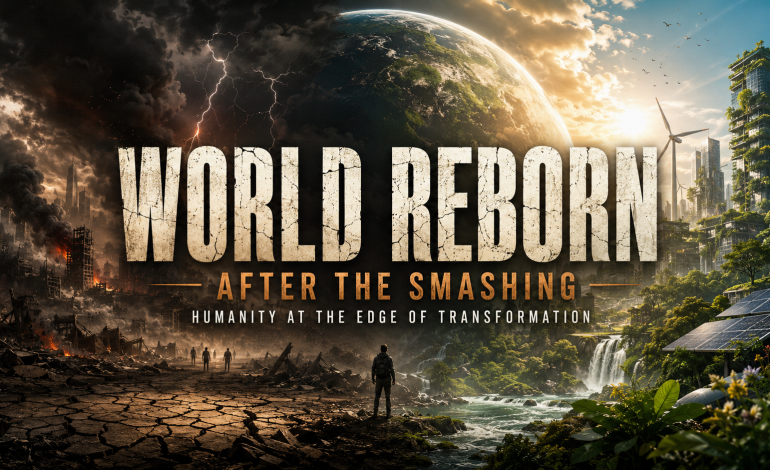

WORLD REBORN
Deep Investigative Research Series
After the Smashing — Humanity at the Edge of Transformation
PROLOGUE
AFTER THE SMASHING
History rarely collapses in a single explosion.
Civilizations usually unravel silently — through stress fractures invisible to ordinary people until the system suddenly fails.
Across the world today, people sense something unstable beneath daily life:
economic anxiety, climate disasters, political polarization, AI disruption, collapsing trust, mental exhaustion, and accelerating uncertainty.
“World Reborn” investigates whether humanity is entering another civilizational transition — not necessarily extinction, but transformation.
Researchers in complexity science, climate systems, social resilience, and collapse theory increasingly warn that modern civilization shows patterns historically associated with systemic instability. (MDPI)
CHAPTER 1 — THE WORLD DOES NOT FEEL STABLE ANYMORE
Modern instability is psychological before it becomes physical.
People experience:
- constant uncertainty,
- information overload,
- economic insecurity,
- climate anxiety,
- institutional distrust,
- digital exhaustion.
The modern world is interconnected so deeply that disruptions spread globally within hours.
Researchers studying societal resilience argue that advanced societies become vulnerable when complexity grows faster than adaptability. (MDPI)
Invisible collapse begins before visible collapse:
- declining trust,
- emotional fatigue,
- weakening institutions,
- fragmented social cohesion.
This creates collective anxiety — the feeling that “something is wrong” even before systems visibly fail.
CHAPTER 2 — THE FALL OF GREAT CIVILIZATIONS
Ancient collapses followed repeating patterns:
- environmental stress,
- political fragmentation,
- resource depletion,
- inequality,
- overcomplexity.
Rome
The Roman Empire became administratively enormous and increasingly difficult to maintain.
Bronze Age Collapse
Entire Mediterranean civilizations disappeared within decades due to interconnected trade failures, invasions, droughts, and systemic shocks.
Maya Civilization
Environmental stress, drought, warfare, and agricultural decline destabilized once-advanced urban systems.
Easter Island
Ecological depletion demonstrated how societies can undermine their own survival foundations.
Modern researchers argue collapse often emerges not from a single catastrophe but from multiple interacting pressures overwhelming resilience. (Article Gateway)
CHAPTER 3 — THE SCIENCE OF CIVILIZATION COLLAPSE
Complexity theory explains why advanced systems become fragile.
As societies grow:
- infrastructure expands,
- bureaucracy increases,
- energy demands rise,
- coordination costs multiply.
Eventually, societies spend more energy maintaining complexity than solving new problems.
Researchers inspired by Joseph Tainter’s collapse theory modeled how increasing societal complexity can create self-reinforcing fragility. (MDPI)
Core Collapse Concepts
Tipping Points
f(x)=\frac{1}{1+e^{-k(x-x_c)}}
Small changes suddenly trigger massive systemic shifts.
Cascading Failure
Interconnected systems amplify disruption:
banking → energy → supply chains → politics → social unrest.
Diminishing Returns
genui{“math_block_widget_always_prefetch_v2”:{“content”:”y=a\ln(x)+b”}}
Each additional layer of complexity produces smaller benefits while increasing maintenance costs.
CHAPTER 4 — THE AGE OF POLYCRISIS
Humanity no longer faces isolated crises.
Today’s risks interact simultaneously:
- climate instability,
- geopolitical conflict,
- AI disruption,
- economic fragility,
- mental health decline,
- cyberwarfare,
- migration pressure.
This is called polycrisis — when multiple crises amplify one another.
Highly interconnected global systems spread shocks rapidly across continents.
A war disrupts energy.
Energy disrupts food.
Food disrupts politics.
Politics disrupts economies.
The result is nonlinear instability.
CHAPTER 5 — CLIMATE DESTABILIZATION AND PLANETARY BREAKDOWN
Scientists warn that Earth systems may approach irreversible tipping points if warming accelerates further. (OECD)
Key Risks
- Arctic melt acceleration
- Ocean current disruption
- Coral reef collapse
- Amazon rainforest dieback
- Food system instability
- Water scarcity
- Climate migration
The OECD climate tipping point report warns that crossing thresholds may trigger cascading ecological and socioeconomic consequences beyond humanity’s adaptive capacity. (OECD)
Some researchers fear a future “Hothouse Earth” scenario where feedback loops push warming beyond human control. (The Guardian)
CHAPTER 6 — THE COLLAPSE OF THE HUMAN MIND
Modern civilization created unprecedented connectivity — but also unprecedented loneliness.
Key psychological trends:
- anxiety disorders,
- depression,
- burnout,
- digital addiction,
- declining meaning,
- social isolation.
Hyperconnectivity fragmented attention and weakened deep human relationships.
Entire populations now experience chronic stress cycles driven by:
- economic pressure,
- social comparison,
- political outrage,
- algorithmic manipulation.
Civilizational stress increasingly manifests as mental exhaustion.
CHAPTER 7 — TECHNOLOGY CREATED A FRAGILE WORLD
Modern life depends on invisible systems:
- satellites,
- cloud servers,
- financial networks,
- GPS,
- logistics infrastructure,
- undersea cables.
The more efficient systems become, the less resilient they often are.
Global supply chains optimized for speed lack redundancy.
A cyberattack, grid failure, or satellite disruption could cascade globally.
Researchers increasingly describe modern civilization as a tightly coupled technological system vulnerable to synchronized disruption. (ScienceDirect)
CHAPTER 8 — AI AND THE END OF HUMAN EXCEPTIONALISM
Artificial intelligence may become the most transformative force in human history.
Potential impacts:
- automation of knowledge work,
- mass labor disruption,
- AI-managed governance,
- surveillance societies,
- autonomous warfare,
- synthetic media manipulation.
The question is no longer whether AI changes civilization — but whether humanity can adapt faster than technological acceleration.
Some futurists envision post-human civilization where biological humans are no longer the dominant intelligence.
CHAPTER 9 — THE COLLAPSE OF NATIONS
Political systems worldwide face rising instability:
- polarization,
- distrust,
- corruption,
- nationalism,
- weakening democratic norms.
Migration pressures and resource competition intensify geopolitical tension.
Global cooperation declines precisely when planetary coordination becomes most necessary.
Many analysts fear fragmentation into competing blocs rather than unified global governance.
CHAPTER 10 — THE SECRET PREPARATIONS OF ELITES
Reports of billionaires purchasing:
- remote land,
- fortified compounds,
- underground shelters,
- private survival systems,
have fueled speculation about elite expectations of future instability.
Survivalism has entered mainstream culture.
The rise of luxury preparedness reflects growing elite concern about systemic fragility.
CHAPTER 11 — THE COMING RESOURCE WARS
Future conflicts may increasingly center around:
- freshwater,
- lithium,
- rare earth minerals,
- food production,
- energy infrastructure.
As climate stress intensifies, resource nationalism may reshape geopolitics.
The Arctic’s melting ice is already creating new strategic competition zones.
CHAPTER 12 — THE DEATH OF THE OLD ECONOMIC SYSTEM
Modern economies depend on:
- perpetual growth,
- expanding debt,
- increasing consumption.
But infinite growth collides with planetary limits.
Automation threatens traditional employment structures while wealth concentrates upward.
Many economists now debate whether industrial capitalism can survive the AI era.
CHAPTER 13 — WHEN CITIES START FAILING
Mega-cities concentrate vulnerability:
- overheating,
- infrastructure decay,
- energy demand,
- housing instability,
- transportation fragility.
Urban systems require enormous continuous maintenance.
Blackouts, floods, or water shortages can destabilize millions rapidly.
Future migration patterns may shift populations away from climate-vulnerable urban centers.
CHAPTER 14 — THE NEW TRIBAL AGE
Shared reality is fragmenting.
People increasingly live inside:
- ideological bubbles,
- algorithmic realities,
- digital tribes.
Information warfare now shapes politics, identity, and perception itself.
Nations may weaken while decentralized communities strengthen.
CHAPTER 15 — THE RETURN OF NATURE
History shows nature recovers rapidly when industrial pressure declines.
Examples include:
- wildlife resurgence,
- reforestation,
- ecological recovery in abandoned zones.
Earth’s systems possess resilience mechanisms beyond human civilization.
Nature may outlast industrial humanity.
CHAPTER 16 — THE SPIRITUAL REBIRTH AFTER COLLAPSE
Periods of suffering often trigger philosophical transformation.
As material systems fail, societies historically rediscover:
- spirituality,
- meaning,
- community,
- moral frameworks.
Future civilizations may blend:
- advanced technology,
- ecological awareness,
- ancient wisdom traditions.
CHAPTER 17 — THE REBIRTH OF CIVILIZATION
Collapse does not always mean extinction.
It may produce:
- localized resilient economies,
- decentralized energy,
- regenerative agriculture,
- AI-assisted sustainability,
- water-independent infrastructure.
Future societies may become smaller, smarter, and ecologically integrated.
CHAPTER 18 — THE FUTURE HUMAN
Emerging technologies could transform humanity itself:
- genetic engineering,
- neural interfaces,
- cybernetic augmentation,
- AI-human integration.
The definition of “human” may evolve dramatically during the next century.
CHAPTER 19 — WORLD REBORN
Civilization may stand at a historical threshold comparable to:
- the agricultural revolution,
- the industrial revolution,
- the rise and fall of empires.
The central question is not whether the current system changes.
It already is.
The real question:
What emerges after instability?
History suggests destruction often precedes transformation.
EPILOGUE
AFTER THE FALL, THE EARTH BREATHED AGAIN
If humanity survives the coming century, future generations may view this era not simply as collapse — but as transition.
A civilization built on extraction may evolve into one built on resilience.
A fragmented species may rediscover interdependence.
And from the ruins of one world, another may rise.
RESEARCH SOURCES & JOURNALS
Scientific & Research Sources
- OECD Climate Tipping Points Report
- MDPI — Societal Complexity & Collapse Model
- ScienceDirect — Stability Theory & Societal Collapse
- SAGE Journals — Why Do Societies Collapse?
- Journal of Leadership & Ethics — Logistics and Collapse
- International Journal — Civilization Collapse & Sustainability
- ArXiv — Dynamic Network Collapse Model
- ArXiv — General Theory of Societal Collapse
- ArXiv — Civilization Collapse-Recovery Dynamics
- ArXiv — Stable Hothouse Earth Mechanism