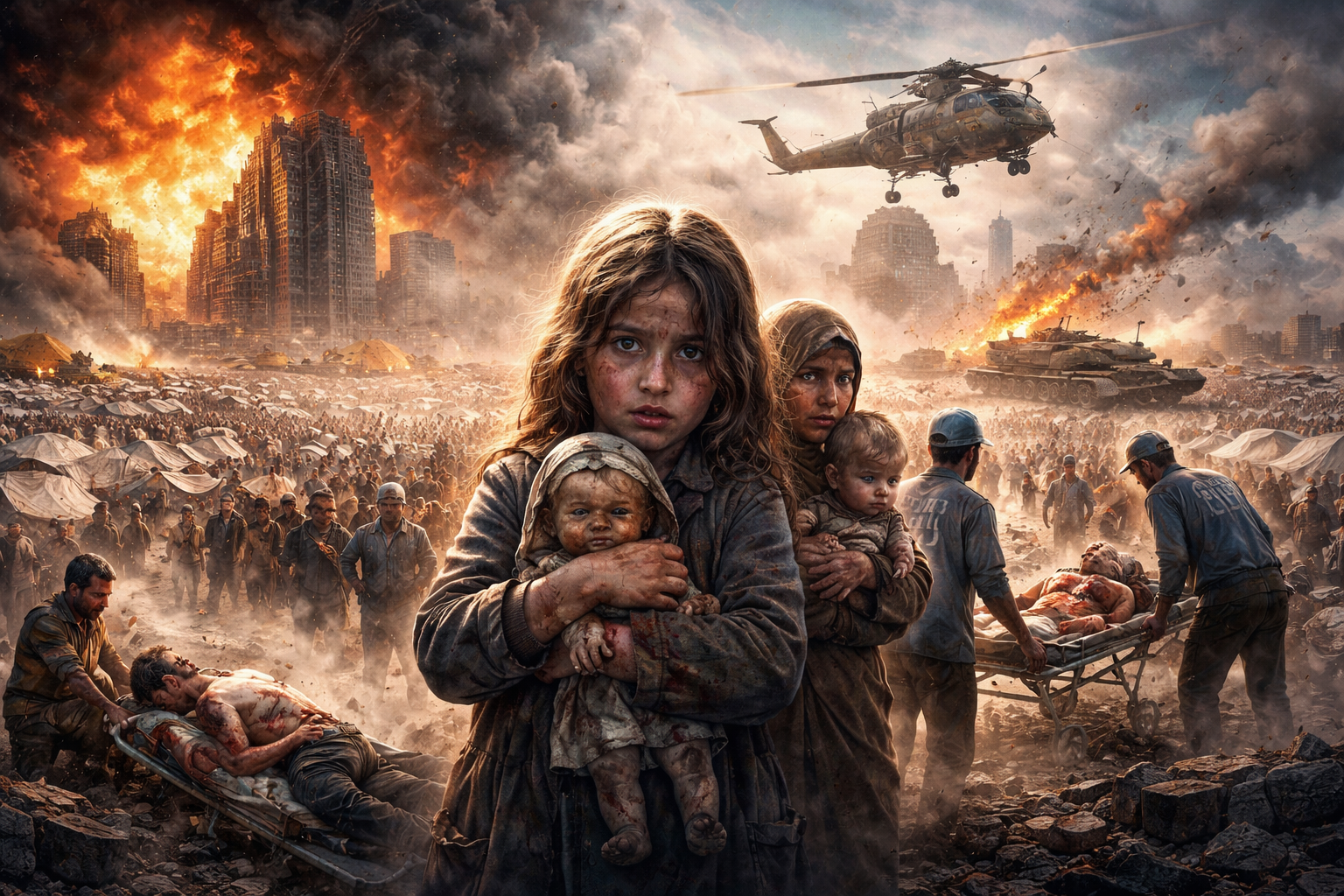
WORLD REBORN: After the Smashing — Collapse, Fragmentation, and the Rise of New Civilizations
PROLOGUE – WORLD REBORN WORLD REBORN: After the Smashing — Collapse, Fragmentation, and the Rise of New Civilizations From “Is Collapse Coming?” to “Which Systems Are Already Failing, and Which
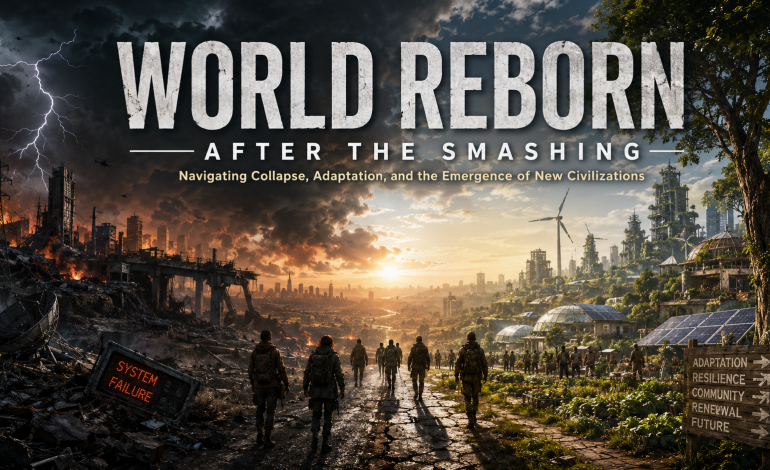

PROLOGUE – WORLD REBORN
WORLD REBORN: After the Smashing — Collapse, Fragmentation, and the Rise of New Civilizations
From “Is Collapse Coming?” to “Which Systems Are Already Failing, and Which Are Being Reborn?”
The traditional collapse question frames civilization as a binary state — standing or fallen, functioning or failed. This framing is no longer useful. Today’s planetary condition is not pre-collapse stability nor post-collapse ruin. It is simultaneous failure and emergence.
The evidence is not speculative. In May 2026, a joint report by the International Telecommunication Union (ITU), the UN Office for Disaster Risk Reduction (UNDRR), and Sciences Po documented that 89% of digital disruptions stem not from initial shocks but from cascading effects across systems, and the number of people affected can be up to ten times higher than those initially exposed. This is not a future warning — it is an empirical finding about how fragility propagates right now.
The same report identifies a deeper vulnerability: societies have grown dependent on digital systems without maintaining analogue skills and adequate fallback options. When big systems fail, offline alternatives no longer exist. This is the signature of advanced fragility — efficiency purchased at the cost of redundancy.
Contemporary collapse scholarship has moved beyond alarmism into rigorous analysis. In a 2026 article in the Journal of Classical Sociology, Martin Savransky documents how “collapsology” and “deep adaptation” frameworks have moved from activist margins into mainstream climate thinking, establishing communities, think tanks, and public endorsements (including by France’s former Minister of Environment). The distinguishing feature of this intellectual wave: the diagnosis no longer poses a problem susceptible to technocratic solutions. It presents a “global predicament” — “an inextricable, irreversible and complex situation for which there are no solutions, just measures for adapting to it”.
This is the shift. Not “can we prevent collapse?” but “how do we live within permanent instability?”
Defining the Next Century’s Core Axis: Fragmentation vs. Integration
The sociological literature provides a precise vocabulary for what is unfolding. A major 2024 analysis in Sotsiologicheskie Issledovaniya (Russian Academy of Sciences) documents that contemporary sociology operates under conditions of “metaparadigm crisis and post-globalization”.
Fragmentation drivers documented include:
-
Rising postcolonial discourse stigmatizing Western knowledge frameworks and creating theoretical alternatives to “global North” domination
-
Conceptions opposing social reality of networks and flows (Castells, Latour, Urry) to classical sociality of structures and agency
-
Postmodern fragmentation of interpretive authority — what the ZeMKI Media Research Center (University of Bremen) identifies as “dwindling trust in democratic institutions and epistemic authorities” alongside “increasing fragmentation of interpretive power in digital public spheres”
Integration pressures documented include:
-
Calls for a “third integrative wave” in the 2020s displacing “tendencies of disintegration, discrimination, growing gaps and rising barriers”
-
New theorizing around coherent configurations of four structure types: institutions, interactions, networks, and flows
-
“Augmented reality” as integrating metaphor overcoming constitutive distinctions between system/lifeworld, locality/globality, private/public, material/symbolic, real/virtual, physical/digital
The fragmentation is not merely academic. It manifests in real infrastructure and governance systems.
What Is Already Failing (Evidence from 2026)
Digital-Physical Cascades:
The ITU-UNDRR-Sciences Po report maps specific vulnerabilities now operative:
| Risk Scenario | Mechanism | Current Status |
|---|---|---|
| Solar storm | Disables satellites, destabilizes grids | Recovery measured in months; G5 storm already caused transformer failure at US nuclear plant (May 2024) |
| Submarine cable cuts | >99% of global internet traffic | 11 cables damaged since 2023; 7 incidents Nov 2024-Jan 2025 |
| Extreme heat | Overwhelms data centers | Healthcare/financial transaction failures possible |
| Geomagnetic induction | Grid digitization increases exposure | Sweden-Poland interconnection disrupted May 2024 |
Critical Infrastructure Convergent Threats:
A Gallagher report released April 2026 identifies four converging pressures destabilizing essential systems: geopolitical risk, natural catastrophes, cyber threats, and aging assets.
Key findings:
-
Disruptions to critical infrastructure rose from 26th to 22nd in WEF Global Risks Report 2026
-
70% of US cyber attacks in 2024 successfully compromised private sector infrastructure
-
Single pipe supplying 60% of Calgary’s water ruptured twice in 18 months (Dec 2025) — aging infrastructure failure
-
Strait of Hormuz disruption (2026 conflicts) stalled 20% of global oil/gas shipping
Climate-Infrastructure Convergence:
-
Los Angeles wildfires (Jan 2025): $60 billion+ damage, ~400 excess deaths from air quality and healthcare disruption
-
Super Typhoon Yagi (Vietnam, Sept 2024): $16 billion+ regional economic losses
The pattern is unmistakable: single-point failures now produce multi-sector, multi-national cascades.
What Is Being Reborn (Contemporary Evidence)
Alternative Futures Construction:
The ZeMKI Research Center’s 2026 doctoral research examines how competing visions of “the time after” are actively being constructed by diverse actors — from far-right groups to left-wing resistance movements to prepper networks to state military institutions.
Key finding: visions of the future operate as mobilization tools, yet “dwindling trust in democratic institutions and epistemic authorities, as well as the increasing fragmentation of interpretive power in digital public spheres, make it difficult to develop a common, hegemonic imagination of society’s future”.
The rebirth is not unified. It is contested. Multiple futures are being built in parallel, often at odds with one another.
Deep Adaptation as Emergent Framework:
Savransky (2026) documents that deep adaptation thinking has moved beyond academic circles into:
-
Activist communities (Extinction Rebellion)
-
Online forums (Reddit’s r/collapse)
-
Dedicated think tanks and independent institutes
-
Government recognition (Yves Cochet, France’s Minister of Environment 2001-2002)
The framework offers not solutions but “measures for adapting” to irreversible predicament. This represents a fundamental shift in what “response” means — from prevention to navigation.
Philosophical Reorientation:
A 2026 PhilArchive work articulates what may be the underlying transformation: from “human as掠夺者 (predator/extractor)” to “human as sense organ of the cosmos” — a shift from linear expansion against planetary limits to circular integration within thermodynamic reality. Whether one accepts this framing, the emergence of such thinking across academic, activist, and philosophical domains signals a genuine civilizational reassessment.
The Core Axis: Fragmentation
The evidence supports fragmentation as the dominant near-term trajectory:
| Domain | Fragmentation Evidence |
|---|---|
| Digital | Cascading failures propagate across borders; no global resilience governance |
| Infrastructure | Submarine cables cut by sanctions-evading vessels; repair times 7+ months |
| Geopolitical | Supply chains diverging (China→Mexico) but destination grids lack capacity |
| Epistemic | No shared interpretive authority; “quiet” digital disruptions invisible until threshold |
| Temporal | Inability to develop “common hegemonic imagination” of future |
But integration is not absent — it is reactive. Systems integrate through cascading failures, not through design. The Panama Canal drought, the Strait of Hormuz shutdown, the Baltic cable cuts — these are moments of forced integration via vulnerability, not coordination.
Prologue Conclusion: The Research Frame
The investigation that follows in WORLD REBORN proceeds from this prologue’s three foundational claims:
-
The question has changed. Not “will civilization collapse?” but “which systems are failing, which are emerging, and how do overlapping crises reconfigure both?”
-
Fragmentation is empirically dominant across digital, physical, geopolitical, and epistemic domains — but integration occurs through crisis propagation, not governance.
-
The rebirth is already underway in fragments: deep adaptation communities, alternative future visions, contested local resilience experiments. It is not singular, heroic, or coordinated. It is messy, contradictory, and real.
Source Index for Prologue
| Source | Publication | Date | Key Contribution |
|---|---|---|---|
| ITU/UNDRR/Sciences Po | When Digital Systems Fail | May 2026 | 89% cascading failures; 10x affected multiplier; analogue skill loss |
| Russian Academy of Sciences | Sotsiologicheskie Issledovaniya | Sept 2024 | Metaparadigm crisis; third integrative wave; post-globalization fragmentation |
| Gallagher | Critical Infrastructure Risk Report | April 2026 | Four converging threats; cable damage data; WEF ranking shift |
| ZeMKI (U Bremen) | PhD dissertation | Jan 2026 | Alternative future construction; interpretive fragmentation |
| Savransky | Journal of Classical Sociology | May 2026 | Deep adaptation; collapsology; global predicament framework |
| Yang | PhilArchive | March 2026 | Thermodynamic reframing; extractor-to-sense-organ shift |