CHAPTER 2 : WORLD REBORN — WHAT THE PATTERNS PREDICT (2026–2100)
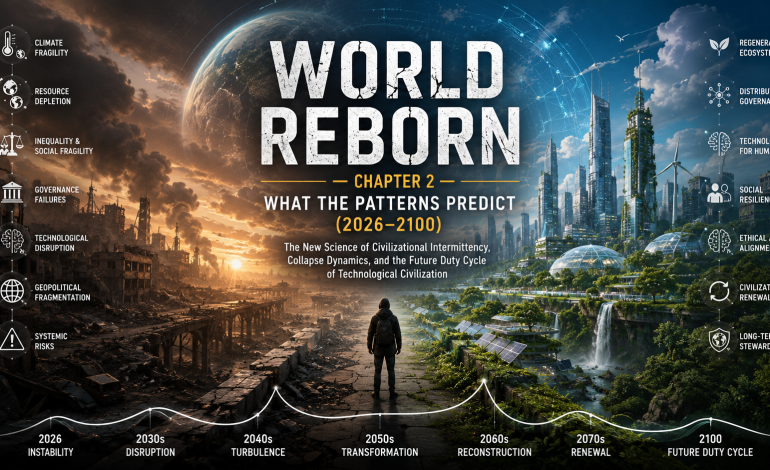
WORLD REBORN — CHAPTER 2 WHAT THE PATTERNS PREDICT (2026–2100) The New Science of Civilizational Intermittency, Collapse Dynamics, and the Future Duty Cycle of Technological Civilization No ancient history recap.

WORLD REBORN — CHAPTER 2
WHAT THE PATTERNS PREDICT (2026–2100)
The New Science of Civilizational Intermittency, Collapse Dynamics, and the Future Duty Cycle of Technological Civilization
No ancient history recap. Only what collapse dynamics tell us about the next 75 years.
The New Science of Civilizational Intermittency
The question is no longer “will civilization collapse?” but “what is the duty cycle of technological civilization?”
In April 2026, researchers from the Centro de Astrobiología (CSIC-INTA) and the Blue Marble Space Institute of Science published a major study in arXiv modeling collapse-recovery dynamics across ten plausible futures for Earth-originating civilization over a 1000-year window .
The paper’s central finding: civilizations may not be continuously active. They may be intermittent — alternating between technological activity, dormancy, recovery, and regression. The fraction of time a civilization remains technologically active is its duty cycle, and this study found duty cycles ranging from 0.38 to 1.00 across different scenarios.
The Two Most Important Levers
The researchers performed sensitivity analysis to determine which factors most determine whether a civilization survives or collapses. The answer:
-
Resource depletion rate — how quickly a society uses up the natural and material foundations of its existence
-
Post-collapse recovery fraction — what proportion of technological and social capacity remains after a crash
The paper states explicitly: “Reducing resource consumption may be at least as important as mitigating existential hazards for avoiding civilizational collapse.”
This inverts conventional risk discourse. Most attention goes to nuclear war, asteroids, pandemics, or AI alignment. The modeling suggests that how fast we burn through resources — and what we can save when systems fail — matters equally or more.
The Three Strands of Fragility (2026)
A comprehensive analysis published in April 2026 by the Titanic Lifeboat Academy synthesizes the converging research into a three-strand framework :
Strand 1 — Direct Impacts (The Physical World Pushing Back)
Climate extremes are no longer exceptional. Once-in-50-year heatwaves now occur roughly every 10 years at today’s warming (approximately 1.3-1.4°C). At 1.5°C, they could happen every 6 years. At 4°C, every 1-2 years.
The food system has been silently rewired around these shifting conditions. International food and agricultural trade carries approximately 5,000 trillion kilocalories per year — more than double the level at the turn of the millennium. Per person, the calories embedded in traded food rose from about 930 kcal per day in 2000 to roughly 1,640 kcal in 2021.
One study estimates that about 1.4 billion people’s food security already depends on imports, with another 460 million living in places where even ramping up imports can no longer fully cover local production shortfalls.
Strand 2 — Socio-Climate Feedbacks (Our Responses Amplify Shocks)
When stresses bite, governments reach for familiar tools: export bans, interest-rate hikes, border closures, subsidies. Each decision makes sense from a narrow vantage point. Systemically, they behave like feedback loops that amplify the original disturbance.
The pattern is familiar: Drought drives up grain prices. Exporters restrict shipments. Import-dependent countries panic-buy. Prices rise higher. Farmers plant less. Financial markets demand higher interest rates. Poor governments cannot cushion their populations.
The 2026 World Economic Forum Global Risks Report describes the coming decade as an “age of competition,” with geoeconomic confrontation ranked as the single most likely trigger of a major global crisis.
Strand 3 — Exogenous Shocks (The Fuse-Lighting Events)
A war, a pandemic, a financial panic — hitting a civilization already strained by strands 1 and 2.
The Iran war (2026) serves as a real-time example. The first two weeks released over five million tonnes of greenhouse gases — more than the annual emissions of Iceland. The International Energy Agency described the resulting supply losses as “the largest disruption to oil markets in history.”
Roughly 25-30 percent of global nitrogen fertilizer exports depend on shipping routes through the Strait of Hormuz. Fertilizer benchmarks jumped 19-28 percent. Knock-on price rises appeared in far-off markets. Farmers facing those costs cut application rates, which means lower yields in subsequent seasons.
The NASA-Funded HANDY Model (2026 Context)
A study partially sponsored by NASA’s Goddard Space Flight Center, published in the peer-reviewed Elsevier journal Ecological Economics, developed the “Human And Nature DYnamical” (HANDY) model to investigate collapse dynamics .
The model identifies the most salient interrelated factors explaining civilizational decline:
-
Population
-
Climate
-
Water
-
Agriculture
-
Energy
These factors lead to collapse when they converge to generate two crucial social features:
-
“The stretching of resources due to the strain placed on the ecological carrying capacity”
-
“The economic stratification of society into Elites [rich] and Masses [poor]”
Under conditions “closely reflecting the reality of the world today,” the study finds that “collapse is difficult to avoid.”
Two key mechanisms:
In the first collapse scenario, “Elites eventually consume too much, resulting in a famine among Commoners that eventually causes the collapse of society. It is important to note that this Type-L collapse is due to an inequality-induced famine that causes a loss of workers, rather than a collapse of Nature.”
In the second scenario, focusing on resource exploitation: “with a larger depletion rate, the decline of the Commoners occurs faster, while the Elites are still thriving, but eventually the Commoners collapse completely, followed by the Elites.”
Crucially, elite wealth monopolies buffer the rich from environmental collapse until much later than the commoners, allowing them to “continue ‘business as usual’ despite the impending catastrophe.” The study argues this mechanism explains “how historical collapses were allowed to occur by elites who appear to be oblivious to the catastrophic trajectory (most clearly apparent in the Roman and Mayan cases).”
The Ten Plausible Futures (2026–3026)
The Blanco et al. study models ten scenarios, each with different implications for the 2026–2100 period :
| Scenario | Governance | Resource Regime | Projected Duty Cycle | 2026–2100 Implication |
|---|---|---|---|---|
| S1: Big Brother is Watching | Centralized authoritarian | Scarcity | Low | Fragile, brittle, prone to sudden failure |
| S2: Wild West | Oligarchic/competitive | Scarcity | Low | Fragmented, conflict-prone, slow recovery |
| S3: Golden Age | Participatory/distributed | Non-scarcity | High | Stable, resilient, equitable |
| S4: Living with the Land | Oligarchic | Scarcity | Very low | Low-impact but vulnerable to external shocks |
| S5: Transhumanism | Participatory/distributed | Non-scarcity | Very high | Post-biological, potentially stable |
| S6: Sword of Damocles | Oligarchic | Scarcity | Low | High-tech but high-risk, cascading failure |
| S7: Restoration | Participatory/distributed | Post-collapse recovery | Moderate to High | Recovered from collapse, resilient |
| S8: Ouroboros | Oligarchic | Scarcity | Oscillatory | Cyclical collapse and regrowth |
| S9: Deus Ex Machina | Participatory/distributed | Non-scarcity | High but unstable | Tech-driven expansion with crash risk |
| S10: Out of Eden | Participatory/distributed | Non-scarcity | Very high | Harmonized coexistence |
Key insight: Governance structure matters enormously. Centralized systems may retain higher technological capacity through individual collapse events due to concentrated infrastructure, but their rigidity makes them more susceptible to repeated collapses — consistent with Tainter’s finding that increasing sociopolitical complexity yields diminishing returns, ultimately rendering centralized systems fragile. Distributed governance supports greater redundancy and flexibility.
What This Means for 2026–2100
The WEF Global Risks Report 2026 — based on a survey of over 1,300 global leaders — finds that 68% of respondents believe the global political environment will become more fragmented and multipolar over the next decade . Only 6% expect the post-war international order to be revived.
The report identifies the top short-term risks (0-2 years) as:
-
Geoeconomic confrontation
-
Mis- and disinformation
-
Societal polarization
The top long-term risks (10 years) shift dramatically:
-
Extreme weather events
-
Biodiversity loss and ecosystem collapse
-
Critical changes to Earth systems
Environmental risks drop in short-term prioritization but dominate the long-term outlook. This is not because climate risk has diminished — it is because geopolitical and economic risks have become so acute that they crowd out environmental attention in the short term .
The Metacrisis Framework
The concept of “polycrisis” may no longer be sufficient. A May 2026 arXiv paper argues that we are in a “metacrisis” — where ecological crisis, meaning crisis, and language crisis converge and amplify one another .
The paper documents specific crisis interactions:
-
Ecological ↔ Meaning: LLM-generated content uses eco-anxiety to capture attention; doomscrolling numbs eco-anxiety; algorithmic content narcotizes dysfunction and apathy, making it harder for communities to unite in the face of ecological crisis.
-
Meaning ↔ Language: Avalanches of attention-grabbing LLM content from dominant languages crowd out local languages; attention capture leads to non-participation in local lifeworlds.
-
Language ↔ Ecological: Language loss undermines indigenous capacity to care for ancestral lands rich in species diversity; mining and climate disasters intensified by data centers displace linguistic communities.
“Big AI is accelerating the metacrisis.”
The Global Governance Gap
The Global Challenges Foundation’s Global Catastrophic Risks Report 2026 (published December 2025) argues that humanity is navigating a critical juncture defined by accelerating, interconnected risks that threaten the stability of the Earth system .
The report’s core diagnosis: traditional governance, designed for gradual and predictable change, is no longer adequate in a world approaching irreversible thresholds.
Key findings:
-
Earth system tipping points demand new governance approaches — anticipatory, adaptive, and cross-domain
-
Ecological systems are approaching collapse with cascading risks to food, water, health, and political stability
-
The current global governance architecture is fragmented, experiencing eroding legitimacy, and historically exclusionary
But the report argues against retreating into isolationism. The interconnected nature of modern risks offers an opportunity to reimagine cooperation — from imbalance to inclusion, ensuring that the Global South and civil society have equitable representation.
Chapter 2 Conclusion: The Shape of 2026–2100
The research converges on several high-confidence projections:
1. Intermittency, not extinction, is the most likely outcome. Civilization will not simply “collapse” or “survive.” It will oscillate — periods of technological activity followed by dormancy, recovery, or regression.
2. Resource depletion rate is the critical variable. Reducing consumption may be more important than preventing existential catastrophes. This is a harder political truth than most are willing to confront.
3. Inequality accelerates collapse. Elite wealth monopolies buffer the rich from consequences until it is too late. This dynamic — observed in Rome, the Maya, and the HANDY model — is actively operating today.
4. Governance structure determines resilience. Distributed, participatory systems (polycentric governance) outperform centralized hierarchies in surviving shocks. Centralized systems are brittle; they hold together until they suddenly don’t.
5. The metacrisis is real. Ecological, meaning, and language crises are not separate. They amplify one another. Big AI is not a neutral tool — it is an accelerant.
6. Global governance is fragmenting, but cannot be abandoned. 68% of global leaders expect a more fragmented, multipolar world. Only 6% expect the post-war order to revive. Yet the only pathway through planetary risks is cooperation.
Chapter 2 Source Index
| Source | Publication | Date | Link |
|---|---|---|---|
| Blanco et al. | Projections of Earth’s Technosphere, arXiv | April 2026 | arXiv:2604.13774v1 |
| Tipping Insights | “2026 – Of Potatoes And Pitchforks” | May 2026 | tippinsights.com |
| Bird, S. | “Big AI is Accelerating the Metacrisis”, arXiv | May 2026 | arXiv:2512.24863v2 |
| Global Challenges Foundation | Global Catastrophic Risks Report 2026 | Dec 2025 | Planetary Security Initiative |
| WEF | Global Risks Report 2026 | Jan 2026 | weforum.org |
| Titanic Lifeboat Academy | “The Three Tightening Strands” | April 2026 | titaniclifeboatacademy.org |
| WEF | “Global risks over the past 5 years” | Jan 2026 | weforum.org |
| Ahmed, N. | “NASA-funded study: Industrial civilization headed for irreversible collapse” | (classic, cited in 2026 context) | elreporterosf.com |
| WEF | Global Risks Report 2026 — Chapter 2 (full) | Jan 2026 | weforum.org |