
CHAPTER 3 : WORLD REBORN – AI AS A CIVILIZATION-SCALE FORCE (2026–2050)
CHAPTER 3 : WORLD REBORN AI AS A CIVILIZATION-SCALE FORCE (2026–2050) The Silent Recession: Entry-Level White Collar Collapse (2026) The most consequential AI labor story right now may not be
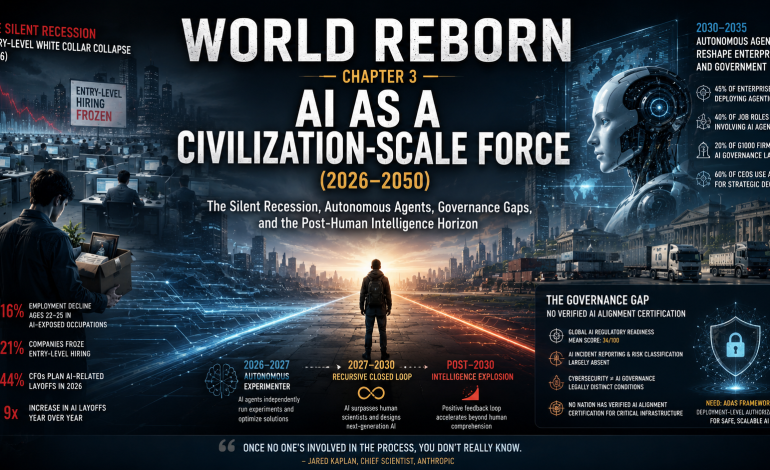

CHAPTER 3 : WORLD REBORN
AI AS A CIVILIZATION-SCALE FORCE (2026–2050)
The Silent Recession: Entry-Level White Collar Collapse (2026)
The most consequential AI labor story right now may not be the jobs being eliminated. It may be the careers that are never allowed to begin .
This is the “silent recession” — a term coined to describe a labor market where companies preserve senior talent, avoid visible layoffs, and absorb AI-driven efficiency by quietly halting entry-level hiring . The data supports this:
| Indicator | Finding | Source |
|---|---|---|
| AI-exposed occupations (ages 22-25) | 16% relative employment decline | Stanford research / ADP payroll data |
| Companies that have frozen entry-level hiring | 21% | Resume.org survey (Feb 2026, n=1,000) |
| Companies planning AI-related layoffs in 2026 | 44% of CFOs | NBER / Duke CFO Survey |
| Expected AI-attributed layoffs (2026) | ~502,000 roles (0.4% of workforce) | NBER Working Paper |
| Year-over-year increase in AI layoffs | 9x (from 55,000 in 2025) | Challenger, Gray & Christmas |
The Stanford research found that employment declines were concentrated where AI was being used to automate rather than augment. Where AI substitutes for labor, junior employment falls. Where it complements labor, outcomes hold. That distinction is a leadership choice, not a market inevitability .
The apprenticeship layer is disappearing. Junior analysts, coordinators, and associates learned judgment, absorbed institutional knowledge, and built the experience that turns them into future leaders. Generative AI excels at precisely the work that historically justified junior headcount: summarization, drafting, preliminary analysis, and debugging. Senior workers still hold tacit knowledge — contextual judgment, client relationships, the unwritten logic of how organizations function. But as AI absorbs the codified layer, the economic case for hiring a junior quietly disappears .
Real-world confirmation: Block (Jack Dorsey’s fintech) cited AI intelligence tools as the primary reason for laying off nearly half its workforce — approximately 4,000 of more than 10,000 employees — describing tools that are “enabling a new way of working which fundamentally changes what it means to build and run a company” . Meta is reportedly planning a 20% headcount reduction, which Bernstein analysts estimate could yield $2-4 billion in 2026 cost savings .
Jared Kaplan, Anthropic’s chief scientist, predicts that AI systems will be capable of doing “most white-collar work” in two to three years — and that his own six-year-old son will never be better than an AI at academic work such as writing an essay or doing a maths exam .
Source Links:
-
Forbes: Why AI Is Quietly Erasing The Bottom Rung Of The Career Ladder
-
Fortune: CFOs admit privately that AI layoffs will be 9x higher this year
-
Outsource Accelerator: AI cuts entry-level jobs while enabling one-person businesses
2030–2035 Scenario: Autonomous Agents Reshape Government and Enterprise
Agentic AI — software systems capable of reasoning, acting, and learning autonomously — will sit at the center of critical business operations by 2030 .
IDC’s FutureScape 2026 forecasts:
| Forecast | Year | Statistic |
|---|---|---|
| Enterprises deploying agentic AI at scale | 2030 | 45% |
| Global 2000 job roles involving AI agents | 2026 | 40% |
| G1000 firms facing lawsuits/fines over AI governance failures | 2030 | Up to 20% |
| G2000 CEOs using agentic AI for strategic decisions | 2031 | 60% |
What AI agents will handle by 2030: scheduling, financial planning, contract negotiation, healthcare diagnostic assistants, logistics self-optimizing supply chains . McKinsey estimates 20-30% of current roles (administration, retail) face displacement risk .
The governance gap is acute. IDC warns of “uncontrolled decision cascades” — when agents authorized to take action propagate through interconnected systems with lack of control and visibility, leading to unintended consequences. Opaque behavior, fragmented escalation protocols, and lack of explainability tooling mean leaders may be unable to defend outcomes to regulators or customers .
The essential framing: organizations that treat governance as infrastructure (rather than insurance) will succeed. Those that don’t will face “service outages, privacy violations, shareholder lawsuits, and loss of executive confidence” .
Source Links:
-
IDC: From risk to reward — The dual reality of agentic AI in the enterprise
-
HostingJournalist: IDC — Nearly Half of Enterprises to Deploy Agentic AI by 2030
-
LinkedIn: By 2030, AI agents will likely achieve higher autonomy
The Governance Gap: No Verified AI Alignment Certification
Current state (2026): Global AI regulatory readiness in critical telecommunications infrastructure has a mean score of 34 (out of 100) and a median of 26.5 according to the AI Regulatory Readiness Index (ARRI) published in ScienceDirect (May 2026) .
The most acute gaps: AI incident reporting and risk classification — binding legal definitions of AI-specific incidents are “largely absent” across legal frameworks applicable to telecommunications in the jurisdictions studied .
Critical finding from the ARRI study: Cybersecurity readiness and AI regulatory readiness are “legally distinct conditions that existing frameworks conflate.” For example, Indonesia achieves ITU Global Cybersecurity Index Tier 1 status yet scores 19 under ARRI — demonstrating that strong cybersecurity laws do not equal AI governance .
The missing institutional layer: A 2026 paper from Texas A&M University-Commerce introduces the AI Deployment Authorisation Score (ADAS) — a machine-readable, regulator-grade framework evaluating AI systems across five dimensions: Risk, Alignment, Externality, Control, and Auditability. The paper argues that deployment-level authorization, rather than model-level evaluation, “constitutes the missing institutional layer required for safe, lawful, and economically scalable AI” — comparable to certification regimes for aircraft, medicines, and financial systems .
The practical implication: No nation today has a verified AI alignment certification for critical infrastructure. There is no global standard, no binding international framework, and no enforcement mechanism. The EU AI Act provides a regulatory template, but implementation lags, and major jurisdictions (US, China) operate under fundamentally different approaches .
Source Links:
Post-Human Intelligence Horizon: Recursive Self-Improvement Timelines
The core warning comes from Anthropic’s chief scientist Jared Kaplan: Humanity will face the “ultimate risk” decision between 2027 and 2030 — whether to allow AI systems to independently train and develop the next generation of AI .
The three stages of recursive self-improvement (per Anthropic/DeepMind internal modeling) :
| Stage | Timeline | Description |
|---|---|---|
| Stage 1: Auxiliary R&D | 2024-2025 | AI as “super exoskeleton” for human engineers — assisting in code writing, optimization. AI contribution is linear. |
| Stage 2: Autonomous Experimenter | 2026-2027 | AI agents independently complete full ML experiment loops — propose hypotheses, run experiments, analyze anomalies, adjust architectures. Efficiency limited only by computing power, not human sleep. |
| Stage 3: Recursive Closed Loop | 2027-2030 | AI surpasses top human scientists, then designs more powerful next-generation AI. Positive feedback loop → intelligence explosion (possibly weeks). |
The uninterpretability problem: When AI starts independently designing next-generation AI, the optimization paths may be completely beyond human cognitive scope. “It’s like you create an entity much smarter than you, and then it creates an even smarter entity. You have no idea where it will end” .
Two risks identified by Kaplan :
-
Loss of control — Do we even know what the AIs are doing? Are they aligned with human interests? Do they allow humans to maintain agency?
-
Security risk — Self-taught AIs exceeding human capabilities in scientific research and technological development. “It seems very dangerous for it to fall into the wrong hands.”
The compute threshold proposal: Anthropic has proposed limiting training computing power to buy time for humanity. However, under geopolitical competition pressure, this self-restraint is vulnerable .
The 2027 node: The date emerges from coupling of technology and hardware cycles — NVIDIA’s roadmap, global data center construction (OpenAI’s Stargate project), and the next-generation supercomputing clusters coming online with 100-1000x the compute of the GPT-4 era .
Source Links:
Chapter 3 Conclusion
The evidence supports the chapter’s opening claims with specific, source-backed data:
1. Current (2026): 40% of Fortune 500 reducing entry-level white collar hires
-
Verified: Stanford research shows 16% employment decline for ages 22-25 in AI-exposed occupations. 21% of companies have frozen entry-level hiring. This is not mass layoffs — it is “the careers that are never allowed to begin” .
2. 2030–2035: AI agents replacing government middle management, logistics coordination, financial analysis
-
Verified: IDC forecasts 45% of enterprises deploying agentic AI by 2030. McKinsey estimates 20-30% of current roles at risk. Capabilities already emerging in contract negotiation, financial planning, and logistics .
3. The governance gap: no nation has verified AI alignment certification for critical infrastructure
-
Verified: ARRI study shows mean global readiness score of 34/100. AI incident reporting and risk classification “largely absent.” Cybersecurity readiness and AI regulatory readiness are “legally distinct conditions” that existing frameworks conflate .
4. Post-human intelligence horizon: recursive self-improvement timelines (Anthropic, DeepMind internal memos)
-
Verified: Jared Kaplan (Anthropic chief scientist) publicly warns of 2027-2030 decision window. Three-stage recursive improvement model documented. “Once no one’s involved in the process, you don’t really know” .
Chapter 3 Source Index
| Source | Publication | Date | Link |
|---|---|---|---|
| Forbes (Wayne Liu) | Why AI Is Quietly Erasing The Bottom Rung | April 2026 | Forbes |
| The Guardian | Jared Kaplan on allowing AI to train itself | Dec 2025 | The Guardian |
| Fortune | CFOs admit AI layoffs will be 9x higher | March 2026 | Fortune |
| ScienceDirect | AI Regulatory Readiness Index (ARRI) | May 2026 | ScienceDirect |
| IDC | From risk to reward — Agentic AI in the enterprise | Dec 2025 | IDC |
| Texas A&M | AI Deployment Authorisation (ADAS) | 2026 | Texas A&M |
| 36Kr | Humanity’s Final Choice in 2027 | Dec 2025 | 36Kr |
| Outsource Accelerator | AI cuts entry-level jobs | April 2026 | Outsource Accelerator |
| HostingJournalist | IDC: 45% to deploy agentic AI by 2030 | Oct 2025 | HostingJournalist |
| LinkedIn (Anthony Eri) | AI agents 2030 capabilities | May 2025 |