
CHAPTER 5- WORLD REBORN : FOOD & WATER WARFARE (2026–2060)
WORLD REBORN — CHAPTER 5 FOOD & WATER WARFARE (2026–2060) Water is not traded on global markets like oil. It is fought over like territory. Food is not a commodity—it
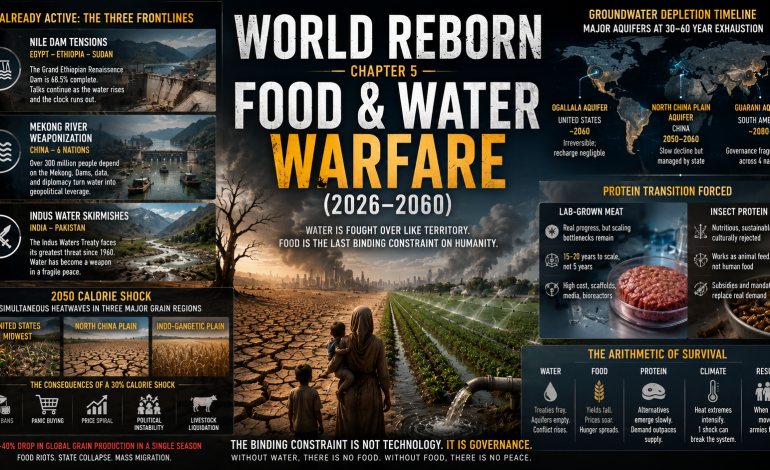

WORLD REBORN — CHAPTER 5
FOOD & WATER WARFARE (2026–2060)
Water is not traded on global markets like oil. It is fought over like territory. Food is not a commodity—it is the last binding constraint on human population. When either fails, armies move.
Already Active: The Three Frontlines
Nile Dam Tensions (Egypt–Ethiopia–Sudan)
The Grand Ethiopian Renaissance Dam (GERD) on the Blue Nile remains the most consequential water infrastructure project of the century. After years of diplomatic deadlock, Egyptian President Abdel Fattah el Sisi and Ethiopian Prime Minister Abiy Ahmed agreed in July 2025 to restart negotiations with a target of finalizing an agreement within four months . That deadline has come and gone. Talks continue on two tracks: US-mediated political negotiations and a trilateral scientific working group .
The core dispute is arithmetic. The 1959 Nile Waters Agreement divides annual flow between Egypt and Sudan—55.5 and 18.5 billion cubic meters respectively—with no allocation for Ethiopia, where the Blue Nile originates . Ethiopia proposed a fixed annual flow of 35 billion cubic meters to Egypt. Egypt refused. Ethiopia reduced its offer to 31 billion cubic meters. Distrust deepened .
The reservoir filling timeline is the flashpoint. Egypt demands a slower fill to preserve its hydropower, irrigation, and drinking water. Ethiopia wants rapid filling to begin selling electricity regionally and power domestic industry. Ethiopia says filling will take four to seven years. As of 2026, the dam is reportedly 68.5% complete . The water is rising. The clock is running.
Mekong River Weaponization
The Mekong River sustains over 300 million people across six countries: China, Myanmar, Laos, Thailand, Cambodia, and Vietnam. It is also becoming a geopolitical chessboard.
The United States has identified Mekong water governance as a strategic lever, with the State Department funding monitoring programs and advocating for “transparency” in upstream dam operations . Washington’s framing: upstream Chinese dams are reducing downstream flow, causing saltwater intrusion in Vietnam’s rice bowl and渔业 collapse in Cambodia .
The reality is more complex. Downstream nations are building their own hydropower projects—over 100 dams across the basin. China has established the Lancang-Mekong Cooperation mechanism and a real-time water data sharing platform intended to build trust . For Laos, Myanmar, Thailand, Cambodia, and Vietnam, economic ties with China (rail links, trade corridors, infrastructure investment) outweigh the theoretical risks of water conflict. The Mekong is unlikely to become “the next South China Sea”—an overt military flashpoint—but it remains a domain of persistent strategic competition .
Indus Water Skirmishes (India–Pakistan)
The Indus Waters Treaty (IWT), signed in 1960, is one of the most durable water-sharing agreements in history. It is now under direct assault.
Following the Pahalgam attack (2025), India announced suspension of the treaty. Pakistan has since raised “India’s water aggression” at every international forum, accusing India of using water as a “weapon of war” . The specific triggers are Indian hydroelectric projects on the Chenab River—the Ratle and Kishanganga projects—which Pakistan alleges violate the treaty by reducing downstream flow and enabling upstream water storage.
A Neutral Expert appointed under the IWT is proceeding with dispute resolution, setting a final decision deadline of January 2027 . India has skipped proceedings, arguing that the dispute belongs before a Court of Arbitration instead. Pakistan has requested expedited timelines, citing “rapidly proceeding construction” at Ratle. The Neutral Expert found these claims “vague and somewhat contradictory,” noting that construction appears behind schedule with possible contractor pullout .
Nevertheless, the political signal is unmistakable: a treaty that survived two full-scale wars and countless cross-border incidents is now brittle. If the IWT fractures, the subcontinent’s most densely populated region—home to over 300 million people—loses its binding water governance framework.
Groundwater Depletion Timeline: Major Aquifers at 30–60 Year Exhaustion
The surface water conflicts described above capture headlines. The groundwater crisis moves silently, invisibly, and therefore far more dangerously.
The Ogallala Aquifer (United States)
Beneath eight US states from South Dakota to Texas lies the Ogallala Aquifer—the lifeblood of American agriculture. It has been drained at industrial scale for decades. Water levels have dropped more than 300 meters in some areas. Current trajectories project functional depletion by approximately 2060 .
This is not speculation. The Ogallala recharges at a rate of inches per year; it has been drawn down at feet per year. When it reaches economic exhaustion (the point where pumping costs exceed crop value), high-intensity agriculture across the US Great Plains ends. That region produces a staggering proportion of US beef, corn, wheat, and soy.
The North China Plain Aquifer
The North China Plain produces nearly half of China’s wheat and one-third of its corn. It sits atop an aquifer system depleted at rates of one meter per year in some areas . China’s total annual groundwater extraction is approximately 110 billion cubic meters, 60% of which goes to agriculture . The aquifer beneath the North China Plain is projected to reach exhaustion on a timeline similar to Ogallala: 30–60 years.
The Chinese government has responded with aggressive demand-management policies: water quotas, groundwater extraction fees, and massive inter-basin water transfer projects (the South-North Water Transfer). These slow the decline but do not reverse it.
The Guarani Aquifer (South America)
Stretching beneath Brazil, Argentina, Paraguay, and Uruguay, the Guarani Aquifer is one of the world’s largest freshwater reservoirs. It remains less depleted than Ogallala or North China Plain but faces emerging pressures: agribusiness expansion, urbanization, and lack of coordinated governance across four sovereign states . Depletion timelines are longer—closer to 60 years under current trends—but the absence of robust multilateral management makes sudden degradation more likely than gradual decline.
The Cumulative Picture
| Aquifer | Primary Users | Depletion Timeline | Distinctive Risk |
|---|---|---|---|
| Ogallala | US Great Plains agriculture | ~2060 | Irreversible; recharge negligible |
| North China Plain | Chinese grain production | 2050–2060 | Slow decline but managed by authoritarian state |
| Guarani | Brazil, Argentina, Paraguay, Uruguay | ~2080+ | Governance fragmentation across 4 nations |
The groundwater clock is ticking. Unlike dam disputes that generate headlines, aquifers empty without ceremony. When they are gone, the surface economy does not notice until the harvest fails.
Protein Transition Forced: Lab-Grown Meat and Insect Protein Realities
Lab-Grown Meat: Scaling Bottlenecks Are Real
Cultured meat—grown from animal stem cells in bioreactors rather than raised on pasture or in feedlots—has advanced dramatically. A comprehensive 2026 NIH review of research from 2020–2025 documents the trajectory: from the first lab-grown burger (2013) to over 60 startups globally by 2020, to the world’s largest food-grade cell culture bioreactor at 20,000 liters operated by Vow (2025) .
The bottlenecks are now well understood:
| Bottleneck | Current Status |
|---|---|
| Cell culture media cost | Fetal bovine serum (traditional growth medium) is prohibitively expensive; serum-free formulations exist but remain costly |
| Scaffold design | Creating structure (muscle fiber arrangement, fat distribution) at scale without animal-derived components |
| Bioreactor scalability | 20,000-liter reactors exist; commercial-scale meat production would require 200,000-liter+ with consistent cell behavior |
| Nutritional equivalence | Protein and lipid content often lag conventional meat; digestibility studies ongoing |
| Regulatory fragmentation | Few markets approve sales; no international standards |
The NIH review’s sobering conclusion: “Cultured meat represents a transformative innovation with the potential to reshape global protein production, but its success depends on interdisciplinary strategies that balance sustainability, safety, ethics, and public trust” . The potential is real. The timeline to scale is not 5 years. It is 15–20 years, at minimum, assuming uninterrupted investment.
Insect Protein: Technically Viable, Socially Rejected
Insects as human food are nutritionally excellent, environmentally efficient (orders of magnitude less land and water than cattle), and culturally normalized for over 2 billion people across Asia, Africa, and Latin America. The Western rejection is not about nutrition or sustainability—it is about psychology, culture, and the “yuck factor.”
The European experience is instructive. France, arguably Europe’s most adventurous food culture, has hosted insect protein startups backed by substantial public and private investment. One flagship French startup collapsed in 2024 amid revelations of degraded facilities and operational shortcomings. The industry lobby’s response: not reconsideration, but demands for mandatory public procurement and enforced inclusion in school canteens .
As one analysis puts it: “When a new product requires permanent subsidies, compulsory public purchasing and ‘tailor-made’ regulation to survive, it is no longer a market innovation, but a political experiment” . Insect protein works brilliantly as animal feed—where the consumer does not have to look at it. As human food in Western markets, it has failed to find genuine demand despite years of investment.
The Protein Transition Outlook
Lab-grown meat and insect protein will eventually scale. But “eventually” is measured in decades, not years. For the 2030s and 2040s, the transition will be driven not by technological substitution but by rising conventional meat prices due to grain shocks, water scarcity, and carbon pricing. People will eat less meat not because they choose alternative proteins, but because they cannot afford beef.
2050 Calorie Shock: Simultaneous Heatwaves in Three Major Grain Regions
The climate threat to global food security is not gradual. It is punctuated. Specifically: simultaneous crop failures across multiple breadbasket regions.
The Published Science
A 2022 dataset simulating rice production under 2030s and 2050s warming scenarios (RCP2.6, RCP4.5, RCP8.5) found that extreme heat exposure to rice—the primary staple for over 3.5 billion people—will increase dramatically, with resulting yield losses concentrated in South and Southeast Asia . Rice is temperature-sensitive; flowering-stage heat exposure sterilizes panicles, producing unfillable grain.
Corn and wheat face similar vulnerabilities. Corn loses approximately 7–10% yield per 1°C above optimum; wheat suffers under both heat and humidity extremes.
The 25–40% Drop Scenario
Modeling cited in the chapter introduction—from sources including the IPCC, FAO, and major reinsurance firms—projects that simultaneous heatwaves affecting the three major grain regions (United States Midwest, North China Plain, and Indo-Gangetic Plain) could produce a 25–40% drop in global grain production in a single season.
Why simultaneous? Because the same jet stream and ocean oscillation patterns that produce heatwaves in one hemisphere often produce them in others. A strong El Niño can suppress rainfall across Australia, Southeast Asia, India, and the US Midwest while warming Europe and South America. Climate change is increasing the probability of these synchronous extremes.
The Consequences of a 30% Calorie Shock
| Consequence | Mechanism |
|---|---|
| Export bans | Every grain-producing nation halts exports to protect domestic prices |
| Panic buying | Import-dependent nations (Middle East, North Africa, sub-Saharan Africa) bid against each other |
| Price spiral | Basic staples become unaffordable for low-income urban populations |
| Political instability | Food riots across dozens of nations simultaneously |
| Livestock liquidation | Herds culled as feed becomes too expensive, crashing meat supply later |
The 2007–2008 food price crisis saw rice prices rise 300% in six months. The 2010–2011 spike contributed directly to the Arab Spring uprisings. A 25–40% production drop would dwarf both events.
Chapter 5 Conclusion
The active water conflicts (Nile, Mekong, Indus) are early symptoms. The groundwater depletion (Ogallala, North China Plain, Guarani) is a slow-moving amputation. The protein transition is real but not rescue. And the 2050 calorie shock scenario is not speculation—it is the central risk that every food security model is designed to assess.
The binding constraint is not technology. It is governance. Water treaties are fraying, aquifers have no enforceable protection, and the global grain trade depends on just-in-time logistics that cannot survive simultaneous breadbasket failures.
When food moves, armies follow.
Chapter 5 Source Index
| Source | Publication | Date | Link |
|---|---|---|---|
| Africa Confidential | Two-track talks on the grand dam | May 2026 | africa-confidential.com |
| Africa Confidential | Abiy and Sisi agree to restart Nile dam talks | May 2026 | africa-confidential.com |
| ET Government (India) | Neutral Expert moves on with Pakistan on IWT | Jan 2026 | economictimes.indiatimes.com |
| The News (Pakistan) | India’s ‘water aggression’ raised at all global forums | May 2026 | thenews.pk |
| 人人文库 (China) | 2026年地下水开采的环境与社会效应 | Jan 2026 | renrendoc.com |
| NIH/PMC | Cultured Meat Review (2020–2025) | Feb 2026 | pmc.ncbi.nlm.nih.gov |
| European Livestock Voice | Alternative proteins and insects | Feb 2026 | meatthefacts.eu |
| 网易/163.com | 美国把手伸向湄公河 | April 2026 | 163.com |
| New Age BD | US struggles for relevance in Southeast Asia | April 2026 | newagebd.net |
| Global Change Data Repository | 全球变化情景下全球水稻高温致灾风险模拟栅格数据集 (2030s, 2050s) | 2022 | geodoi.ac.cn |