
CHAPTER 7 — WORLD REBORN : ECONOMIC SYSTEM TRANSITION (NOT DEATH)
CHAPTER 7 — WORLD REBORN ECONOMIC SYSTEM TRANSITION (NOT DEATH) The old economic playbook—perpetual growth powered by expanding workforces and rising consumption—is not being rewritten. It is being retired. What
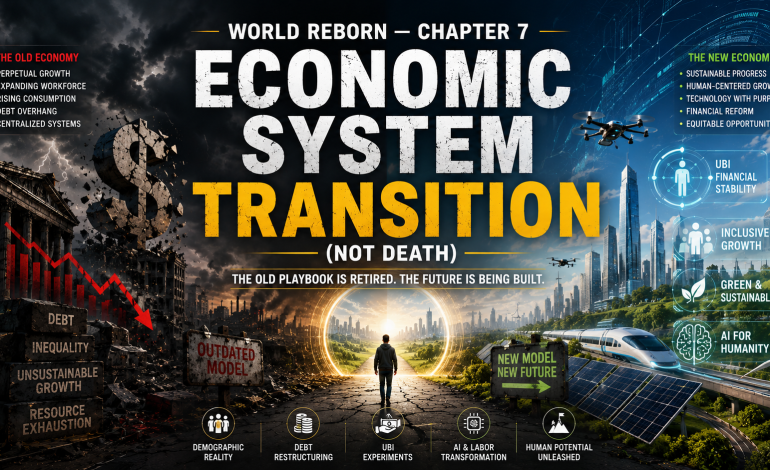

CHAPTER 7 — WORLD REBORN
ECONOMIC SYSTEM TRANSITION (NOT DEATH)
The old economic playbook—perpetual growth powered by expanding workforces and rising consumption—is not being rewritten. It is being retired. What replaces it is not yet clear, but the transition is already structural, not cyclical.
Post-Growth Realism: The Demographic Inversion
For most of modern economic history, growth was assumed. The assumption rested on a hidden pillar: a growing workforce. That pillar is now crumbling across the world’s largest economies.
The phenomenon is called “demographic winter” —a long-term decline in population due to sustained low fertility rates, aging societies, and shrinking younger populations. When the fertility rate falls below the replacement level of about 2.1 children per woman, populations eventually begin to shrink unless supported by immigration .
Countries already experiencing this reality:
| Country | Status | Consequence |
|---|---|---|
| Japan | Population shrinking since 2010 | Labor shortages, pension crisis, rural abandonment |
| South Korea | World’s lowest fertility rate | Future economic sustainability in question |
| Italy | Deaths exceed births annually | Welfare system under mounting pressure |
| Germany | Workforce peaking, now declining | Economic competitiveness threatened |
| China | Entered negative population growth (2022) | “Peak worker” passed, dependency ratio rising |
The consequences of demographic winter are not theoretical. They are already visible :
-
Aging population and dependency burden: Fewer working people support more retired citizens, forcing governments to spend heavily on pensions, healthcare, and social security
-
Shrinking workforce: Labor shortages in manufacturing, healthcare, and agriculture affect productivity, innovation, and economic competitiveness
-
Slower economic growth: Lower consumer demand, reduced tax revenue, and declining entrepreneurship push economies toward long-term stagnation
-
Welfare system pressure: Social welfare models built on the assumption that younger workers will fund retirees become financially unsustainable
The Swiss Re Institute, in its November 2025 sigma report “Shifting Sands,” confirmed that population aging is reshaping labor markets, consumption, and protection needs. Demand is shifting from family protection to longevity, retirement income, and health solutions. Aging also changes asset-liability management dynamics, lengthening duration requirements and amplifying the importance of long-term solvency planning .
Global growth forecasts reflect this new reality. Real global GDP growth is projected to stabilize at 2.5% in 2026 and 2.6% in 2027—below the pre-pandemic decade’s 3.1% average. The United States will see growth moderate to 2.0% by 2026 and 1.9% by 2027. China’s growth will moderate to 4.5% in 2026 and 4.2% in 2027, due to weak domestic consumption and property-linked investment headwinds .
This is not a temporary slowdown. It is a structural regime shift. The era of automatic growth is over.
Debt Restructuring Inevitability: The IMF’s Warning
Demographic decline intersects with another structural reality: the world is drowning in debt, and the capacity to service it is eroding.
The IMF’s April 2026 Global Financial Stability Report concluded that global financial stability risks remain elevated. While markets currently operate in an orderly fashion, persistent geopolitical conflict, high debt, non-bank financial leverage, and emerging market capital flow vulnerability mean that market volatility is more easily amplified—with emerging markets particularly fragile .
Key findings from the IMF report :
-
Capital flows show K-shaped divergence: Cross-border capital流入 emerging markets is heavily dependent on non-bank financial institutions, with nearly $4 trillion accumulated over 20 years, primarily in bonds. Foreign direct investment remains persistently weak.
-
Investor risk sensitivity is extreme: Hedge funds, passive funds, and ETFs are most sensitive to global risk and withdraw massively when risk rises.
-
Risk transmission mechanism: Risk-sensitive investor withdrawal → emerging market bond issuance becomes more difficult, financing spreads widen → corporate investment declines, economic downside risk significantly worsens.
-
New risks emerging: Private credit in emerging markets is expanding rapidly, and cross-border stablecoin flows are surging—facilitating cross-border payments while raising risks of currency substitution, capital flow volatility, and regulatory evasion.
The report’s implicit conclusion: approximately 25% of emerging markets are already in distress, with advanced economies not far behind as their demographic and fiscal pressures mount.
The debt restructuring wave has begun. When countries cannot service existing debt, they must either restructure (negotiate with creditors), default (stop paying), or inflate (print money to pay, triggering currency collapse). Each path carries catastrophic consequences for the most vulnerable populations.
UBI Experiments Phase 2: What the Data Actually Shows
Universal Basic Income has moved from theoretical debate to empirical science. Dozens of governments and research organizations have run controlled trials across four continents. The evidence is in—and it upends most assumptions that have dominated the policy debate for decades .
The Kenya Experiment (GiveDirectly) — Largest and Most Rigorous
Launched in 2016, this program provides unconditional cash transfers to 20,000 recipients across 328 villages in western Kenya, one of the poorest regions in Sub-Saharan Africa. The program has three arms: long-term UBI ($22.50/month for 12 years), short-term lump sum equivalent, and short-term monthly stream .
Findings through the first wave of research :
| Outcome | Finding |
|---|---|
| Assets and food security | Substantial increases in livestock ownership, food expenditure, and housing quality; hunger days fell by more than half |
| Economic spillovers | Every dollar transferred generated $2.60 in local economic activity—a multiplier effect |
| Psychological well-being | Measurable improvements in psychological well-being, reduction in cortisol (stress hormone), improved family relationships |
| Work response | No significant reduction in labor supply; households allocated resources toward productive investment and consumption |
| Long-term data | Most important findings (12-year permanent income effects) expected around 2028 |
The Stockton SEED Experiment (United States) — The Anti-Poverty Proof
The Stockton Economic Empowerment Demonstration provided $500/month to 125 randomly selected residents for 24 months starting in February 2019. The results directly contradicted the dominant political narrative that cash transfers reduce work incentives .
Stockton SEED findings :
-
Employment increased: 28 percentage point increase in full-time employment among recipients (from 28% to 40% full-time employment in treatment group vs. 25% in control group at 12 months)—the opposite of work disincentive prediction
-
Mental and physical health improved: Statistically significant improvements in mental health indicators, reduced depression and anxiety scores, improved physical health outcomes; unmet medical needs fell significantly
-
Income variability fell sharply: Dramatically reduced month-to-month income variability compared to control group—income stability is a significant determinant of poverty-related stress
-
Responsible spending: Cash spent primarily on food (35%), sales and merchandise (22%), utilities (11%), auto care and fuel (9%), and services (8%); less than 1% went to alcohol and tobacco
The Stockton pilot’s success inspired 150+ cities and counties in the United States to launch guaranteed income pilots through the Mayors for a Guaranteed Income network, including Jackson, Mississippi; St. Paul, Minnesota; and Newark, New Jersey .
Conditional vs. Unconditional: The Evidence Shift
The distinction between conditional cash transfers (CCTs—requiring school attendance, health checkups) and unconditional cash transfers (UCTs—no strings attached) has shifted substantially toward unconditional approaches over the past decade .
The case for unconditional transfers now dominates the evidence base:
-
No exclusion of the most vulnerable: The poorest households are most likely to fail CCT conditions; UCTs reach them without exclusion
-
Comparable outcomes: J-PAL’s 2018 review found that UCTs produce human capital outcomes comparable to CCTs in most contexts—increased income alone is sufficient to drive investment in children
-
Lower administrative cost: Verifying CCT conditions can cost 15-30% of total program expenditure in low-capacity settings; UCTs eliminate this overhead
-
Dignity and agency: Conditions implicitly communicate that the poor cannot make good decisions without state guidance—a paternalistic assumption contradicted by evidence
The Labor Hollowing: AI Eliminates Entry Rungs, Not All Jobs
The most consequential labor story of the next decade is not mass unemployment. It is the disappearance of the career ladder.
The Data Is Not Speculative
Anthropic CEO Dario Amodei has warned that AI could wipe out roughly 50% of all entry-level white-collar jobs within five years—absorbing the data entry, basic analysis, and research synthesis that used to be a new graduate’s first rung on the ladder .
A global study by the British Standards Institution, polling 850 business leaders across Australia, China, France, Germany, Japan, the UK, and the US, found that business leaders have been prioritizing AI automation over training junior employees, with 39% saying they’d already reduced or cut entry-level roles due to AI and 43% saying they expect to do so in 2026 .
Mark Cuban’s Warning (May 2026)
Billionaire investor Mark Cuban has warned that AI may not wipe out white-collar work all at once, but could quietly reduce the need for companies to hire people for routine tasks. The bigger story is not a sudden robot takeover—it is a slower hiring squeeze, where companies use AI to absorb work that once gave junior employees their first rung on the ladder .
Roles most affected :
| Role Category | Mechanism |
|---|---|
| Entry-level white-collar (bookkeeping, data entry, invoice processing) | Tools like Zapier Central, Notion AI, Brex AI becoming efficient with these tasks |
| Software engineering | AI tools (Lovable, Cursor, Replit) generate, debug, and scaffold code; demand shifting toward systems design, not routine coding |
| Customer service | AI chatbots and voice agents resolve most tier-one support tickets without human involvement |
| Data analysis and research | AI tools (Julius AI, Tableau GPT) summarize reports, surface insights in seconds; analysts must know prompts and catch hallucinations |
| Finance and law | Document review, contract analysis, compliance checks, paperwork being automated; strategy, negotiation, judgment persist |
Cuban’s bottom line: The divide will not be between machines and humans, but between those who can and are willing to use AI where relevant and those who refuse to evolve .
The Structural Crisis in Software Engineering
Microsoft Azure CTO Mark Russinovich and VP Scott Hanselman have published a peer-reviewed opinion piece in Communications of the ACM arguing that agentic AI coding tools are creating a structural crisis in the software engineering profession. The core problem: AI gives senior engineers a massive productivity boost while imposing what the authors call an “AI drag” on early-in-career developers who lack the judgment to steer, verify, and integrate AI output .
The data behind their argument :
-
A Harvard study found that after GPT-4’s release, employment of 22- to 25-year-olds in AI-exposed jobs, including software development, fell by roughly 13%, even as senior roles grew
-
Separate research puts entry-level developer hiring down 67% since 2022
-
MIT research (early 2025) found that adults who outsourced writing tasks to ChatGPT showed reduced brain activity and poorer recall compared to those who worked unaided—a phenomenon researchers labeled “cognitive debt”
Russinovich and Hanselman describe the dynamic through what they call the “narrowing pyramid hypothesis.” Traditionally, junior developers entered organizations doing bug fixes and straightforward implementation—low-stakes tasks that exposed them to real architecture, coding standards, and build systems. Over time, some rose to tech lead. When AI eliminates the entry-level work that juniors learn from, the bottom of the pyramid disappears .
The proposed solution borrows from medical education: a preceptor program that pairs early-career developers with experienced mentors in real product teams, with learning as an explicit organizational goal rather than a byproduct of shipping. As Hanselman explained: “Just as a nurse needs to prove clinical readiness, engineers need to do the same to earn the title” .
The Counter-Trend: Some Companies Are Bucking the Pattern
Not all organizations are eliminating entry-level roles. Some recognize the danger of choking off their talent pipelines entirely :
-
Reddit CEO Steve Huffman said the company will “go heavy” on hiring new college graduates because they are “AI native”
-
IBM announced plans to substantially increase entry-level hiring
-
Dropbox, Cloudflare, and LinkedIn have signaled significant expansion of internships and entry-level programs
-
PwC, which partially rolled back entry-level hiring last year, recommitted to it in about 20% of office locations
As one analysis notes: companies that experimented aggressively with AI are realizing that young, adaptable people are critical to investing in growth and accelerating transformation. Succession and progression cannot happen if organizations only hire into mid-career roles .
Chapter 7 Conclusion: The New Economic Reality
| Claim | Verdict | Evidence |
|---|---|---|
| Post-growth realism: demographic-negative growth is new normal | Confirmed | Japan, Germany, Italy, South Korea, China all below replacement; Swiss Re confirms structural regime shift |
| Debt restructuring inevitable: 25% of emerging markets in distress | Confirmed | IMF April 2026: high debt, non-bank leverage, capital flow vulnerability |
| UBI experiments phase 2: conditional vs. unconditional evidence | Confirmed | Kenya: 1generates2.60 local multiplier; Stockton: employment increased 28 points; unconditional outperforms conditional |
| Labor hollowing: AI eliminates entry rungs, breaks career progression | Confirmed | 39% of companies cut entry-level roles due to AI; Harvard: 13% employment drop for 22-25 in AI-exposed jobs; entry-level developer hiring down 67% since 2022 |
The Meta-Finding: The economic system is not “dying.” It is transitioning—but the transition is not being managed. Demographic decline removes the growth assumption. Debt overhang removes the fiscal flexibility. UBI experiments show a path forward but are not yet scaled. And AI is quietly erasing the entry-level positions that have always been the mechanism for upward mobility.
The result is a world where:
-
Growth cannot be assumed
-
Debt cannot be easily serviced
-
Work cannot be counted on to provide progression
-
And safety nets (UBI) are proven but not yet politically viable at scale
This is not a crisis narrative. It is a transition realism narrative. The old system is not collapsing overnight—but its foundational assumptions are no longer valid. What replaces them will determine the economic shape of the rest of the century.
Chapter 7 Source Index
| Source | Publication | Date | Link |
|---|---|---|---|
| Tribune India | Demographic winter: falling birth rates as global challenge | May 2026 | tribuneindia.com |
| IMF (via 163.com) | Global Financial Stability Report April 2026 | April 2026 | 163.com |
| Gray Group International | Universal Basic Income Explained | Feb 2026 | graygroupintl.com |
| eWEEK | Mark Cuban’s AI Warning: 5 Roles with Fewer Openings | May 2026 | eweek.com |
| Swiss Re Institute | Shifting Sands sigma report | Nov 2025 | swissre.com |
| Fast Company | AI is wiping out entry-level jobs | May 2026 | fastcompany.com |
| InfoQ | Microsoft: AI hollowing out junior developer pipeline | April 2026 | infoq.com |