CHAPTER 8 — WORLD REBORN : POLITICAL FRAGMENTATION (2026–2050)
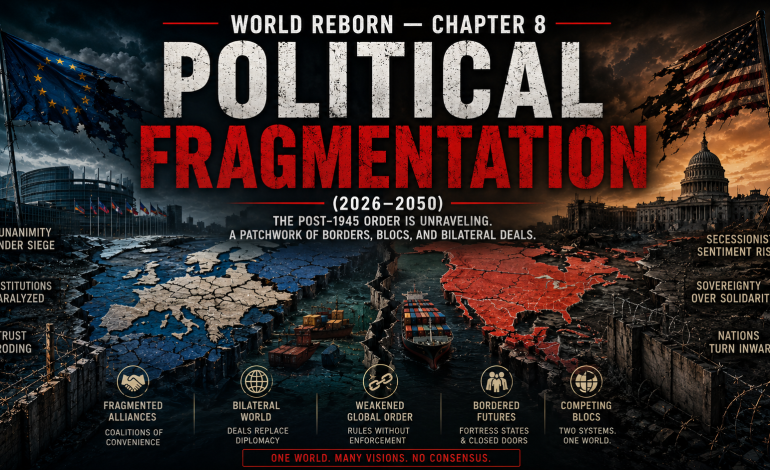
CHAPTER 8 — WORLD REBORN POLITICAL FRAGMENTATION (2026–2050) *The post-1945 order—of expanding cooperation, multilateral institutions, and shared sovereignty—is not being reformed. It is being abandoned. What replaces it is not

CHAPTER 8 — WORLD REBORN
POLITICAL FRAGMENTATION (2026–2050)
*The post-1945 order—of expanding cooperation, multilateral institutions, and shared sovereignty—is not being reformed. It is being abandoned. What replaces it is not a single system but a patchwork of competing blocs, bilateral deals, and fortress borders. The only question is how orderly the transition will be.*
Already Here: The Unraveling of Regional Orders
The European Union: Unanimity Under Siege
The EU’s foundational decision-making mechanism—unanimity among member states—is increasingly seen as a structural liability rather than a democratic safeguard. German Foreign Minister Johann Wadephul stated in May 2026 that the unanimity requirement has “sometimes held the EU hostage to national and external interests,” with individual countries blocking critical decisions on sanctions, aid, and defense .
Wadephul explicitly warned: “When it comes to security, the principle of unanimity can put us in existential danger, because these are matters of life and death” . His proposed solution: move toward qualified majority voting for key decisions, or allow coalitions of “willing Member States” to advance strategic priorities without requiring consensus from all 27 members.
This reflects a deeper institutional crisis documented in an April 2026 European Parliament question. Multiple MEPs raised concerns that mechanisms such as “enhanced cooperation” and a “two-speed Europe” risk fostering “camouflaged federalism” —a gradual shift of authority from national capitals to EU institutions under the banner of “strategic autonomy” .
The tension is unresolvable within the existing treaty framework. Either the EU accepts paralysis (preserving national sovereignty at the cost of collective action) or it accepts federalization (preserving collective action at the cost of national sovereignty). Neither outcome preserves the post-Maastricht equilibrium.
The United States: Secessionist Talk Moves Mainstream
Secessionist sentiment in the United States is no longer fringe. A February 2026 YouGov poll found that California has the highest support for secession at 29 percent, with nine states showing increased support for leaving the Union compared to 2024 levels .
Connecticut saw the largest jump—from 9 percent to 22 percent—while Minnesota rose to 23 percent. Overall national support for secession stands at 18 percent, down from 23 percent in 2024, but the geographic concentration of support is what matters: secession sentiment clusters in states that feel permanently alienated from national political outcomes .
Syracuse University Professor Ryan Griffiths, author of The Disunited States: Threats of Secession in Red and Blue America and Why They Won’t Work (Oxford University Press, 2025), identifies the driver: “The key factor driving this interest in secession is polarization. Whether it is the Red-State secessionists, the BlueExiters, the California Independence Party or the Texas Nationalists, they all point to unstoppable polarization and political dysfunction as the reason secession is necessary. They have lost faith in the American political system” .
The rhetoric has moved from abstract to operational. In April 2026, Texas House Speaker Dustin Burrows directed a committee to study the legal and economic implications of Texas absorbing counties from eastern New Mexico—a proposal one New Mexico legislator dismissed with “Over my dead body” . While the proposal is legally far-fetched (requiring both states’ consent and Congressional approval), its political function is clear: secessionist discourse has become a mainstream tool for mobilizing conservative bases.
The mechanism is well-understood. As historian Richard Kreitner notes: “As people become more disenfranchised, more disillusioned from the political process, you’re going to start looking outside of the political process, the political structure, the constitutional structure, for a possible solution. If you’re going to do that in a country founded with a secessionist manifesto, the Declaration of Independence, at some point people are going to start thinking about that” .
West Africa: The ECOWAS Fracture
The most dramatic institutional collapse of 2026 occurred in West Africa. Burkina Faso, Mali, and Niger—all under military junta rule following coups between 2020 and 2023—announced their immediate withdrawal from the 15-nation Economic Community of West African States (ECOWAS) .
The juntas’ joint statement declared that ECOWAS, “under the influence of foreign powers, betraying its founding principles, has become a threat to its member states and its population” . The move followed ECOWAS’s suspension of all three countries and imposition of heavy sanctions on Niger and Mali. Crucially, ECOWAS’s failure to follow through on threats of military intervention to restore Niger’s ousted president exposed the bloc’s internal divisions and lack of credible enforcement power .
The three nations have formed an alternative “Alliance of Sahel States,” explicitly rejecting the regional order that had governed West African diplomacy for decades. As one EU parliamentary hearing was told, ECOWAS has “lost credibility in the eyes of many Africans”—and simply following its lead is no longer a viable strategy for external powers seeking engagement in the Sahel .
The ECOWAS fracture is a template for what comes next: regional bodies that cannot enforce compliance will face coordinated defections by member states who perceive the costs of membership as exceeding the benefits.
2030–2040 Scenario: The End of Global Governance
The trajectory from 2026 points toward a world where global governance effectively ends—not through a single dramatic dissolution, but through progressive irrelevance.
The UN Process: Paralysis Acknowledged
The writing is already visible. The UN Security Council remains paralyzed by permanent member vetoes on Ukraine, Gaza, and any issue touching great power interests. The annual COP process continues producing agreements that nations ignore without consequence. The World Trade Organization’s dispute resolution mechanism has been non-functional since 2019, with no replacement in sight.
By the 2030s, the working assumption among major powers will be that binding global agreements are impossible. Climate change will be addressed not through UN framework conventions but through bilateral resource deals—China financing solar infrastructure in Southeast Asia in exchange for lithium access; the EU negotiating carbon border adjustments with individual African nations; the US striking LNG-for-military-base agreements with Pacific islands.
The Logic of Bilateralism
Bilateral deals have inherent advantages over multilateral frameworks: they are faster to negotiate, easier to enforce (since both parties have direct leverage), and do not require overcoming collective action problems among dozens of nations with divergent interests. Their disadvantage is fragmentation—a patchwork of inconsistent agreements that create arbitrage opportunities and leave weaker powers with less bargaining leverage.
The climate domain will be particularly affected. Carbon pricing, emissions monitoring, and technology transfer will be governed by a spaghetti bowl of bilateral accords rather than a unified regime. The result will be higher transaction costs, more loopholes, and slower overall decarbonization—but that is the price of a world that has abandoned the illusion of unified global governance.
What Replaces the UN System
| Function | Current Institution | 2030–2040 Replacement |
|---|---|---|
| Climate | UNFCCC/COP | Bilateral resource + technology deals |
| Trade | WTO | Regional blocs + bilateral agreements |
| Security | UN Security Council | Great power spheres of influence |
| Humanitarian | UN agencies | Ad hoc coalitions + NGO networks |
| Health | WHO | Regional health bodies + bilateral coordination |
The UN will not dissolve. It will become a forum for coordination without enforcement—a place where nations signal intentions rather than binding commitments. The actual work of global problem-solving will happen elsewhere, on a smaller scale, with less ambition and more realism about what is possible without a hegemon to enforce compliance.
China-US Decoupling: Two Planetary Systems Emerging
The Reality Behind the Rhetoric
Despite years of “decoupling” rhetoric, the economic reality in May 2026 is more complex. At the Trump-Xi summit in Beijing, the choreography itself carried enormous meaning. Tim Cook, Jensen Huang, Elon Musk, and Jane Fraser sat prominently behind US officials—corporate executives positioned as “economic emissaries at the intersection of capital, technology, and geopolitical survival” .
As one analysis notes: “Despite years of political hostility and rhetoric about economic decoupling, the connective tissue between the two economies remains deeply embedded in the corporate bloodstream” . The world can talk about separation, but when the lights flicker inside the global growth machine, Washington still calls Silicon Valley, Wall Street, and multinational industry to the negotiating table.
China ended 2025 with a record trade surplus of nearly $1.2 trillion, helped by stronger sales to non-US markets even as exports to the US fell . Tariffs have not decimated Chinese manufacturing; they have redirected it.
Where Decoupling Is Real
However, in specific strategic domains, decoupling is advanced and accelerating:
| Domain | Decoupling Status | Mechanism |
|---|---|---|
| Advanced Semiconductors | Near-complete separation | US export controls on chipmaking equipment; China indigenous substitution push |
| AI Development | Diverging ecosystems | Different regulatory frameworks, training data restrictions, compute access |
| Rare Earths | China retains leverage | Export controls; foreign compliance rules for Chinese-origin materials |
| Finance | Partial decoupling | Reduced cross-border investment; currency diversification efforts |
| Supply Chains | Managed diversification | “China+1” strategies; nearshoring to Mexico, Vietnam, India |
Taiwan remains the central pressure point. China and Taiwan together account for almost 40% of emerging-market exposure, and TSMC’s production capacity remains irreplaceable in the short to medium term. The US is expanding domestic chipmaking capacity, but as one portfolio manager notes: “There’s still a huge installed base of production capacity within Taiwan. You need chips, you need all the tooling” .
The Two Systems Scenario
By 2030–2040, the world will have two distinct technological-economic systems:
-
System A (US-aligned): Predominantly Western democracies; shared regulatory frameworks for AI, data, and semiconductors; NATO-linked security architecture; dollar-based financial system
-
System B (China-aligned): BRI-linked developing economies; different technical standards; renminbi-based trade settlement for commodities; no shared democratic governance assumptions
These systems will not be hermetically sealed. They will overlap and interact—particularly through multinational corporations that must operate in both. But the trend is toward divergence, not convergence. The era of assuming that global technology standards, financial systems, and governance norms would converge around a Western liberal model is over.
Migration Fortress World: The Demographic Contradiction
The North Closes Borders While Labor Demand Rises
The defining contradiction of the coming decades: aging, shrinking economies in the Global North need workers desperately—but are building walls to keep them out.
The demographic math is relentless. Germany’s workforce is peaking and beginning to decline. Japan’s population has been shrinking since 2010. China entered negative population growth in 2022. South Korea has the world’s lowest fertility rate. Italy’s deaths exceed births annually. Across the Global North, the dependency ratio (non-working to working population) is rising rapidly .
The logical response would be increased immigration—bringing working-age adults from younger, faster-growing populations in the Global South to fill labor shortages, support pension systems, and maintain economic dynamism.
But the political response is the opposite. Across Europe, North America, and increasingly East Asia, immigration policy is tightening. Border walls are being extended. Asylum systems are being restricted. The political coalition for open or even managed migration has collapsed under pressure from populist movements that frame immigration as a cultural and economic threat.
The Ukraine Case Study
Ukraine offers a stark illustration of how demography and migration interact under crisis conditions. Ukraine’s population on government-controlled territory has dropped to approximately 22-25 million—a steep decline from pre-war estimates. The current labor deficit is approximately two million workers .
Ukraine has responded by listing Morocco among 70 countries under review for labor migration—including Afghanistan, Egypt, Iraq, Pakistan, and Bangladesh. But the scale of recruitment remains tiny. In 2024, only 4,720 work permits were issued to foreigners; in 2025, 7,483—still less than half the pre-war level .
Even a country with a “catastrophic” demographic situation, facing an existential war, struggles to implement large-scale labor migration. The barriers—bureaucratic, cultural, political—are immense. If Ukraine cannot quickly scale migration, how will wealthier but politically paralyzed nations manage?
The Hirsch Framework
Alan Hirsch’s working paper for the New South Institute (March 2026) examines precisely this intersection: demographic change, technological change, and migration .
The paper asks how these three trends fit together and what they mean for relationships between the Global North and Global South. Its key insight: the relationship between these forces is more complex than often assumed. Technology (particularly AI) could potentially offset some labor shortages through automation—but not all, and not in the care economy, construction, agriculture, and hands-on services where shortages are most acute.
The Contradiction Is Unsustainable
The fortress world cannot persist indefinitely without severe economic consequences. Labor shortages will drive wage inflation, reduce service quality, and accelerate automation. But the political barriers to migration are not softening—they are hardening.
The most likely resolution is not a return to open borders, nor a complete sealing of borders. It is a managed, segmented, and temporary migration system:
-
Highly skilled workers admitted relatively freely
-
Low-skilled workers admitted through tightly capped, time-limited, employer-sponsored visas
-
No pathway to citizenship for most migrants
-
Deportation enforced for overstays
-
Automation deployed wherever possible to replace unavailable labor
This is not a humane or economically optimal system. It is the political equilibrium available in a fragmented, polarized world. The Global North will get the workers it needs—but grudgingly, conditionally, and without granting the rights and security that would make migration a genuinely shared benefit for North and South.
Chapter 8 Conclusion
| Claim | Verdict | Evidence |
|---|---|---|
| EU struggling with unanimity; US secessionist talk; ECOWAS leaving | Confirmed | German FM calls unanimity “existential danger” ; California 29% support secession ; Burkina, Mali, Niger quit ECOWAS |
| 2030–2040: global governance effectively ends; climate via bilateral deals | Projection | UN paralysis already advanced; bilateral logic dominant at Trump-Xi summit |
| China-US decoupling: two separate systems emerging | Confirmed | Decoupling real in chips, AI, rare earths; but corporate ties remain ; Taiwan central |
| Migration fortress world: closing borders despite labor demand | Confirmed | Demographic decline across Global North ; Ukraine labor deficit 2 million but minimal recruitment |
The Meta-Finding: The post-1945 order—of expanding cooperation, multilateral institutions, and shared sovereignty—is not being reformed. It is being abandoned. What replaces it is not a single system but a patchwork of competing blocs, bilateral deals, and fortress borders.
Three parallel fragmentations are underway:
-
Institutional (EU unanimity crisis, ECOWAS defection, UN paralysis)
-
Geopolitical (US-China decoupling into two technological-economic systems)
-
Demographic-political (Global North needs workers but builds walls)
These fragmentations are not independent. They reinforce one another. A fragmented geopolitical landscape makes migration policy more nationalistic, which accelerates labor shortages, which fuels political discontent, which further fragments institutions. The spiral is self-reinforcing.
The only question is how orderly the transition will be—and whether any new equilibria can emerge before the old ones completely collapse.
Chapter 8 Source Index
| Source | Publication | Date | Link |
|---|---|---|---|
| European Parliament | Question on two-speed Europe, unanimity under threat | April 2026 | Europarl.europa.eu |
| Governing | The Hopeless Impulse to Carve Up States | April 2026 | Governing.com |
| Africa Confidential | Juntas walk out of Ecowas | April 2026 | Africa-confidential.com |
| Investing.com | Asia Wrap: The Red Carpet Reset? | May 2026 | Investing.com |
| Morocco World News | Ukraine targets Morocco among 70 nations to fill worker gap | May 2026 | Moroccoworldnews.com |
| BGNES | Berlin pushes to scrap unanimity for key EU decisions | May 2026 | Bgnes.com |
| Syracuse University Maxwell School | Griffiths on secession support | Feb 2026 | Maxwell.syr.edu |
| New Age BD | Burkina, Mali, Niger quit West African bloc | May 2026 | Newagebd.net |
| AInvest | Trump-Xi Summit gives investors new China playbook | May 2026 | Ainvest.com |
| New South Institute | Hirsch: Demographic change, technology and migration | March 2026 | Nsi.org.za |