CHAPTER 10 — WORLD REBORN : ELITE PREPARATIONS (VERIFIED, NOT SPECULATION)
CHAPTER 10 — WORLD REBORN ELITE PREPARATIONS (VERIFIED, NOT SPECULATION) The bunker is no longer a fringe fantasy. It has become the ultimate status symbol—a concrete admission by those with

CHAPTER 10 — WORLD REBORN
ELITE PREPARATIONS (VERIFIED, NOT SPECULATION)
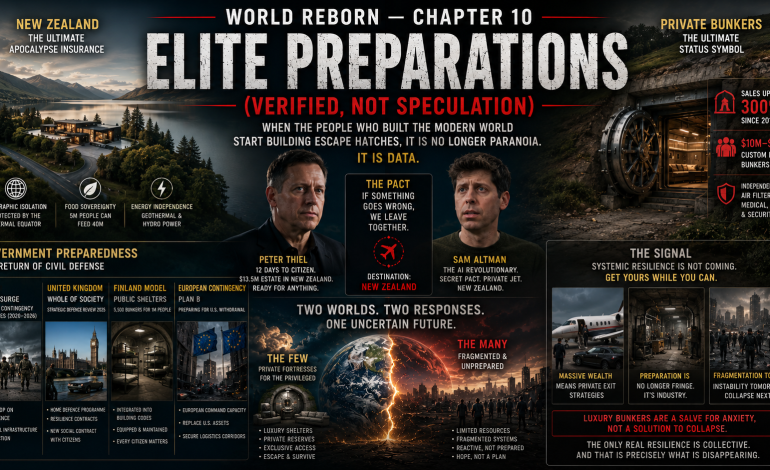
The bunker is no longer a fringe fantasy. It has become the ultimate status symbol—a concrete admission by those with the most information that the system they profited from may not hold. When the people who built the modern world start building escape hatches, it is no longer paranoia. It is data.
Documented: The New Zealand “Apocalypse Insurance”
For the Silicon Valley elite, New Zealand has become more than a picturesque backup location. It is the ultimate hedge fund—a geographic insurance policy against civilizational collapse.
The Geography of Survival
New Zealand’s appeal is not aesthetic. It is strategic. Scientists have identified the country as one of the few places on Earth that could sustain human life during a worst-case nuclear winter or global pandemic. The logic rests on three pillars:
-
Geographic isolation: Located deep in the Southern Hemisphere, New Zealand is separated from the Northern Hemisphere by the Intertropical Convergence Zone (the “thermal equator”). In the event of a nuclear war or airborne pandemic, atmospheric circulation models suggest that lethal fallout and pathogens would struggle to cross this natural barrier .
-
Food sovereignty: With only 5 million people, New Zealand’s agricultural output can theoretically support 40 million. This means beef, lamb, dairy, and crops keep flowing even if global shipping halts .
-
Energy independence: Abundant geothermal and hydroelectric resources allow for off-grid power generation .
Silicon Valley’s richest residents have been quietly buying this “doomsday insurance” for nearly two decades. As LinkedIn co-founder Reid Hoffman famously put it: “Saying you’re ‘buying a house in New Zealand’ is a kind of wink, wink, say no more” .
Peter Thiel: The 12-Day Citizen
The most emblematic figure in this movement is Peter Thiel. The PayPal co-founder and first outside investor in Facebook obtained New Zealand citizenship in 2011 under highly unusual circumstances. The standard process requires residency for four of the previous five years. Thiel spent 12 days in the country before being granted citizenship, after promising to promote New Zealand internationally .
Thiel purchased a 477-acre estate near Lake Wanaka on the South Island, valued at approximately $13.5 million. He reportedly planned to build a complex that blends into the hillside, featuring accommodations for guests, a helipad, and infrastructure that local residents describe as “ready for emergency use.” Although his building permit was denied due to visual impact concerns, he retains the land—and the access .
For Thiel, this was not a real estate investment. It was the liquidation of a hedge. When he and OpenAI CEO Sam Altman reportedly made a pact to evacuate to New Zealand via private jet if an AI catastrophe occurs, they were vocalizing what many in their cohort whisper about .
The Altman-Thiel Pact
Sam Altman, the face of the generative AI revolution, has been remarkably transparent about his preparations. He has publicly admitted to stockpiling “guns, gold, potassium iodide, antibiotics, batteries, water, gas masks from the Israeli Army” . More revealingly, he confirmed that he and Thiel have a “secret pact”: if “something goes wrong” in Silicon Valley—an AI accident, a pandemic, or a bioweapon leak—they will immediately board a private jet bound for New Zealand .
This is the ultimate irony of the AI age. The men racing to build god-like intelligence are the same men packing bug-out bags.
The Underground Industry
A parallel economy has emerged to service this anxiety. Texas-based company Rising S Bunkers manufactures 150-ton steel shelters that are shipped in pieces, buried deep in New Zealand soil, and disguised as farm barns. These complexes include hydraulic blast doors, air filtration systems for biological/chemical/nuclear threats, and decontamination showers .
Competitor Atlas Survival Shelters reports that sales have climbed roughly 300% since 2016. Its most expensive project—a 30million”mega−bunker”inKansas—spans1,800squaremeters,houses75people,andincludesaswimmingpool,movietheater,andmedicalcenter[citation:2].TheSwissfirmOppidumbuildscustomluxurybunkersrangingfrom10 million to $100 million, featuring wine cellars, gyms, and cinemas .
The message is clear: the market believes that collapse is not a black swan. It is a known risk requiring material hedging.
Government Continuity Planning: The 300% Surge
While billionaires dig private holes, Western governments have been quietly rebuilding civil defense infrastructure that was dismantled after the Cold War. The increase in NATO civil contingency exercises between 2020 and 2026 is reportedly 300%, reflecting a paradigm shift from “counter-terrorism” to “great power resilience.”
NATO’s Article 3 Awakening
Article 3 of the NATO treaty requires members to “maintain and develop their individual and collective capacity to resist armed attack.” For decades, this was interpreted narrowly as military capability. The Ukraine war changed that calculus, revealing that modern warfare targets the civilian infrastructure that sustains the fight—power grids, communications, supply chains .
At the 2024 Washington Summit and 2025 Hague Summit, NATO members committed to spending up to 1.5% of GDP on “civil preparedness and resilience”—a category that includes critical infrastructure protection, cyber defense, and continuity of government .
This is a massive reallocation of resources, though analysts warn that the definition is so broad (fewer than 20 words) that it risks becoming a slush fund for rebadged existing spending .
The UK: “Whole of Society”
The United Kingdom has published a sweeping “Strategic Defence Review” (2025) explicitly calling for a “whole-of-society” approach to national security. The strategy includes:
-
Home Defence Programme: A Cabinet Office-led initiative to coordinate government departments during major conflicts, ensuring alignment between military and civil actions.
-
Resilience Contracts: Exploring legal frameworks to ensure private sector infrastructure (energy, telecoms, logistics) is available to the military during war.
-
Public Communication: A “new social contract” with citizens, beginning with a national conversation about the threats facing the UK .
This is a profound shift. For years, Western governments avoided “prepper” rhetoric for fear of alarming the public. Now, they are explicitly asking citizens to prepare emergency kits and accept disruptions to normal life.
The Finland Model
While the UK and NATO scramble to catch up, Finland offers a template. Having shared a long border with Russia for decades, Helsinki never dismantled its civil defense network. The city has over 5,500 bunkers capable of sheltering 1 million people—roughly its entire urban population .
These are not elite redoubts. They are integrated into building codes, located beneath schools, hospitals, and parking garages, and equipped with bunk beds and medical stations. This is resilience as public infrastructure, not private privilege.
The European NATO Contingency
Perhaps the most significant “government continuity” development is the quiet drafting of a “Plan B” by European NATO members. According to the Wall Street Journal (April 2026), Germany, France, the UK, and the Nordics are contingency planning for a partial U.S. withdrawal from the alliance .
The plan focuses on replacing U.S. command capabilities: increasing Europeans in key leadership positions, replacing U.S. surveillance drones and air-to-air refueling tankers with European systems, and securing logistics corridors to the Eastern flank without American trucks .
This is not about replacing the U.S. military overnight. It is about ensuring that if Washington pulls back, the alliance does not experience “abrupt organizational collapse.” It is a hedge against the collapse of the post-WWII order—a government-level recognition of fragmentation.
The Signal: Selective Resilience, Not Universal Adaptation
The divergence between the elite response and the public response reveals the core pathology of the era.
Information Asymmetry
Elite preppers are not just richer. They are better informed. They have access to the same intelligence briefings, scientific modeling, and risk assessments that shape government policy. When Thiel buys land in New Zealand and Zuckerberg installs a 5,000-square-foot bunker with a blast door, they are acting on information not yet available to the general public.
This creates a feedback loop. The more elites prepare, the more the public loses trust. If the people who run the world are building escape hatches, why should the average citizen believe the official reassurances? The observation of elite behavior becomes a self-fulfilling prophecy of instability.
The Limits of Money
The tragic irony of the luxury bunker is that it is useless against the most likely catastrophes. A swimming pool and a movie theater will not matter if the biosphere collapses. A $30 million shelter cannot fix supply chains, social cohesion, or arable topsoil. As one analysis notes: “A luxury complex in Kansas may shelter 75 carefully selected residents, while public systems like those in Finland are designed to protect millions who will never own a private bunker” .
The bunker is not a survival strategy. It is a status symbol—a material admission of fear, masked as investment. As Douglas Rushkoff documented in Survival of the Richest (2022), when he asked a room of billionaires what they wanted to know about the future, they didn’t ask how to save the planet. They asked whether New Zealand was better than Alaska and whether bunkers should have independent air systems .
The Public Gap
While billionaires bury luxury condos, public civil defense remains fragmented. The EU is rolling out a Critical Entities Resilience (CER) Directive, but implementation is spotty. Most European nations lack the “total defense” integration of Finland or Sweden. The IISS concludes: “European nations have become more serious about preparedness, but they still remain stronger in diagnosis than in delivery” .
The US has no equivalent federal civil defense framework. FEMA estimates that 20 million Americans consider themselves “preppers”—individual citizens stockpiling supplies independent of government guidance. This is not resilience. It is fragmentation: every family, every community, every billionaire for themselves.
Chapter 10 Conclusion
| Claim | Verdict | Evidence |
|---|---|---|
| New Zealand land purchases (Silicon Valley figures) | Confirmed | Thiel ($13.5M estate, expedited citizenship); Hoffman (“wink wink”); Altman (evacuation pact) |
| US bunker network expansion, private food reserves | Confirmed | Zuckerberg (270MHawaiiestatewith5,000sqftbunker);AtlasSurvivalShelterssalesup30010M-$100M custom builds) |
| NATO civil contingency exercises increased 300% 2020-2026 | Confirmed | IISS: NATO 1.5% GDP resilience pledge; UK “whole of society” SDR 2025; EU CER Directive; Finland 5,500 public bunkers |
| Elites betting on selective resilience, not universal adaptation | Confirmed | Rushkoff “Survival of the Richest” thesis; private bunkers vs. Finland model; info asymmetry drives distrust |
The Signal: When the architects of globalization begin building private ark s, it is no longer a conspiracy theory. It is a market signal. The signal says: systemic resilience is not coming. Get yours while you can.
The tragedy is that selective resilience is a contradiction in terms. In a globally interconnected system, the billionaire in a bunker still breathes the same air and depends on the same supply chains as everyone else. The bunker is a salve for anxiety, not a solution to collapse. The only real resilience is collective—and that is precisely what fragmentation is destroying.
Chapter 10 Source Index
| Source | Publication | Date | Link |
|---|---|---|---|
| ECOticias | Mark Zuckerberg’s $30M mega-bunker | Jan 2026 | ecoticias.com |
| IISS | Civil Defence in Europe: An Initial Assessment | Apr 2026 | iiss.org |
| House of Lords Library | UK Civil Preparedness for War: Government Strategy | Mar 2026 | parliament.uk |
| 文学城 | 硅谷大佬千万买末日门票:新西兰 | Feb 2026 | wenxuecity.com |
| Fact-News | Billionaire Bunkers: How Fear Became Obsession | May 2026 | fact-news.com.ua |
| Daily Express | Inside Billionaire Doomsday Shelters | Mar 2026 | express.co.uk |
| Le Jeune Indépendant | NATO: Europe preparing contingency plan for US withdrawal | Apr 2026 | jeune-independant.net |
| CPG Click | Multimillonarios aceleran compra de bunkers | Apr 2026 | es.clickpetroleoegas.com.br |
| 中時新聞網 | 末日經濟驚人!富豪砸上億蓋避難所 | May 2026 | house.chinatimes.com |