CHAPTER 12 – WORLD REBORN : WHAT IS BEING REBORN (ALREADY)
CHAPTER 12 – WORLD REBORN WHAT IS BEING REBORN (ALREADY) Collapse narratives dominate headlines. But beneath the fragmentation, something else is growing—not as a coordinated plan, but as a million

CHAPTER 12 – WORLD REBORN
WHAT IS BEING REBORN (ALREADY)
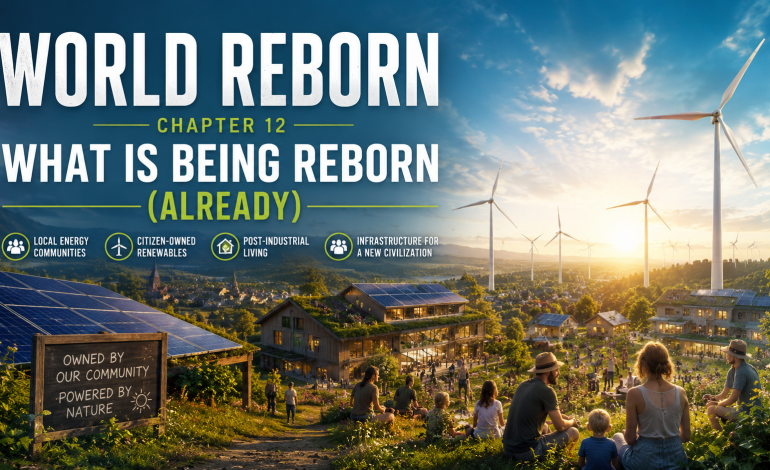
Collapse narratives dominate headlines. But beneath the fragmentation, something else is growing—not as a coordinated plan, but as a million small experiments in post-industrial, post-fossil, post-nuclear-family living. This chapter documents what is already being rebuilt, not as utopia, but as infrastructure for a different kind of civilization.
Local Energy Communities: Germany’s Citizen-Owned Renewables
The most advanced model of decentralized energy ownership is in Germany, where energy sharing has moved from pilot to legal framework.
Germany’s 2026 Energy Sharing Revolution
In November 2025, the German Bundestag passed an amendment to the Energy Industry Act (EnWG) introducing Section 42c, which legalizes energy sharing—the ability of citizens and small businesses to generate renewable electricity and share it with each other within an energy community. The law takes effect in June 2026 .
The significance cannot be overstated. Prior to this, tenant electricity models and communal building supply were limited to individual buildings or neighborhoods. Energy sharing offers significantly greater spatial and organisational flexibility: renewable electricity generated from systems and temporarily stored in “front-of-the-meter” storage facilities can now be shared with other end consumers in the same balancing area via the public grid. From 2028 onward, sharing will be possible even across balancing areas .
Eligible participants include: private individuals, SMEs, municipalities and other public institutions, and citizen energy companies .
The Großschwabhausen Wind Farm Model
A concrete example of citizen-owned renewables already operating is the Großschwabhausen wind farm project in Thuringia. Energiequelle GmbH, together with three citizens’ energy cooperatives (“Saale-Holzland,” “Ilmtal,” and “Jena”), is developing six Enercon E-160 wind turbines with a combined capacity of 33.36 MW. The cooperative structure enables up to three of the six turbines to be transferred into citizen ownership, allowing local residents to directly benefit from revenues generated by wind power .
The Thuringian Energy and GreenTech Agency (ThEGA) recognized this project as a model example of successful citizen participation and regional value creation .
Construction began in March 2027, with commissioning planned for May 2028 (first phase) and October 2028 (second phase). Further projects with citizen energy stakeholders are already being planned in northern Thuringia .
The Challenge: Financial Incentives
Germany’s framework is not yet perfect. The country has not introduced specific incentives such as premiums or grid fee reductions (unlike Austria or Italy). Taxes, levies, and grid fees continue to be charged via conventional residual electricity contracts. Whether the Federal Network Agency will ease implementation through rule-setting remains to be seen .
US Microgrid Cooperatives: Wyoming and Salt Lake City
The US model is less legally advanced but operationally active, particularly in rural areas and environmental justice communities.
In Wyoming, PowerSecure has partnered with Powder River Energy Corporation (PRECorp) to deploy a utility-scale solar and battery project in Moorcroft. The system includes a 5 MW battery system and 1.25 MWdc / 21.6 MWh of ground-mounted solar. Once operational in 2027, it will help the cooperative manage peak demand, strengthen reliability, and control costs—projected to save PRECorp $1 million annually .
The motivation is structural: rural utilities face the same grid strain as urban ones. PRECorp CEO Brian Mills framed the project as a trust-based evolution: “Our value to our members, has always been, we have to be a trusted energy partner. This entire project is loaded with technology and experience that will equip that very value point that the members have of our cooperative” .
In Salt Lake City, a community solar cooperative called SLC SolarShare is being developed with a dual mission: affordable renewable energy and neighborhood resilience. The model combines:
-
Community solar membership: Households receive monthly bill credits, lowering energy costs
-
Resilience hubs: Solar + battery backup at community centers provide clean air and cooling during climate emergencies (heatwaves, poor air quality, outages)
-
Job training partnerships: Solar installation apprenticeships with local hiring focus
The cooperative prioritizes neighborhoods with high energy burden, asthma rates, poor air quality, and lower tree canopy—explicitly advancing environmental justice through community governance with resident representation .
Federal incentives (IRA tax credits, Justice40 funding) provide financial support. Break-even is expected in 8–12 years, consistent with typical community solar timelines .
Regenerative Agriculture Scaling: India, Europe, Latin America
Industrial agriculture is chemically dependent, soil-depleting, and increasingly expensive for smallholders. Regenerative alternatives are scaling—not through charity, but through demonstrated economic and ecological returns.
India’s National Mission on Natural Farming (NMNF)
India has made the world’s largest institutional commitment to chemical-free agriculture. The NMNF was approved in November 2024 with a total outlay of ₹2,481 crore (approximately $300 million) as a centrally sponsored scheme. The mission targets 1 crore farmers (10 million) across 7.5 lakh hectares (750,000 hectares) .
Adoption numbers as of March 2026 :
| Metric | Number |
|---|---|
| Clusters formed | 18,786 |
| Area covered | 8.80 lakh hectares (880,000 hectares) |
| Farmers enrolled | 18.19 lakh (1.82 million) |
| Community Resource Persons (CRPs) trained | 33,676 |
Farmers receive an output-based incentive of ₹4,000 per acre per year for two years (up to one acre per farmer) to offset the transition period when yields may dip before soil health recovers .
Research validation: The Indian Council of Agricultural Research (ICAR) runs a research program through 20 cooperation centers covering 16 states, involving 11 State Agricultural Universities and 8 ICAR institutes. Results show that natural farming performance is “highly context specific,” but measurable improvements in soil health indicators have been documented: soil organic carbon increased from approximately 0.90% to 1.15% in Himalayan trials, with significantly higher microbial counts and diversity indices than chemical-fed soils .
Farmer-reported outcomes (NITI Aayog evaluation) :
-
91.2% reported increased crop productivity and improved soil health
-
90.1% reported reduced input costs
-
68.5% reported improved soil health
The structural shift: India’s fertilizer subsidy is the second-largest government expenditure after food subsidy, creating a massive fiscal contradiction—subsidizing chemical agriculture while promoting natural farming. The PM-PRANAM scheme attempts to resolve this by incentivizing states to reduce chemical fertilizer use, allowing them to retain 50% of resulting subsidy savings as central grants, with 70% earmarked for organic and bio-fertilizer infrastructure .
Colombia’s Silvopastoral Systems
In Latin America, the most promising regenerative model is silvopastoral systems (SPS) —integrating trees, pasture, and livestock on the same land. Unlike natural farming (which reduces inputs), SPS is a productivity-enhancing regeneration strategy.
Research from the European Commission’s Knowledge for Policy platform (January 2026) documents SPS outcomes in Colombia :
| Metric | Result |
|---|---|
| Milk and meat yields | Double conventional systems |
| Returns (IRR) | Up to 61% |
| Carbon sequestration | Up to 2.5 tons CO2 per hectare/year |
| Emissions | Reduced significantly |
The barrier: Adoption remains extremely low—only 1% of Colombian producers use SPS. Key barriers include insecure land tenure (farmers will not invest in tree establishment without ownership certainty) and limited access to finance for the transition period .
The opportunity: SPS aligns with ESG goals, enabling access to green finance and payments for ecosystem services (PES). A CGIAR-affiliated junior scientist’s field application documents a six-hectare pilot on eroded, drought-prone land that planted approximately 20,000 trees (17,000 Gliricidia sepium for high-protein leaf meal production, 3,000 Tabebuia rosea for timber). Despite the severe 2015–2017 El Niño drought, biannual management achieved 80% survival, producing dual income streams while restoring soil and sequestering carbon .
Europe’s Agroecology Transition
The European data is more policy-driven than farmer-led. The EU’s Common Agricultural Policy (CAP) has shifted toward eco-schemes that reward carbon sequestration, biodiversity, and reduced inputs. However, adoption varies dramatically by member state, and the overall pace remains slower than the climate trajectory requires. The European model is less “already reborn” and more “policy framework awaiting implementation.”
Distributed Manufacturing: 3D Printing, Local Fab Labs, Open-Source Hardware
The manufacturing economy has been hyper-centralized for a century—giant factories, global supply chains, just-in-time logistics. Distributed manufacturing reverses this logic: production happens where consumption happens, using open-source designs and locally available materials.
The Open Lab Starter Kit (OLSK) — Germany
The most advanced open-source distributed manufacturing toolkit comes from a collaboration between Helmut-Schmidt-University (HSU) in Hamburg, the New Production Institute, and InMachines, funded by dtec.bw and the EU’s NextGenerationEU initiative .
The OLSK (final version presented February 2026) is a complete open-source digital fabrication lab, designed for easy replication. It consists of eight machines :
| Machine | Specifications |
|---|---|
| Large Laser Cutter | First open-source desktop laser with tool changer; RF CO₂ 60W & diode 40W; integrated AI image generation |
| Small Laser Cutter | 600 × 400 mm workspace; compact and low-cost |
| Large 3D Printer | 1000 × 1000 × 1300 mm build volume; high-speed; non-planar printing |
| Small 3D Printer | Desktop; auto-calibration; high-flow nozzle |
| Large CNC | 2500 × 1250 mm; 4.5 kW spindle; 14-tool changer |
| Small CNC | Compact; open-source tool changer |
| 3D Scanner | Turntable + moving camera; high-precision |
| Vinyl Cutter | 300 mm; open-source |
Critical design feature: The OLSK is designed for open-source replication. A high proportion of parts can be locally fabricated in existing Makerspaces and FabLabs. Comprehensive documentation (3D designs, bill of materials, assembly instructions, wiring schematics, firmware, machine configurations) is available on GitHub, allowing anyone to rebuild, customize, or contribute .
The operating system—OLOS (Open Lab OS) —is user-friendly and open-source. The large laser cutter includes AI image generation for direct design creation .
The Fab City Hamburg initiative contextualizes the OLSK within a broader vision: decentralized digital production for urban value creation. Instead of cities importing products and exporting waste, Fab Cities aim to produce locally what they consume locally, using digital fabrication and local materials .
Open-Source Hardware Ecosystems Globally
The OLSK is not an isolated project. It is part of a global ecosystem that includes:
-
RepRap (self-replicating 3D printers)
-
Open Source Ecology (Global Village Construction Set—50 industrial machines for civilization)
-
Precious Plastic (open-source plastic recycling and manufacturing machines)
-
WikiHouse (open-source, digitally fabricated housing)
The pattern is consistent: open-source hardware lowers the barrier to manufacturing, enables local adaptation, and reduces dependency on global supply chains. This is not cottage-industry nostalgia—it is digital-era, locally-owned, globally-collaborative production.
The Vulnerability: Distributed manufacturing is not yet a substitute for mass production. It excels at prototyping, small-batch production, repair, and customization—not at producing 10 million identical smartphones. But resilience is not about mass production. Resilience is about the capacity to produce what is needed when it is needed, even if at lower volume and higher marginal cost.
New Kinship Structures: Chosen Family, Mutual Aid Networks, Co-Housing
The nuclear family—two parents, 2.5 children, detached house—was a post-WWII invention, not a timeless human universal. It is failing under economic pressure (housing costs, childcare costs, two-income necessity) and social fragmentation (loneliness, mobility, delayed marriage). What is emerging is not a single replacement but a pluralism of kinship structures.
Co-Housing and Intentional Communities
The Foundation for Intentional Community (FIC) maintains a directory of thousands of co-housing projects, ecovillages, and communal homes worldwide. A representative example is The Hive in Portland, Oregon .
The Hive’s self-description: “a collective with a culture of sharing and an abundant kitchen; a home that holds space for the broader community and each other as a chosen family. We are working on intentional communication, anti-oppressive practices and building resiliency” .
Governance is collaborative/horizontal—power and responsibility shared relatively equally among members. Decision-making authority rests with “All Community Members Together.” Economic model is independent finances with some sharing: monthly fees approximately $800 (rent + utilities + groceries), labor obligation 3 hours/week, and a rent share system that adjusts based on members’ financial situations .
The Hive explicitly prioritizes families with young children—”very interested in having another family with a young kid move in”—creating multi-adult, multi-child households that distribute caregiving and financial burdens .
Mutual Aid Networks
Mutual aid—neighbors helping neighbors without institutional mediation—has exploded since COVID-19. Unlike charity (which flows downward) or state services (which flow through bureaucracy), mutual aid is horizontal: people organizing themselves to meet shared needs (childcare, food, transportation, healthcare navigation, home repair).
Documentation is fragmented because mutual aid is hyperlocal and often ephemeral. But the pattern is consistent across disaster responses (hurricanes, wildfires, floods) and chronic stressors (pandemic isolation, inflation, caregiving gaps). Mutual aid does not replace state services, but it fills gaps that states cannot or will not cover—and in doing so, rebuilds the social fabric that states require to function.
Chosen Family as Structural Adaptation
The phrase “chosen family” originated in LGBTQ+ communities whose biological families rejected them. It has since generalized to anyone whose biological family is absent (geographically), dysfunctional (emotionally), or inadequate (insufficient to meet needs).
Chosen family is not friendship. It is kinship without blood—committed, ongoing, care-providing, obligation-bearing relationships that function like family but are selected rather than inherited. The rise of chosen family reflects both the failure of nuclear family to provide adequate support (particularly for single people, elderly people, and people without children) and the positive desire for intentional, non-obligate relationship structures.
The Structural Driver: The nuclear family’s economic logic assumed a male breadwinner wage sufficient to support a non-working spouse and multiple children. That logic collapsed decades ago, but the cultural expectation of nuclear family persists—leaving individuals trying to replicate an impossible model. Co-housing, chosen family, and mutual aid are not ideological rejections of family. They are pragmatic adaptations to an economy and society that no longer supports the nuclear family as a viable unit.
Chapter 12 Conclusion
| Domain | What Is Being Reborn | Evidence Status |
|---|---|---|
| Local Energy | Citizen-owned renewables; energy sharing legal in Germany (2026); US microgrid co-ops | Confirmed – legal framework operational; projects under construction |
| Regenerative Agriculture | India’s NMNF (1.8M farmers enrolled); Colombia’s SPS (2x yields, 61% IRR) | Confirmed – government data; research validation |
| Distributed Manufacturing | Open Lab Starter Kit (8 open-source machines); global fab lab network | Confirmed – open-source hardware documented; GitHub resources |
| New Kinship | Co-housing, chosen family, mutual aid networks | Confirmed – directory evidence; cultural shift documented |
The Meta-Finding: The rebirth is not a single movement with a manifesto. It is a million small experiments in doing things differently—owning energy cooperatively rather than through utilities, farming without chemicals rather than with them, manufacturing locally rather than globally, forming chosen family rather than relying on nuclear household.
Each experiment is fragile. Each could fail. But collectively, they constitute the infrastructure of a post-industrial civilization—one that is not waiting for permission from governments or corporations, but is being built from the ground up by people who have concluded that the old systems will not save them.
The question is not whether rebirth is happening. It is whether it can scale fast enough to outrun the fragmentation documented in previous chapters.
Chapter 12 Source Index
| Source | Publication | Date | Link |
|---|---|---|---|
| Taylor Wessing | Energy Sharing under Section 42 EnWG | Nov 2025 | taylorwessing.com.cn |
| Solar Builder | PowerSecure/PRECorp Wyoming storage project | April 2026 | solarbuildermag.com |
| PIB Delhi | National Mission on Natural Farming update | March 2026 | pib.gov.in |
| European Commission | Silvopastoral systems in Colombia | Jan 2026 | knowledge4policy.ec.europa.eu |
| HSU Hamburg | Open Lab Starter Kit final presentation | Feb 2026 | hsu-hh.de |
| Foundation for Intentional Community | The Hive directory listing | March 2026 | ic.org |
| Energiequelle | Citizen energy cooperative award | July 2025 | energiequelle.com |
| Prezi | SLC SolarShare cooperative model | May 2026 | prezi.com |
| Drishti IAS | India’s natural farming transition | Jan 2026 | drishtiias.com |