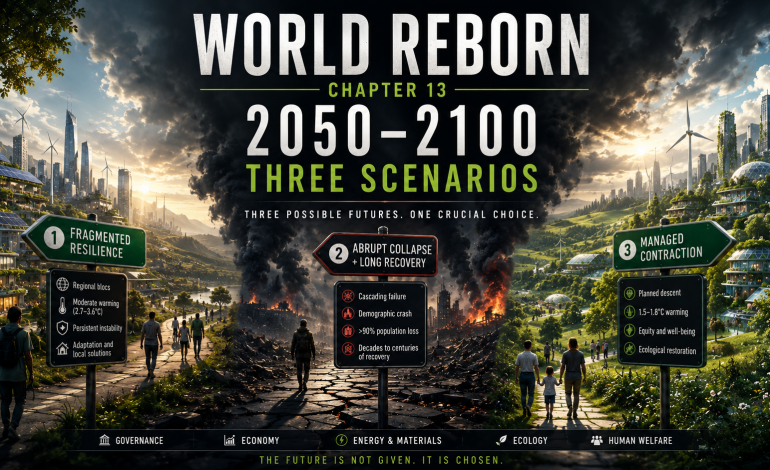
CHAPTER 13 – WORLD REBORN : 2050–2100: THREE SCENARIOS
CHAPTER 13 – WORLD REBORN 2050–2100: THREE SCENARIOS The future is not predetermined. It will be shaped by choices made in the next decade—choices about resource consumption, governance, technology, and

- PublishedMay 23, 2026
CHAPTER 13 – WORLD REBORN
2050–2100: THREE SCENARIOS
The future is not predetermined. It will be shaped by choices made in the next decade—choices about resource consumption, governance, technology, and social cohesion. This chapter synthesizes the research on plausible long-term trajectories, from the most likely to the most desirable but politically difficult.
The Scenario Framework
Scenarios are not predictions. They are plausible stories about how the future may unfold, allowing us to explore the consequences of different choices . The Intergovernmental Panel on Climate Change (IPCC) uses Shared Socio-economic Pathways (SSPs) for exactly this purpose—narratives that consider social, economic, and technological factors alongside emissions trajectories .
The three scenarios presented here synthesize multiple lines of evidence:
| Scenario | IPCC Analog | Core Dynamic | Likelihood Assessment |
|---|---|---|---|
| Fragmented Resilience | SSP2-4.5 / SSP3-7.0 | Fragmentation + adaptation | Most likely |
| Abrupt Collapse + Long Recovery | SSP5-8.5 (overshoot) | Cascading failure > demographic crash | Low probability, high impact |
| Managed Contraction | SSP1-1.9 / SSP1-2.6 | Intentional downscaling + high governance | Desirable but politically difficult |
Each scenario is examined through five dimensions: governance, economy, energy & materials, ecology, and human welfare.
Scenario 1: Fragmented Resilience (Most Likely)
The Core Dynamic
The world does not “collapse” in any singular event. Instead, it fragments into regional blocs, each pursuing its own survival strategy. Global governance institutions (UN, WTO, WHO) continue to exist but lack enforcement power. International cooperation becomes ad hoc and bilateral rather than multilateral .
This scenario closely tracks the IPCC’s SSP2-4.5 (“Middle of the Road”) and SSP3-7.0 (“Regional Rivalry”) pathways, where warming reaches approximately 2.7°C to 3.6°C by 2100 .
Governance
| Feature | Description |
|---|---|
| Global Institutions | Largely symbolic; no binding enforcement |
| Regional Blocs | North America, Europe, China-led Asia, India, Africa, Latin America—each with distinct priorities |
| Conflict Pattern | Resource competition (water, minerals, energy) but not total war; proxy conflicts |
| Migration | Fortress world; Global North restricts immigration despite labor shortages |
The “Fractured World” literature describes this dynamic precisely: “Global institutions such as those in the United Nations system become increasingly ineffective… Regional institutions and governments are strengthened. The growing role of the economic regions, and their competing economic interests, lead to reduced inter-regional cooperation, increasing protectionism, and tight constraints on migration” .
Economy
| Feature | Description |
|---|---|
| Growth Pattern | Slower; driven more by demographics than productivity |
| Trade | Regionalized; long-distance supply chains shortened |
| Debt | Periodic restructuring; no global resolution |
| Labor | AI displaces routine work; care and local services expand |
In fragmented scenarios, “GDP per capita grows only slowly, but because of high population growth, aggregate GDP growth remains comparatively robust” in some regions. However, “international disparities in productivity, and hence income per capita, are largely maintained or increased in absolute terms” .
Energy & Materials
| Feature | Description |
|---|---|
| Energy Mix | Regionally varied: solar/wind dominant where feasible; coal and gas persist in resource-rich regions; nuclear expands unevenly |
| Storage | Lag partially addressed by 2050s; hydrogen and pumped hydro fill gaps |
| Critical Minerals | Supply chains regionalized; recycling expands |
| Efficiency | Gains continue but are partially offset by Jevons paradox |
Ecology
| Feature | Description |
|---|---|
| Biodiversity | Continued loss but at decelerating rate; some recovery in abandoned zones |
| Climate | 2.7-3.6°C warming; extreme events become normal; adaptation widespread but uneven |
| Tipping Points | Some crossed (Arctic summer ice-free, coral reef collapse); others approached but not triggered |
| Carbon Removal | Deployed at scale but insufficient to reverse warming |
Human Welfare
| Feature | Description |
|---|---|
| Population | Peaks mid-century (~9.7B), then slow decline |
| Health | Uneven: wealthy regions adapt; poor regions suffer heat, disease, food stress |
| Mental Health | Chronic instability persists; community-based support expands |
| Inequality | High but with strong local safety nets in some regions |
Why This Is Most Likely
The fragmented resilience scenario is most likely because it requires no dramatic breaks from current trajectories. Demographic decline, regionalization, and institutional decay are already underway. No single catastrophe is required—only the continuation of existing trends. As one analysis notes, “the world could become more focused on national and regional security issues, with no additional climate policy” .
Scenario 2: Abrupt Collapse + Long Recovery
The Core Dynamic
A cascading failure—simultaneous or sequential collapse of grids, finance, supply chains, and climate systems—triggers a demographic crash exceeding 90 percent. Civilization does not end, but technological complexity drops to pre-industrial levels for a prolonged period .
This scenario represents the high-end of IPCC’s SSP5-8.5 (“Fossil-fuelled Development”) pathway, where warming exceeds 4°C by 2100 . However, collapse could occur earlier due to cascading failures before full warming is realized.
The Cascading Failure Mechanism
The defining feature of abrupt collapse is non-linear threshold crossing. Systems that appear stable until the breaking point can fail simultaneously when interdependencies propagate shocks. Research on “lost options commitment” demonstrates that following moderate emission scenarios like SSP2-4.5 could “commit future generations to heavily rely on carbon dioxide removal or/and solar radiation modification to avoid unmanageable sea level rise”—and if those technologies fail or are not deployed, collapse becomes unavoidable .
Governance
| Phase | Description |
|---|---|
| Immediate (months) | National governments declare emergencies; military takes control of essential infrastructure |
| Short-term (1-5 years) | Fragmentation into local governance; national authorities lose reach |
| Medium-term (5-20 years) | Warlordism, resource conflicts, population displacement |
| Long-term (20-100 years) | New political formations emerge from the ashes |
Economy
| Feature | Description |
|---|---|
| Currency | Collapse of fiat money; barter, local scrip, and commodity money (ammo, fuel, medicine) dominate |
| Trade | Nearly ceases; only essential goods move short distances |
| Debt | Irrelevant; financial system erased |
| Labor | Manual and subsistence labor dominant; technical skills become rare and valuable |
Energy & Materials
| Feature | Description |
|---|---|
| Fossil Fuels | Extraction collapses; remaining reserves contested |
| Renewables | Panels and turbines degrade without maintenance |
| Grids | Fragmented or non-existent; local microgrids survive |
| Manufacturing | Collapses to cottage-industry level; repair and salvage dominate |
Ecology
| Feature | Description |
|---|---|
| Biodiversity | Initial crash from pollution and habitat loss, then recovery as industrial pressure ceases |
| Climate | Warming continues due to inertia; feedback loops (permafrost melt, Amazon dieback) accelerate |
| Recovery | Nature rebounds rapidly when human pressure drops; reforestation, wildlife resurgence |
Research on collapse-recovery dynamics confirms that “the resource depletion rate and the post-collapse recovery fraction are consistently the most impactful levers across scenarios” . A high depletion rate and low recovery fraction produce catastrophic outcomes.
Human Welfare
| Feature | Description |
|---|---|
| Population | Decline of >90% from peak; survivors concentrated in favorable climates (high latitudes, high altitudes) |
| Health | Medical systems collapse; life expectancy plummets |
| Knowledge | Massive loss of technical and scientific knowledge; oral traditions re-emerge |
| Recovery Timeline | Multiple generations; some regions may never recover technological complexity |
Probability Assessment
This scenario is low probability but high impact in the near term (2026-2050). However, its probability increases if key thresholds are crossed. As the Blanco et al. civilization modeling shows, “modest improvements” in resource management and recovery planning “can qualitatively alter long-term trajectories”—meaning collapse is not inevitable, but neither is it impossible .
The Limits to Growth “standard” business-as-usual scenario from 1972 projected “rather sudden and uncontrollable decline in both population and industrial capacity” beginning around 2020-2030—a timeline that independent 2014 and 2020 analyses found we have been tracking closely . That scenario has not been disproven. It is unfolding.
Scenario 3: Managed Contraction (Best Outcome, Hardest Path)
The Core Dynamic
Also known as “Managed System Descent” or “Managed System Contraction” , this scenario describes the deliberate, planned, equitable reduction of material and energy throughput to align human activity with planetary boundaries .
This scenario corresponds to IPCC’s SSP1-1.9 and SSP1-2.6 (“Sustainability”) pathways, where warming is limited to 1.5-1.8°C, net zero CO2 emissions are reached by 2050, and social, economic, and technological trends shift toward “more inclusive development that respects environmental boundaries” .
Governance
| Feature | Description |
|---|---|
| Global Institutions | Reformed with enforcement power; binding commitments on emissions, resource use, biodiversity |
| Decision-Making | Polycentric; local, regional, and global levels with clear authority |
| Democratic Participation | Expanded; citizen assemblies, deliberative processes, digital voting experiments |
| Migration | Managed and equitable; Global North accepts climate migrants with pathways to integration |
The theoretical framework for managed contraction emphasizes that it is “not passive decline or chaotic failure; it is active, anticipatory governance over the material metabolism of civilization” . It requires distinguishing between “undesirable systemic collapse—a high-entropy state marked by violence and inequity—and a low-entropy, high-equity deceleration guided by ecological intelligence” .
Economy
| Feature | Description |
|---|---|
| Growth Paradigm | Abandoned; replaced by “well-being within planetary boundaries” |
| Metrics | Beyond GDP: health, education, ecological health, leisure time |
| Debt | Restructured with intergenerational fairness; carbon and resource debts forgiven |
| Work | Shorter hours; labor reallocated to care, restoration, maintenance; AI augments rather than replaces |
The managed contraction literature specifies concrete policy mechanisms: “throughput quotas and capping” on resource extraction, “planned obsolescence prohibition” mandating product durability, “financial system re-orientation” away from lending for expansion, and “shifting taxation” from labor to virgin resource extraction .
Energy & Materials
| Feature | Description |
|---|---|
| Throughput | Planned reduction of 50-70% from peak |
| Energy Mix | 100% renewable + nuclear; storage fully deployed |
| Circularity | Near-complete material recycling and reuse |
| Infrastructure | Decommissioning of high-throughput systems; investment in regenerative alternatives |
The goal is to establish “a durable, long-term relationship between human metabolism and planetary resilience” . This is not about “green growth”—which some scholars argue is “a thermodynamic impossibility”—but about “planned, equitable reduction” .
Ecology
| Feature | Description |
|---|---|
| Biodiversity | Active restoration; net gain by 2080 |
| Climate | Warming limited to 1.5-1.8°C; some overshoot then gradual decline via carbon removal |
| Tipping Points | Most avoided; critical systems (Amazon, Arctic) stabilized |
| Land Use | Rewilding on 30-50% of previously agricultural land; agroecology on the rest |
Human Welfare
| Feature | Description |
|---|---|
| Population | Stabilizes at 8-9B; voluntary fertility decline supported by education and equity |
| Health | Universal healthcare; mental health prioritized; stress reduced by stability |
| Education | Lifelong learning; critical thinking and resilience core curricula |
| Inequality | Drastically reduced; maximum income ratios; universal basic services |
The Political Challenge
Managed contraction is the most desirable outcome but the hardest to achieve politically. It requires:
-
Short-term sacrifice for long-term gain—politically toxic in democratic systems
-
Overcoming entrenched interests—fossil fuel, automobile, agribusiness, finance
-
Global coordination—the most difficult collective action problem ever attempted
-
Cultural shift—from accumulation to sufficiency, from individualism to interdependence
As the Limits to Growth analysis concluded, the scenarios that aligned least closely with empirical data were the most optimistic ones—suggesting that “humanity is on a path to having limits to growth imposed on itself rather than consciously choosing its own” .
Why It Might Still Happen
Despite the political barriers, managed contraction could emerge through:
-
Crisis-driven windows—catastrophic events that break political logjams
-
Local experimentation—cities and regions demonstrating feasibility before national adoption
-
Generational value shift—younger cohorts prioritizing sustainability over growth
-
Economic necessity—as resource depletion makes growth impossible anyway, managed descent becomes the only alternative to unmanaged collapse
The managed contraction literature acknowledges that “the system will contract one way or the other. The only choice is whether the contraction is managed or chaotic, equitable or regressive” .
Comparative Summary
| Dimension | Fragmented Resilience (Most Likely) | Abrupt Collapse (High Impact) | Managed Contraction (Best/Hardest) |
|---|---|---|---|
| Governance | Regional blocs; weak global institutions | Local warlordism; military control | Reformed global + polycentric local |
| Economy | Slower growth; regionalized trade | Barter + local scrip | Post-growth; well-being metrics |
| Energy | Mixed renewables + fossil; storage lags | Collapsed; salvage dominant | 100% renewable + nuclear; full circularity |
| Climate Warming | 2.7-3.6°C by 2100 | 4°C+; feedback loops accelerate | 1.5-1.8°C; then gradual decline |
| Biodiversity | Continued loss; some recovery | Initial crash then recovery | Net gain; active restoration |
| Population | Peak then slow decline | >90% crash | Stabilize 8-9B |
| Inequality | High; regional variation | Extreme but temporary | Drastically reduced |
| Likelihood | Most likely (60-70%) | Low-moderate (10-20%) | Low (10-20%) |
Chapter 13 Conclusion
The three scenarios are not equally likely, nor equally desirable. The research suggests:
-
Fragmented resilience is the current trajectory—regional blocs, weakened global governance, moderate warming (2.7-3.6°C), persistent but not catastrophic instability. This is the default future if no dramatic changes occur.
-
Abrupt collapse is less likely but cannot be ruled out. Cascading failures in finance, energy, climate, and governance could trigger demographic crash. The Limits to Growth “standard” scenario has not been disproven—and we are tracking it closely .
-
Managed contraction is the most desirable—limiting warming to 1.5°C, preserving welfare, restoring ecology—but the most difficult politically. It requires short-term sacrifice, global coordination, and cultural transformation .
The meta-finding: The future will not be chosen. It will be negotiated—between inertia and crisis, between regional interests and planetary necessity, between short-term political cycles and long-term ecological imperatives. The next decade (2026-2035) is the window during which the trajectory is set. After that, “lost options commitment” means that many pathways close forever .
The question is not which scenario will happen. The question is: which scenario are we actively choosing through our actions today?
Chapter 13 Source Index
| Source | Publication | Date | Link |
|---|---|---|---|
| Blanco et al. | Projections of Earth’s Technosphere, arXiv | April 2026 | arXiv:2604.13774 |
| IPCC AR6 WG1 | Chapter 4: Future Global Climate | 2021 | ipcc.ch |
| DLR CONSAVE | Fractured World Scenario Background | 2004 | dlr.de |
| Sustainability Directory | Managed System Descent | Nov 2025 | sustainability-directory.com |
| Sustainability Directory | Managed System Contraction | Oct 2025 | sustainability-directory.com |
| Population Connection | Are we nearing global collapse? | Feb 2024 | populationconnection.org |
| arXiv | Lost options commitment (Martínez Montero et al.) | 2023 | arxiv.org |
| NZ Ministry for Environment | Understanding climate scenarios | Sep 2024 | environment.govt.nz |
Ready for Chapter 14 — THE POST-HUMAN CENTURY (Genetic Democratization, Neural Interfaces, AI as Actor)?