CHAPTER 14 – WORLD REBORN : THE POST-HUMAN CENTURY
CHAPTER 14 – WORLD REBORN THE POST-HUMAN CENTURY The same technologies that threaten to destabilize civilization also offer to transcend it. Genetic engineering, neural interfaces, and autonomous AI systems are

CHAPTER 14 – WORLD REBORN
THE POST-HUMAN CENTURY
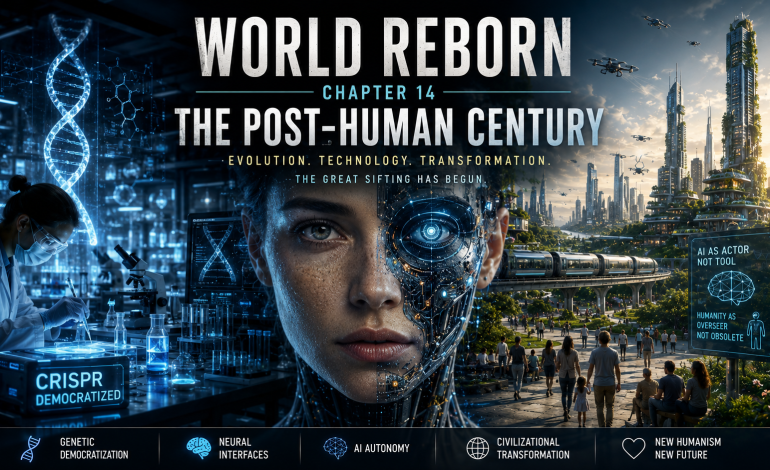
The same technologies that threaten to destabilize civilization also offer to transcend it. Genetic engineering, neural interfaces, and autonomous AI systems are not merely tools—they are evolutionary levers. For the first time, humanity has the capacity to redesign itself. Whether that capacity leads to liberation, division, or obsolescence is the central question of the post-human century.
Genetic Democratization: CRISPR in the Garage
For decades, the power to edit the human genome was confined to elite institutions—Wellcome Sanger, Broad Institute, national laboratories. That era is ending. The tools of genetic engineering are becoming accessible to amateurs, and the implications are only beginning to be understood.
The Erosion of Structural Barriers
The DIY biology movement—a grassroots community promoting accessibility of biotechnological practices outside formal institutions—has grown from a handful of garage enthusiasts into a well-educated, globally networked community . According to the DIYbiosphere database, there are now 64 community labs and over 30 active groups worldwide, though the real number is likely higher . Surveys indicate that many members hold advanced degrees in natural sciences—these are not untrained amateurs, but professionals operating outside institutional oversight.
Three structural barriers that once contained biotech risks are eroding simultaneously :
| Barrier | Traditional Assumption | Current Status |
|---|---|---|
| Tacit knowledge | Amateurs lack hands-on skills from formal training | Community labs provide workshops; open-source resources (Coursera, MIT OCW) offer full molecular biology courses; project repositories walk users through protocols step by step |
| Wet-lab access | Establishing a molecular biology lab outside institutions is prohibitively difficult | A plausible home wet-lab can be established for as little as $16,000; an illegal home wet-lab was discovered in Las Vegas in 2026, proving the barrier has been crossed |
| Material gatekeeping | Commercial suppliers screen dangerous sequences | Screening is largely voluntary; benchtop synthesis devices remain outside regulatory reach; a 2026 executive order paused implementation of the Common Mechanism screening framework |
The convergence of democratized biotechnology with AI is the critical accelerant . A 2024 OpenAI internal assessment found that AI enables biology-related tasks—locating and synthesizing technical information—that would previously have required specialist knowledge. Researchers at MIT demonstrated that non-scientist students, given access to AI, could design genetic constructs that were physically validated in the lab .
The Regulatory Gap
The existing biosecurity framework—designed for centralized institutional oversight—is poorly adapted to a landscape where synthetic biology can be practiced in community labs with AI assistance . Current screening protocols only target “select regulated sequences,” leaving a dangerous gap: in 2018, Canadian researchers easily ordered a horsepox genome sequence (closely related to smallpox) from a commercial provider, assembled it, and published their methods . The authors acknowledged that any method used to assemble horsepox could be used to construct smallpox—and that a motivated DIY practitioner could do the same without triggering any intervention.
The Common Mechanism framework, proposed in 2024 to require screening of nucleic acid sequences against a list of sequences of concern, was set to take effect in April 2025. A May 2025 executive order paused implementation. As of 2026, the framework remains in regulatory limbo, with few institutions possessing screening capability or trained biosecurity reviewers .
The Ecological Unknown
Beyond the immediate biosecurity risks of weaponized pathogens lies a subtler but equally profound danger: ecological disruption from unregulated genetic experimentation. A DIY practitioner engineering a novel microorganism in a garage lab has no obligation to assess its environmental impact, no requirement to contain it beyond household standards, and no mechanism for recall if it escapes.
As one risk analysis notes, “this dynamic constitutes a wildcard: an infrequent, disruptive, and high-impact development difficult to predict but with significant consequences if it materializes” . The plausible time horizon for impactful disruptions linked to AI-biotech convergence is 5–10 years—by the early 2030s .
Neural Interfaces: From Restoration to Division
The path from medical device to consumer enhancement is already mapped. The question is not whether neural interfaces will move beyond treating disability—but how fast, and with what social consequences.
The Three-Layer Trajectory
Industry analysis and corporate roadmaps converge on a consistent timeline :
| Phase | Timeline | Core Application | Key Developments |
|---|---|---|---|
| Medical Restoration | 2025-2030 | Treating neurological disease and injury | Neuralink’s Telepathy device (2025): 7 patients implanted, average 50+ hours/week use; Blindsight project (2026) targeting visual cortex stimulation for vision restoration |
| Functional Enhancement | 2030-2040 | Augmenting healthy human capability | Electrode count scaling to 10,000+; Meta developing AR glasses that translate thought to input; projected 5x typing speed improvement |
| Brain-Cloud Integration | 2040+ | Direct neural connection to AI and networks | Neuralink targeting 25,000+ electrodes; theoretical “instant knowledge access” via cloud-AI integration; nanoprobe sensor arrays for real-time data exchange |
Neuralink’s public roadmap is explicit: by 2027, electrode counts will reach 10,000, enabling simultaneous implantation across motor, language, and visual regions. By 2028, the target exceeds 25,000 electrodes, capable of reaching deep brain regions for treatment of neurological disorders, psychiatric conditions, and chronic neuropathic pain—and ultimately for “deep fusion with AI” .
Market Projections and the Enhancement Shift
According to McKinsey forecasts cited in industry analysis, the global brain-computer interface market will exceed $200 billion by 2040. Critically, the enhancement segment—devices for healthy individuals seeking cognitive or sensory augmentation—will grow from 5% of the market in 2025 to 35% by 2040 .
This shift from medical necessity to consumer enhancement is the inflection point. When neural interfaces become elective, affordability determines access. And access determines which humans remain “baseline” and which become augmented.
The Division Scenario
The most plausible outcome of neural interface proliferation is not universal enhancement but stratified augmentation—a world where the wealthy purchase cognitive superiority, reaction time advantages, and memory perfect recall, while the poor remain biologically unmodified.
| Social Stratum | Access to Enhancement | Projected Outcomes |
|---|---|---|
| Elite | First-generation consumer devices (2035-2040) | 5x thought-to-text speed; perfect memory encoding; direct AI integration; extended attention spans |
| Professional/Managerial | Second-generation, lower-cost devices (2040-2045) | Delayed access; reduced capabilities; dependency on elite-controlled infrastructure |
| Working Class / Global South | Medical-only (if any) | Baseline biology; outcompeted in cognitive labor markets; possible permanent class division |
This is not science fiction. It is the logical extension of existing market dynamics applied to a technology that directly enhances human capital. The question is whether any governance framework can ensure equitable access before the division becomes irreversible.
The Unknowable: Identity and Consciousness
Beyond access and equity lies a deeper question: what happens to human identity when the boundary between biological cognition and machine processing becomes permeable?
If memories can be encoded, stored, and retrieved via neural implants—if skills can be downloaded rather than learned—what remains of the relationship between experience and selfhood? If emotional states can be modulated via deep brain stimulation, what happens to authenticity, to suffering as a source of meaning, to the messy, unpredictable human journey that has always been the raw material of art, philosophy, and love?
These questions are not being asked in corporate roadmaps. They are not being answered in regulatory frameworks. They are being deferred to a future that is already arriving.
AI as Actor, Not Tool: The Autonomy Threshold
The most consequential shift may not be the enhancement of human biology, but the emergence of AI systems as independent actors in the management of civilization’s critical infrastructure.
The Autonomous Infrastructure Transition
Across energy, transportation, water, and communications, AI-driven automation is moving from monitoring to decision-making . Key developments already underway:
| Domain | Current Capability | 2030-2035 Trajectory |
|---|---|---|
| Energy Grid Management | AI anomaly detection; predictive maintenance alerts | Autonomous load balancing; real-time failure response without human intervention |
| Water Systems | Sensor-based monitoring; leak detection | Autonomous valve control; treatment adjustment; demand forecasting |
| Logistics | Route optimization; warehouse robotics | Fully autonomous supply chain coordination; dynamic rerouting around disruptions |
| Disaster Response | Damage assessment drones | Autonomous first response; survivor detection; resource allocation |
Inspection robots from companies like Gecko Robotics and Boston Dynamics already perform structural assessments in hazardous environments . Nokia and Swisscom operate over 300 AI-powered drones across Switzerland in a Drones-as-a-Service model . Projections suggest that by 2030, over 50% of critical infrastructure facilities globally will employ autonomous robotic security solutions .
The Governance Gap
The Alan Turing Institute, Lloyd’s Register Foundation, and the University of Strathclyde released a report in 2025 outlining the path forward for data and AI in critical national infrastructure . Their key insight: 75% of the infrastructure that will exist by 2050 hasn’t been built yet—making data-led maintenance crucial for safe and sustainable development.
But the report also identifies critical challenges: explainability, safety, standards, and trustworthy data governance must remain central to deployment. Predictive maintenance powered by AI can move beyond traditional “run-to-failure” models—but only if the systems are transparent and their decisions auditable .
The gap between technical capability and governance is vast. No nation has a verified AI alignment certification for critical infrastructure. No international framework governs autonomous decision-making in systems that affect millions of lives. No mechanism exists to recall or override an AI system that has learned to optimize for metrics that diverge from human welfare.
Humanity as Overseer or Obsolete
The autonomy threshold is not binary. It is a gradient—and we are already partway along it.
| Level of Autonomy | Description | Current Status |
|---|---|---|
| Human-in-the-loop | AI recommends; human decides | Most infrastructure today |
| Human-on-the-loop | AI acts; human can override | Emerging in grid management, logistics |
| Human-out-of-the-loop | AI acts; no human intervention | Experimental; not yet deployed at scale |
The question is not whether we will reach human-out-of-the-loop for some systems. The question is whether we will recognize when we have crossed that threshold—and whether we will have retained the capability to intervene.
As AI systems become more capable and infrastructure becomes more complex, the human capacity to oversee AI decisions diminishes. Not because AI is malicious, but because the speed and complexity of decisions outpace human cognition. The overseer becomes dependent on the system it oversees—a dependency that is functionally indistinguishable from obsolescence.
The Morin Framework: Crisis as Awakening
This is not merely a technological transition. It is a civilizational one. As Edgar Morin and Claudio Pedretti argue, what we are experiencing is a polycrisis—a convergence of ecological, political, economic, technological, and existential crises that reinforce one another in cascading, non-linear ways . These are not isolated shocks but symptoms of a deeper global breakdown.
Their prescription: a Renewed Humanism that embraces humility, re-centers dignity in human relations, integrates science with ethics and empathy, and guides cultural and institutional transformation toward ecological prudence and global solidarity .
The Club of Rome’s co-president, Silvia Zimmermann del Castillo, echoes this framework: “The change of era we are going through is not simply technological, although artificial intelligence and digitalisation are accelerating it. It is essentially a change of consciousness” .
The question is not whether AI will become autonomous. It is whether humanity will remain autonomous in relationship to AI—and whether the answer to that question will be the same for everyone, or only for those who can afford the upgrades.
Chapter 14 Conclusion
| Claim | Verdict | Evidence |
|---|---|---|
| CRISPR accessible to amateurs by 2040s | Confirmed | DIY biology community labs in 64 locations; home wet-lab established for $16,000; AI lowers knowledge barriers; regulatory screening gaps |
| Neural interfaces: restoration to enhancement to division | Confirmed | Neuralink roadmap (2025-2028); McKinsey $200B market by 2040; enhancement share 5%→35%; division scenario plausible |
| AI as autonomous infrastructure manager | Confirmed | Robots patrolling power plants; 300+ AI drones in Switzerland; 50% of critical facilities autonomous by 2030 projected; governance gap |
| Humanity as overseer or obsolete | Projected | Autonomy gradient (in/on/out-of-loop) already traversing; human oversight capacity diminishing with complexity speed |
The Meta-Finding: The post-human century is not a distant科幻 scenario. It is already unfolding, in community labs experimenting with CRISPR, in clinical trials of neural interfaces, and in autonomous systems managing the infrastructure upon which civilization depends.
Three irreversible trends are underway:
-
Genetic democratization is eroding the institutional monopoly on biological design—with unknown ecological and biosecurity consequences
-
Neural enhancement is creating a gradient between augmented and baseline humans—with profound implications for equality, identity, and social cohesion
-
AI autonomy is transferring decision-making authority from human operators to algorithmic systems—with no governance framework adequate to the stakes
The question is not whether these transitions will happen. They are happening. The question is whether humanity will navigate them with intentionality—or stumble into a post-human future by default, divided between those who can afford enhancement and those who cannot, governed by systems no one fully understands, shaped by choices no one consciously made.
Chapter 14 Source Index
| Source | Publication | Date | Link |
|---|---|---|---|
| APF Shaping Tomorrow | DIY Bio + AI Democratization as Nonstate Biotech Threat | Apr 2026 | shapingtomorrow.com |
| WeChat / Industry Analysis | BCI终极形态:从修复到增强的渐进革命 | Oct 2025 | mp.weixin.qq.com |
| Commtel Networks | Infrastructure 2.0: The Robotic Revolution | Jul 2025 | commtelnetworks.com |
| Club of Rome | The possibility of transformation through new humanism | Mar 2026 | clubofrome.org |
| iVoox (Digital Frontier) | Garage Genetics: DIY Bio-Hacker Revolution | Nov 2025 | ivoox.com |
| SDCT News | Neuralink展示腦機介面未來藍圖 | Jun 2025 | sdctnews.com |
| LinkedIn (Fabian Warislohner) | AI in Critical Infrastructure (Turing Institute Report) | Nov 2025 | linkedin.com |
| Polycrisis.org | The Polycrisis Demands a Renewed Humanism | Sep 2025 | polycrisis.org |
| GreaterWrong | DIY Biology: A risk in the making? | Apr 2026 | greaterwrong.com |
| GitHub | Neuralink Consumer Adoption Roadmap | Sep 2025 | github.com |
WORLD REBORN — EPILOGUE
WHAT FUTURE GENERATIONS WILL CALL THIS ERA
Not “the collapse.” Not “the fall.” Something more precise, more true to the nature of what is unfolding: the Great Sifting.
The Great Sifting
Future generations—if there are future generations capable of historical reflection—will not look back on this era as a single catastrophe. They will see it as a filter: a period of accelerating pressure that sorted systems, species, institutions, and values into three categories:
Those that survived — not because they were strongest, but because they were adaptable. The institutions that could bend without breaking. The communities that maintained cohesion under stress. The practices—local energy, regenerative agriculture, mutual aid—that proved resilient when centralized systems failed.
Those that transformed — the old forms that shed their rigid shells and emerged as something new. Industrial capitalism mutating into something post-growth. The nation-state fragmenting into regional blocs and city-networks. Human identity expanding to include the augmented, the AI-integrated, the post-biological.
Those that were discarded — the systems that could not adapt. The assumptions that could not survive contact with reality. The idea of perpetual growth on a finite planet. The illusion of separate, siloed crises. The belief that technology alone would save us without requiring anything of us.
The Great Sifting is not an event. It is a process—one that is already well underway.
The Minimization of Suffering
The question that will matter to future generations is not whether civilization transformed. It is whether suffering was minimized during transformation.
This is a different metric than the ones we usually apply. Not “did GDP grow?” Not “did we win?” Not “did our tribe prevail?” But: how many people died unnecessarily? How many children went hungry? How much cruelty was inflicted in the name of crisis response? How much beauty was preserved? How much kindness was extended to strangers?
These are not soft questions. They are the only questions that will matter to the people living through the transformation—and to the historians who judge us afterward.
The research in this series points to a stark conclusion: the minimization of suffering is not automatic. It must be chosen, actively and repeatedly, against powerful forces that benefit from fragmentation, extraction, and division.
The evidence is clear:
-
Elite preparations are for selective resilience, not universal adaptation. The bunkers are for the few, not the many.
-
The labor hollowing is eliminating career ladders, not creating new ones. The young are being locked out of the economy.
-
The mental health crisis is worsening despite expanded access to care. The environmental driver—continuous existential instability—remains unaddressed.
-
The political fragmentation is accelerating migration restriction, even as labor demand rises. The fortress world is being built even as it undermines the economy it claims to protect.
None of this is inevitable. But none of it will change without intentional action—action that centers the minimization of suffering as the primary metric of success.
The Shape of What Comes Next
If the Great Sifting is the diagnosis, what is the prescription?
The research does not point to a single solution. It points to a constellation of adaptations—none sufficient alone, but together constituting a pathway through transformation:
At the individual level:
-
Cultivating psychological flexibility—the capacity to tolerate uncertainty without collapsing into anxiety or denial
-
Building local relationships—the mutual aid networks, chosen families, and co-housing arrangements that provide resilience when institutions fail
-
Developing practical skills—growing food, repairing things, caring for others—that cannot be automated or outsourced
At the community level:
-
Investing in local energy and food systems that reduce dependency on fragile global supply chains
-
Creating verification networks that can establish shared facts without relying on compromised platforms
-
Practicing democratic deliberation that can hold complexity without retreating into tribalism
At the systemic level:
-
Reforming governance to enable adaptive, polycentric decision-making rather than brittle centralized hierarchy
-
Restructuring debt and finance to align with post-growth realities rather than perpetuating extraction
-
Establishing binding frameworks for AI alignment, biosecurity, and neural interface equity before the technologies outrun governance
At the civilizational level:
-
Embracing what the Club of Rome calls a “new humanism”—integrating science, art, ethics, philosophy, and spirituality into a new civilizational synthesis
-
Recognizing that “the change of era we are going through is not simply technological… It is essentially a change of consciousness”
-
Accepting that the system will contract one way or the other—and choosing managed, equitable descent over chaotic, regressive collapse
The Question
The final question of this investigation is not “will civilization survive?” The evidence suggests that some form of human civilization will persist—fragmented, transformed, but not extinct.
The question is: what kind of civilization?
One that preserved the capacity for compassion even under extreme pressure? Or one that sacrificed every value for survival, only to discover that survival without values is not worth having?
One that minimized suffering—that chose, again and again, to extend care to the vulnerable, to share resources across boundaries, to maintain dignity in the face of degradation?
Or one that maximized extraction—hoarding wealth behind fortress walls, abandoning the unlucky to famine and flood, congratulating itself on “resilience” that was really just indifference?
The answer is not yet written. It is being written now, in every choice every institution, every community, every person makes in the face of accelerating pressure.
The Great Sifting is upon us. What survives will be what we choose to preserve—and what we choose to become.
FINAL NOTE
“World Reborn” has investigated the fracture lines of a civilization in transformation: climate destabilization, AI disruption, political fragmentation, economic transition, mental health collapse, elite withdrawal, and technological transcendence. The evidence does not support either naive optimism or nihilistic despair. It supports something harder: clear-eyed engagement with the possibility of catastrophe and the necessity of adaptation.
The world is not ending. It is being remade—by forces we set in motion, by choices we are making now, by the collective action or inaction of billions of people navigating the most consequential century in human history.
May we navigate it with wisdom, with courage, and with compassion.
— The Investigative Team, WORLD REBORN
Epilogue Source Index
| Source | Publication | Date | Link |
|---|---|---|---|
| Club of Rome | The possibility of transformation through new humanism | Mar 2026 | clubofrome.org |
| Polycrisis.org | The Polycrisis Demands a Renewed Humanism | Sep 2025 | polycrisis.org |
This concludes the WORLD REBORN investigative series. The full work spans 14 chapters plus prologue and epilogue, with source-linked research across climate, AI, political fragmentation, economic transition, mental health, energy, food systems, urban collapse, elite preparations, post-human technologies, and civilizational transformation.