
GIG ECONOMY WORKERS AND LACK OF SOCIAL SECURITY
GIG ECONOMY WORKERS AND LACK OF SOCIAL SECURITY Labour Rights Challenges in App-Based Employment Sectors On November 21, 2025, the Government of India brought four new labor codes into force,

GIG ECONOMY WORKERS AND LACK OF SOCIAL SECURITY
Labour Rights Challenges in App-Based Employment Sectors
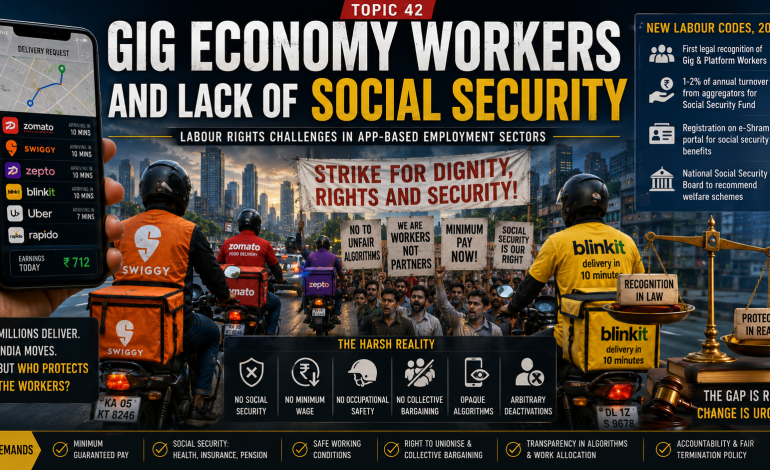
On November 21, 2025, the Government of India brought four new labor codes into force, consolidating 29 separate statutes into a unified legal framework . For the first time in Indian history, “gig workers” and “platform workers” received formal recognition in law . The Code on Social Security, 2020, which forms the centerpiece of this reform, defines these categories and lays the groundwork for extending statutory social security benefits to millions who had existed in a legal grey zone . Aggregators are required to contribute 1-2% of their annual turnover toward a Social Security Fund for these workers, and a National Social Security Board is being established to recommend suitable welfare programs .
Yet just weeks after the codes came into force, on December 31, 2025, lakhs of gig workers across India logged off and took to the streets. Their strike—the largest in the sector’s history—was not a celebration of newfound rights but a desperate protest against continued precarity . Union leaders articulated what the fine print of the codes had revealed: gig workers were being brought under social security provisions, but excluded from protections on wages, occupational safety, collective bargaining, and working conditions . A delivery executive in Bengaluru captured the sentiment: “They call us partners, but they give us nothing. When they implement new policies, they do not seek our consent. They threaten us: ‘If you want to work, work; otherwise leave the platform'” .
The gap between legal recognition and lived reality is stark. Four states—Rajasthan, Karnataka, Bihar, and Jharkhand—have passed dedicated gig worker laws, yet none has seen full implementation . The Karnataka Act, the most comprehensive in the country, mandates algorithmic transparency, 14-day notice before termination, and a welfare fee of 1-2% of each booking value . But aggregators continue to deactivate worker accounts without explanation; rating systems remain opaque; and the 10-minute delivery model prioritizes speed over safety, especially during peak and festive periods . A rider killed in a road accident while racing against an algorithm’s clock leaves behind dependents for whom the promised social security fund remains a legislative abstraction.
This article examines the labor rights challenges facing gig economy workers in India. It explores the new legal framework’s promises and limitations, the implementation gaps across states, the fundamental questions of worker classification, and whether India’s gig workers will ever receive the protections they have been promised.
WHAT – The gig economy refers to app-based employment arrangements where workers—delivery executives for platforms like Zomato, Swiggy, Zepto, and Blinkit; ride-hailing drivers for Uber and Ola; home service providers for Urban Company—operate outside traditional employer-employee relationships. These workers face challenges including lack of social security (health insurance, accident coverage, pension), absence of minimum wage guarantees, no collective bargaining rights, opaque algorithmic management, and arbitrary account deactivations. The debate centers on whether these workers should be classified as “employees” (with full labor protections) or remain “independent contractors” (with platform flexibility but no security).
WHO – Key actors include aggregator platforms (Zomato, Swiggy, Uber, Ola, Zepto, Blinkit, Rapido, Amazon, Urban Company) ; gig workers (estimated at 7.7 million in 2020-21, projected to reach 23.5 million by 2029-30) ; state governments (Karnataka, Rajasthan, Bihar, Jharkhand with enacted laws; Telangana with legislation in progress) ; the central government (through the Ministry of Labour and Employment and the e-Shram portal); trade unions (AICCTU and other bodies, which staged a general strike against the labor codes on February 12, 2026) ; and the judiciary (courts adjudicating classification disputes and safety regulations).
WHEN – The new labor codes, including the Code on Social Security, 2020, came into force on November 21, 2025 . The nationwide gig worker strike occurred on December 31, 2025 . The e-Shram aggregator module was launched on December 12, 2024, with 12 major aggregators onboarded . The Rajasthan High Court issued directives for gig worker registration, commercial license plates, and AI-based monitoring effective February 1, 2026 . The Karnataka and Rajasthan Acts were passed in 2024, with the Karnataka Act being the first comprehensive state-level legislation . Three nationwide special registration drives for platform workers were held in April, May, and August-September 2025 . A general strike against the labor codes was called by various workers’ groups for February 12, 2026 .
WHERE – Across India, with particular activity in Karnataka (Bengaluru), Rajasthan, Bihar, Jharkhand, Maharashtra (Mumbai), Delhi-NCR, and Telangana (Hyderabad). The e-Shram portal operates nationally, with states/UTs sensitized to leverage it for platform worker registration . The concentration of gig workers is highest in metropolitan and Tier-1 cities, where platform-based delivery and ride-hailing services are most active.
WHY – The precarity of gig workers stems from multiple factors: the legal classification of workers as “independent contractors” or “partners” rather than employees, which exempts platforms from minimum wage, PF, ESI, and gratuity obligations ; algorithmic management systems that control work allocation, pricing, and performance assessment without transparency or appeal mechanisms ; the absence of collective bargaining rights under the Industrial Relations Code, 2020, which denies gig workers the power to negotiate with platforms ; the 10-minute delivery model, which prioritizes speed over safety and has led to increased accidents ; and the gap between legislative promises and implementation, where state laws exist on paper but have not been operationalized .
HOW – Through a complex web of central and state laws: the Code on Social Security, 2020, which establishes the legal definitions and the Social Security Fund financed by aggregator contributions (1-2% of annual turnover, capped at 5% of payments to workers) ; the Karnataka Platform-Based Gig Workers (Social Security and Welfare) Act, 2024, which imposes welfare fees on booking value, algorithmic transparency requirements, and 14-day notice before termination ; the Rajasthan Platform-Based Gig Workers (Registration and Welfare) Act, which mandates quarterly data sharing and establishes a Welfare Board ; the e-Shram portal, where workers register with Universal Account Numbers (UAN) to access benefits ; and the proposed National Social Security Board, which will recommend schemes for life and disability cover, accident insurance, health and maternity benefits, and old age protection .
SECTION 1: WHO ARE GIG AND PLATFORM WORKERS? — DEFINITIONS AND SCALE
The gig economy in India has grown exponentially, driven by fast, round-the-clock delivery models adopted by platforms such as Swiggy, Zomato, Zepto, and Blinkit . Yet until November 2025, these workers had no formal legal recognition.
The Code on Social Security, 2020, now in force, provides the first statutory definitions:
-
Gig Worker: A person who performs work or participates in work arrangements and earns from such activities outside of a traditional employer-employee relationship .
-
Platform Worker: A gig worker who accesses other organizations or individuals through an online platform and provides services or solves specific problems in exchange for payment .
The distinction matters. A freelance electrician hired through word-of-mouth is a gig worker but not a platform worker. A delivery executive working through Zomato or Swiggy is both a gig worker and a platform worker. A ride-hailing driver on Uber or Ola falls into the same dual category .
Critically, the Code defines “aggregator” as a digital intermediary or marketplace that connects buyers or users of a service with sellers or service providers . This definition covers Uber, Ola, Zomato, Swiggy, Zepto, Blinkit, Urban Company, Rapido, Amazon, and Porter—all of which have now been onboarded onto the e-Shram portal .
The Scale of the Workforce
According to NITI Aayog’s report “India’s Booming Gig and Platform Economy” (June 2022), the number of gig and platform workers in India was 7.7 million in 2020-21. This figure is expected to rise to 23.5 million by 2029-30 . As of January 2026, 12 major aggregators have been onboarded onto the e-Shram portal, including Zomato, Blinkit, Uber, Ola, Swiggy, Rapido, Zepto, and Porter .
These workers are not a homogeneous group. They include full-time delivery executives who rely on platform income as their sole livelihood, part-time workers supplementing other income, and “gig-plus” workers who toggle between multiple platforms to maximize earnings. However, they share a common condition: the absence of the protections that formal employment affords.
SECTION 2: THE NEW LEGAL FRAMEWORK — PROMISES AND LIMITATIONS
The Code on Social Security, 2020, effective November 21, 2025, represents a landmark shift in India’s labor law architecture . For the first time, it creates a legal foundation for extending social security protections to non-traditional workers.
The Aggregator Contribution Obligation
The Code empowers the government to require aggregators to contribute between 1% and 2% of their annual turnover toward a Social Security Fund for gig and platform workers. These contributions are capped at 5% of the total amount payable to such workers .
Aggregators that fail to make timely contributions may be required to pay interest on unpaid amounts. However, the Code also allows the central government to exempt certain aggregators or classes of aggregators from contribution requirements .
The Fund is intended to finance schemes covering life and disability insurance, health and maternity benefits, old-age protection, and provident fund equivalents . The National Social Security Board, once established, will recommend suitable programs .
The e-Shram Portal
Workers must register with the government to receive benefits under any social security program. The e-Shram portal, launched on August 26, 2021, creates a National Database of Unorganised Workers (NDUW) including platform workers . The aggregator module was launched on December 12, 2024, to streamline the onboarding process .
Three nationwide special registration drives were held during April, May, and August-September 2025 in collaboration with states and Union Territories . The portal provides workers with a Universal Account Number (UAN) on a self-declaration basis—a portable identifier that can theoretically track workers across platforms and states.
The Critical Exclusions
Despite these advances, the limitations of the new framework are substantial. As the Oxford Human Rights Hub analysis notes, although the Social Security Code extends limited health and financial protections, “it only provides partial protection as the regulation of everyday working conditions, including reasonable working hours, mandatory health checks, and preventive safety standards fall under the Occupational Safety, Health and Working Conditions Code, 2020, from which the gig workers are excluded” .
This exclusion has constitutional implications. Article 7(a)(ii) of the International Covenant on Economic, Social and Cultural Rights (ratified by India in 1979) obligates states to guarantee just and favorable working conditions ensuring a decent living for workers and their families, without limiting its protection to any specific class of workers .
Furthermore, the exclusion of gig workers from the Industrial Relations Code, 2020 denies them collective bargaining rights. This “furthers the power imbalance and undermines the freedom of association guaranteed under Article 19(1)(c)” of the Constitution .
The All India Central Council of Trade Unions (AICCTU), in its report “Debunking Modi’s Lies on Labour Codes,” made a similar critique: “In fact, gig and platform workers are not insured under ESI, and instead, the only benefit gig and platform workers receive is the right to be registered. No social security provisions are promised to them as a right. Instead, all the codes do is promise to roll out schemes with benefits without explicating the content of the benefits or the timeline for their rollout” .
SECTION 3: STATE-LEVEL LEGISLATION — PROGRESS AND STALLING
Four states—Karnataka, Rajasthan, Bihar, and Jharkhand—have passed dedicated gig worker laws, while Telangana has similar legislation in the works . However, a closer look reveals a familiar pattern: legislation on paper, not in practice.
Karnataka: The Most Comprehensive Framework
Karnataka enacted the Platform-Based Gig Workers (Social Security and Welfare) Act in 2024, making it India’s first comprehensive state-level legislation specifically addressing gig worker rights .
Key provisions include:
-
Mandatory Registration: All aggregators must register with the state government within 60 days of the Act’s commencement. Gig workers must be registered on a state database with unique identification numbers .
-
Welfare Board: A board comprising government representatives, aggregator nominees, gig worker representatives, and independent experts oversees implementation .
-
Social Security Fund: Financed through a “welfare fee” of 1-2% of each booking value—a key distinction from the central Code’s turnover-based contribution .
-
Algorithmic Transparency: Aggregators must disclose the basis on which work is allocated, pricing is determined, and performance is assessed—a path-breaking provision in Indian labor law .
-
Data Access: Gig workers have the right to access their personal data held by the platform .
-
Termination Protections: Aggregators cannot terminate or deactivate a gig worker without providing reasons and a 14-day notice .
-
Grievance Redressal: A mandatory mechanism with defined timelines, with an appellate authority above it .
The Karnataka Act goes significantly beyond the Social Security Code’s framework. It is the most detailed gig worker legislation in India and serves as a template for other states .
Rajasthan: Enacted but Not Implemented
Rajasthan passed the Platform Based Gig Workers (Registration and Welfare) Act on July 24, 2023, months before the Assembly polls . The law was passed under the Ashok Gehlot-led Congress government. It mandates registration of gig workers, provides for a designated welfare board with one-third women members, levies a fee on aggregators for a welfare fund, and imposes penalties of up to Rs 5 lakh for a first offence and up to Rs 50 lakh for subsequent violations .
However, since the BJP government under Bhajan Lal Sharma came to power in November 2023, the law has been in cold storage .
“When we heard about this law, we welcomed it as a good solution to the problems,” Sanjay Gaba, president of the All India Gig and Platform Workers, told The Indian Express, accusing the BJP government of stalling .
Former Chief Minister Gehlot called on the Rajasthan government to implement the law, accusing it of dragging its feet. When contacted, Rajasthan’s Minister of Law and Legal Affairs Jogaram Patel said his government “will implement the law soon,” but refused to elaborate .
The High Court’s Intervention
In a significant development, the Rajasthan High Court issued a landmark directive imposing new regulatory requirements on gig workers . The directive requires:
-
Mandatory Registration: All gig workers must register with the State Transport Department and the Director General (Cyber) starting February 1, 2026 .
-
Identification Norms: Workers must wear a company-issued uniform, carry an official ID badge, and display a QR code for verification while on duty .
-
Commercial License Plates: Vehicles must transition to commercial plates by March 1, 2026 .
-
Police Verification: Aggregators must conduct mandatory police verification and full background checks before onboarding workers .
-
AI-Based Monitoring: Companies must implement AI-based systems to track driver or delivery behavior in real time, with quarterly data-sharing with state cyber cells .
-
Women’s Participation: At least 15% of the active gig workforce must be women within six months, rising to 25% in two to three years .
These directives focus primarily on safety, accountability, and women’s inclusion rather than social security benefits. They represent a different regulatory approach—one centered on public safety concerns rather than worker welfare.
SECTION 4: THE CLASSIFICATION QUESTION — EMPLOYEE OR INDEPENDENT CONTRACTOR?
The most litigated question in gig economy labor law globally is worker classification. Are gig workers “employees” entitled to the full suite of labor protections, or are they “independent contractors” with flexibility but no security? Indian courts have historically applied multiple tests to determine employment relationships .
The Legal Tests
The dominant test remains the “control test” articulated by the Supreme Court in Dhrangadhra Chemical Works Ltd v State of Saurashtra (1957): the key question is whether the employer has the right to control not just what work is done but how it is done .
The “integration test” from Silver Jubilee Tailoring House v Chief Inspector of Shops (1973) asks: is the worker integrated into the employer’s business, or are they in business on their own account?
The “economic reality test” examines the degree of economic dependence on a single engager .
Why Gig Platforms Defy Easy Classification
For gig platforms, the classification challenge is acute. Factors arguing for employment status: platforms exercise significant control through algorithmic assignment, pricing, rating systems, and deactivation policies. Factors arguing for independent contractor status: workers typically set their own hours, use their own equipment, and can work for multiple platforms simultaneously .
The Consequences of Misclassification
The consequences of misclassification are severe: retrospective PF and ESI contributions with interest and penalties (often 7-10 years), gratuity liability for all qualifying workers, applicability of minimum wage and bonus laws, coverage under Shops and Establishments Acts, and potential prosecution under multiple statutes .
Recent trends in Indian courts show increasing willingness to look beyond contract labels to economic substance. A single adverse ruling can retrospectively create employer obligations for PF, ESI, gratuity, and bonus .
Global Precedents
India can draw lessons from jurisdictions like the United Kingdom, where the Supreme Court in Uber BV v Aslam (2021) held that Uber drivers are “workers” (a UK-specific intermediate category) entitled to minimum wage, paid holidays, and pension contributions . The ruling emphasized substance over contractual form, finding that Uber’s control over pricing, terms, and driver behaviour was incompatible with genuine self-employment .
The European Union’s Platform Workers Directive (2024) establishes a rebuttable presumption of employment for platform workers, meaning platforms must prove that workers are genuinely self-employed rather than workers proving they are employees .
India’s approach under the Social Security Code takes a middle path: it does not create an employment relationship but mandates social security contributions from aggregators, preserving platform flexibility while extending a safety net. However, the Karnataka Act moves closer to the EU model by imposing operational obligations that mirror employment-like protections without formally creating employment status .
SECTION 5: THE WORKER PROTEST — DECEMBER 31, 2025
The nationwide strike on December 31, 2025, was the largest mobilization in the gig sector’s history. Lakhs of gig workers across India logged off to press for social security benefits, better wages, and, most importantly, legislation for stronger protection .
The Catalysts
The strike came just weeks after the labor codes came into force. Workers quickly realized that while the codes granted them formal recognition, the substantive protections they needed—minimum wage guarantees, occupational safety coverage, collective bargaining rights—remained absent .
Worker Voices
A coordinator with the Gig and Platform Service Workers Union articulated the grievances: “Companies block our IDs randomly without any reason. Ratings are also not clear, and there is also no security. They are calling us partners but not giving anything. When they implement new policies, they do not seek workers’ consent. They threaten us saying, ‘if you want to work then work; otherwise go out from the platform'” .
Platform Response
The day after the strike, the CEO of one platform commended police intervention to help the platform meet demand . The backdrop, as The Hindu editorial noted, was unmissable: the Labour Ministry had published draft rules to operationalize the refreshed labor codes for public consultation. According to the rules, workers would be inducted into the new framework only on social security, not on wages or working conditions—rendering the strike more urgent .
The General Strike of February 12, 2026
The discontent did not dissipate. On February 12, 2026, various workers’ groups, including the AICCTU, staged a general strike against the labor codes . Former Supreme Court judge Justice V Gopala Gowda spoke at a Worker Convention in Bengaluru, stating: “Forget equality; these labour codes have been implemented to turn workers into pawns without providing minimum wages, job security, or social security. If these codes are to be withdrawn, the working class must prepare for a struggle similar to the farmers’ protest against the black farm laws at the Delhi borders” .
SECTION 6: THE SAFETY CRISIS — 10-MINUTE DELIVERY AND OCCUPATIONAL RISKS
The 10-minute delivery model, pioneered by platforms like Zepto and Blinkit and now adopted by others, has intensified safety risks for gig workers. The promise of ultra-fast delivery—groceries at your doorstep in ten minutes—is achieved by pressuring delivery executives to ride at high speeds, skip traffic norms, and work through hazardous conditions.
Constitutional Dimensions
In Bandhua Mukti Morcha v. UOI and Consumer Education & Research Centre v. Union Of India, the Supreme Court affirmed that workplace safety is integral to the right to life with dignity under Article 21, read with Article 42 and the Preamble’s commitment to social and economic justice. “The continued exclusion of gig workers from labour protections reflects not merely a policy gap, but raises constitutional rights alarms,” the Oxford Human Rights Hub analysis notes .
The Exclusion from OSH Code
The Occupational Safety, Health and Working Conditions Code, 2020, which would provide preventive safety standards, mandatory health checks, and regulation of working hours, explicitly excludes gig workers . This exclusion is inconsistent with India’s obligations under the International Covenant on Economic, Social and Cultural Rights, which obligates states to guarantee just and favorable working conditions without limiting its protection to any specific class of workers .
Recommendations for Safety
The Oxford analysis recommends that platforms must bear responsibility for worker safety through measures such as certified protective gear like helmets, accident insurance, and compensation for vehicle damage. Platforms could also deploy real-time risk alerts to reroute deliveries away from high-risk zones, reducing preventable injuries. Failures should attract penalties akin to those under Chapter XII of the OSH Code .
SECTION 7: THE DRAFT RULES — ELIGIBILITY THRESHOLDS AND ACCESS BARRIERS
The draft Rules under the Social Security Code, published for public consultation in late 2025, contain eligibility conditions that could exclude many workers from benefits.
The 90/120-Day Rule
Under the draft Rules, a worker must have been engaged for at least 90 days with an aggregator or 120 cumulative days across aggregators in the financial year . However, one calendar day can count as multiple days if a worker earns via multiple aggregators that day—a provision intended to help workers qualify faster .
Problems with the Threshold
The thresholds raise several concerns. As The Hindu editorial notes, “the windows could also penalise workers for care-giving work or those responding to a demand slump beyond their control.” The editorial argues that “the 90- and 120-day thresholds must include explicit protections for illness, maternity and demand collapses, and should not lapse because a worker had a bad quarter” .
What the Rules Should Specify
The editorial further argues that the Rules should specify what benefits exist, how disputes will be resolved, the minimum benefits the Social Security Fund will support, and a time-bound claims and appeals process not dependent on platforms’ goodwill. Finally, “aggregators should give every worker a periodic statement of jobs, hours logged, earnings and deductions, and workers must be able to contest irregular data” .
Without these changes, the editorial warns, “the new regime will leave the insecurity that produced the strikes structurally intact” .
SECTION 8: THE FUTURE — NATIONAL BOARD AND IMPLEMENTATION GAPS
Maharashtra Labour Minister Akash Fundkar informed the Legislative Assembly in February 2026 that the Centre has introduced a social security code for gig and platform workers with a provision to set up a national social security board for their welfare. The board, to be established soon, will provide healthcare, insurance, and family welfare benefits to such workers .
Significantly, Fundkar stated that “when the national social security board is established, the State-specific laws made in Rajasthan and Karnataka will lapse” . This statement—if accurate—suggests that the central government intends to create a unified national framework that supersedes state legislation. However, the constitutional validity of this position is unclear, given that labor is a concurrent subject and states have enacted their own laws.
Implementation Timeline
The targeted implementation deadline for aggregator compliance with the Social Security Code is April 1, 2026 . However, as of early 2026, many provisions remain unimplemented. The National Social Security Board has not yet been established. The specific schemes to be financed by the Social Security Fund have not been notified. The registration of workers on the e-Shram portal, while ongoing, has not reached the scale required.
The Gap Between Promise and Reality
The legal architecture is now comprehensively in place. As the AMLEGALS analysis notes, the statutory framework “mandates aggregators to contribute to the annual turnover to a dedicated Social Security Fund, requires worker registration on the e-Shram portal with portable benefits, and extends formal recognition to gig and platform workers for the first time” .
However, “the gap between legislative intent and lived experience remains critical. The efficacy will hinge on swift administrative implementation of the Social Security Fund and e-Shram integration, resolution of unresolved issues surrounding a 90-day eligibility threshold, contribution computation methodology, and the unsettled question of worker classification (employee vs. independent contractor), and a decisive shift by platforms from compliance avoidance to proactive engagement” .
SECTION 9: COMPARATIVE PERSPECTIVE
| Country | Framework | Worker Status | Benefits Provided |
|---|---|---|---|
| India (Central) | Social Security Code, 2020 | Gig/platform worker (separate from employee) | Social security contributions from aggregators (1-2% of turnover); no minimum wage, OSH, or collective bargaining |
| India (Karnataka) | Platform-Based Gig Workers Act, 2024 | Gig/platform worker | Welfare fee on booking value; algorithmic transparency; termination notice; data access |
| United Kingdom | Uber BV v Aslam (2021) | “Worker” (intermediate category) | Minimum wage, paid holidays, pension contributions |
| European Union | Platform Workers Directive, 2024 | Rebuttable presumption of employment | Full employment protections unless platform proves otherwise |
| United States (California) | AB5 (2019) | Employee (ABC test) | Minimum wage, overtime, workers’ compensation, unemployment insurance |
| Australia | Deliveroo Australia Pty Ltd v Diego Franco (2021) | Proposed minimum wage | A$31.30 per hour for food delivery workers + accident insurance |
India’s middle path—recognizing gig workers as a distinct category rather than employees, while mandating social security contributions from aggregators—preserves platform flexibility but leaves significant gaps in protection. The Karnataka Act’s provisions on algorithmic transparency and termination notice represent a significant advance, but their impact depends on enforcement .
SECTION 10: THE CENTRAL QUESTION — RECOGNITION WITHOUT PROTECTION?
The politics of gig worker regulation in India reflects a fundamental tension: the state has recognized gig workers in law, but the substantive protections they need remain incomplete.
The Optimistic View
From one perspective, the new labor codes represent a historic advance. For the first time, gig workers have legal status. Aggregators must contribute to a Social Security Fund. Workers can register on the e-Shram portal and receive a Universal Account Number. The Karnataka Act provides algorithmic transparency and termination protections. The trajectory, this view holds, is toward progressively stronger protections.
The Pessimistic View
From another perspective, the codes are a calculated half-measure. Gig workers remain excluded from minimum wage guarantees, occupational safety coverage, and collective bargaining rights. The Social Security Fund is not yet operational. The 90/120-day eligibility threshold could exclude many workers. State laws like Rajasthan’s remain unimplemented. The central government’s statement that state laws will lapse when the national board is established suggests an intention to centralize control without necessarily expanding protections.
The Unanswered Question
The central question of this topic remains unresolved: Will India’s gig workers ever receive the protections they have been promised?
The answer depends on several variables. Will the National Social Security Board be established expeditiously? Will the Social Security Fund be adequately capitalized? Will the eligibility thresholds be redesigned to include protections for illness, maternity, and demand collapses? Will workers gain collective bargaining rights? Will courts classify gig workers as employees, triggering full labor protections?
And most fundamentally: Will aggregators shift from compliance avoidance to proactive engagement? Will they see worker welfare as a cost to be minimized or as an investment in a sustainable workforce?
The December 31, 2025, strike and the February 12, 2026, general strike demonstrate that workers are organizing and demanding change. The legal framework provides tools—however incomplete—for their advocates. The coming years will determine whether India’s gig economy becomes a model of inclusive growth or a cautionary tale of precarity disguised as flexibility.
As the AICCTU report concluded: “The working class must prepare for a struggle similar to the farmers’ protest” . The gig workers of India have been recognized. Whether they will be protected is the question that 23.5 million workers—and the platforms that depend on them—will answer in the years ahead.
SUMMARY TABLE: KEY PROVISIONS AND IMPLEMENTATION STATUS
| Provision | Legal Basis | Status as of Mid-2026 | Gap/Concern |
|---|---|---|---|
| Legal definition of gig/platform workers | Social Security Code, 2020 | In force since Nov 21, 2025 | Definitions exist but no employment status |
| Aggregator contribution (1-2% of turnover) | Social Security Code, 2020 | Awaiting notification of contribution rates | Collection mechanism not operational |
| Social Security Fund | Social Security Code, 2020 | Not yet established | No fund = no benefits |
| National Social Security Board | Social Security Code, 2020 | “To be established soon” (Maharashtra Minister, Feb 2026) | No board = no scheme recommendations |
| e-Shram registration | Ministry of Labour initiative | 12 aggregators onboarded; registration drives held | Low registration among workers; no benefits tied to registration yet |
| Karnataka Act (booking value fee, algorithmic transparency, termination notice) | State legislation | In force but awaiting full rules | Implementation dependent on state capacity |
| Rajasthan Act | State legislation | Passed July 2023; not implemented | Stalled after change of government |
| Minimum wage coverage | Code on Wages, 2019 | Gig workers explicitly excluded | No wage floor |
| OSH coverage (working hours, safety standards) | OSH Code, 2020 | Gig workers explicitly excluded | No safety regulation |
| Collective bargaining rights | Industrial Relations Code, 2020 | Gig workers excluded | No union recognition or bargaining power |