
ECONOMIC GROWTH VS HOUSEHOLD FINANCIAL STRESS
ECONOMIC GROWTH VS HOUSEHOLD FINANCIAL STRESS The Disconnect Between GDP Growth and Everyday Living Standards In January 2026, an op-ed in Moneycontrol posed a question that captured the anxieties of
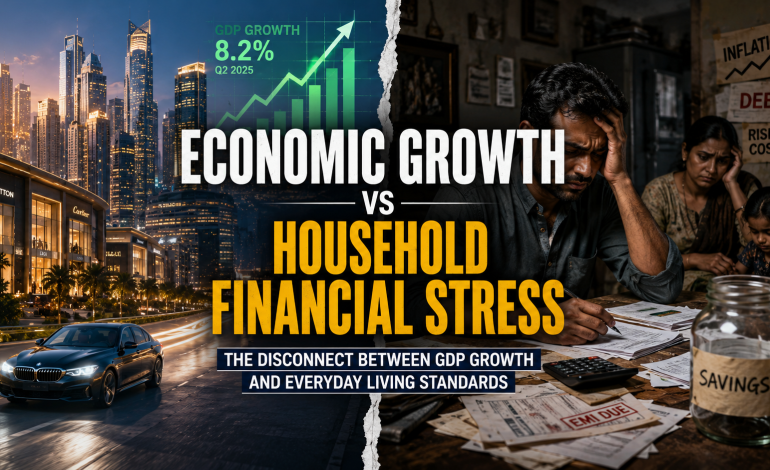

ECONOMIC GROWTH VS HOUSEHOLD FINANCIAL STRESS
The Disconnect Between GDP Growth and Everyday Living Standards
In January 2026, an op-ed in Moneycontrol posed a question that captured the anxieties of urban India: What is a ₹500 note really worth? The author described two encounters on the same day in the same city. In a fine-dining restaurant in Mumbai, ₹500 bought three artistic dumplings with microgreens and a delicately dolloped sauce. Later that evening, a signboard outside a Udipi joint read “Full Veg Thali – ₹500”: three curries, a big portion of rice, two sides, a tall glass of buttermilk. Same city. Same denomination. Radically different value .
This ₹500 paradox extends far beyond food. For two migrant workers returning home to Meerut from Mumbai, ₹500 barely covers a one-way Sleeper class ticket, forcing them to travel unreserved or delay family reunions. For an auto driver in Maharashtra, ₹500 sustains a week—twenty vada pavs at ₹20-25 each. For the upper middle class, ₹500 is a necessary luxury; for others, it is basic sustenance. The contrast reveals a deeper narrative: currency has become unmoored from any stable sense of value .
The macroeconomic numbers tell a triumphant story. Real GDP growth of 8.2 percent in the second quarter of 2025, projections remaining above 6.5 percent through 2026, infrastructure spending at record levels . India is the world’s fastest-growing major economy, on track to become the third-largest by 2028. Yet these macroeconomic triumphs belie two “rupee realities” playing out daily. Net household financial savings have fallen to roughly 5 percent of GDP—a multi-decade low. Household debt has climbed to approximately 43 percent of GDP, driven largely by unsecured personal loans and consumption-oriented credit .
Chartered Accountant Nitin Kaushik, whose social media analysis has sparked widespread debate, describes the situation as a “silent crisis” gripping India’s middle class in 2026. A salary of ₹1.5 lakh per month today, he argues, delivers roughly the same real purchasing power as ₹90,000 did a decade ago. Fixed deposits yielding 7 percent are losing ground to inflation of 10-12 percent on essential expenses like housing, education, and healthcare. The traditional math of saving no longer works .
This article examines the disconnect between India’s headline GDP growth and household financial stress. It explores the collapse of household savings, the rise of consumption-driven debt, the erosion of real wages, the inadequacy of traditional financial planning, and the fundamental question of whether India’s growth model is building national power at the expense of household resilience.
WHAT – The GDP-growth-versus-household-stress disconnect refers to the phenomenon where India’s economy continues to expand at impressive rates (6.5-8.2 percent real GDP growth) while middle-class and lower-income households experience stagnant real incomes, rising debt burdens, shrinking savings buffers, and increasing financial precarity. The disconnect is measured through indicators like net household financial savings (falling to 5.2 percent of GDP), household debt (crossing 41 percent of GDP), inflation-adjusted wage growth (near-zero over the past decade), and emergency savings adequacy (declining from three months to six-twelve months recommended).
WHO – Salaried middle-class households (earning ₹5-25 lakh annually) bear the brunt of this disconnect, facing rising EMIs, school fees, healthcare costs, and rent. Chartered Accountants and financial planners like Nitin Kaushik have become prominent voices warning of systemic risks. The Reserve Bank of India monitors household financial health through its periodic surveys. The Finance Ministry sets tax and expenditure policies that either alleviate or exacerbate household stress. Commercial banks and non-bank financial institutions extend the credit that households increasingly rely on to bridge income-expense gaps.
WHEN – The disconnect has been building over the past decade but has become acute since 2022-2023. The 2026 Budget (presented February 1, 2026) was expected to address household financial stress but delivered only incremental relief. Key data points: net household savings hit a 50-year low of 5 percent of GDP in FY24 before inching up slightly to 5.2 percent . Household debt crossed 41 percent of GDP in 2025 . The rupee depreciated from ₹60 per USD in 2014 to ₹90 per USD in 2026—a 50 percent erosion in a decade .
WHERE – Across India, though the disconnect is most pronounced in metropolitan cities (Mumbai, Delhi, Bengaluru, Chennai, Hyderabad, Pune, Ahmedabad) where housing costs consume 40-45 percent of post-tax income. However, rural India faces its own version of the crisis, with gold loans surging as families pledge assets to bridge cash shortfalls—borrowing for survival rather than investment . The urban-rural gap persists despite poverty reduction figures.
WHY – Multiple structural factors drive the disconnect: the capital-intensive nature of India’s growth model, which creates fewer jobs per unit of GDP growth; the shift from defined-benefit pensions to defined-contribution schemes, placing retirement risk on individuals; stagnant real wages as nominal increases are eroded by inflation in essential goods and services; the inadequacy of social safety nets, forcing households to self-insure against health and income shocks; and a tax-and-transfer system that does not adequately redistribute from capital to labor.
HOW – Through mechanisms such as: bracket creep (tax deductions not indexed to inflation, eroding their real value); the shift in household savings from bank deposits to equity markets, which starves banks of stable funding for long-term investment; the rise of unsecured personal loans and buy-now-pay-later schemes, which substitute credit for income growth; the erosion of emergency savings buffers (76 percent of salaried Indians without an emergency fund fall into high-interest debt traps during crises); and the “silent” erosion of purchasing power through gradual currency depreciation that no one notices until the cumulative effect becomes devastating.
SECTION 1: THE ₹500 PARADOX — TWO RUPEES REALITIES
The disconnect between macroeconomic statistics and household experience is perhaps best illustrated through the lens of a single currency denomination. As a Moneycontrol op-ed argued in January 2026, “what is ₹500 really worth?” The answer depends entirely on which India you inhabit .
The Value Divide in Practice
In 2014, a little over ₹60 bought one US dollar. In 2026, that figure is around ₹90—a 50 percent depreciation over twelve years. “What is silently insidious about this is that no one wakes up one fine morning and has a sudden realisation that their wallet is lighter. It’s gradual. Quiet. And incredibly surreptitious” .
Yet this “silent catastrophe” unfolds amid controlled domestic inflation (0.71 percent year-on-year as measured by official indices) and increased GDP per capita (PPP) from 1,212in1990to11,159 in 2024. “On paper, living standards have improved—yet every day feels costlier” .
The op-ed’s author describes the “classic dichotomy of two Indias: ₹500 is ‘necessary luxury’ in one, basic sustenance in another.” In metropolitan cities, upper middle-class to high-net-worth individuals pay millions for lifestyle club memberships with waiting periods spanning generations. “That remains a distant dream for lower socioeconomic strata” .
Beyond Anecdote: The Structural Divide
The ₹500 paradox is not merely an emotional dilemma—it is an overlooked policy issue. The author argues that gradual currency depreciation is “not an isolated economic event; it’s a societal phenomenon of living in two simultaneous rupee realities.” The fine-dining establishment prices imported ingredients in a weaker rupee and caters to a clientele with global lifestyle aspirations. The Udipi restaurant hasn’t recalibrated as yet: it thinks, acts, and prices local .
This divide manifests across every goods and services continuum. As the op-ed concludes, “Economic growth lifts consumption, yet low savings delay spending on homes and small businesses. Over the last decade, 171 million people escaped poverty, alongside multidimensional poverty which dropped to 15.5 percent in 2022-23. Yet, the urban-rural gap persists. This is the ₹500 divide personified: luxury dumplings versus survival vada pavs; inequality starkly amplified despite macro wins” .
SECTION 2: THE SAVINGS CRISIS — WHEN THE SAFETY NET FRAYED
The most alarming indicator of household financial stress is not income stagnation but the collapse of the savings rate—the buffer that protects families from emergencies and funds long-term goals like retirement, children’s education, and home purchases.
The Numbers
Net household financial savings have fallen to roughly 5.2 percent of GDP—a slight improvement from a near 50-year low of 5 percent in FY24, but still far below historical levels. At the same time, household financial liabilities have hit a record 6.2 percent of GDP . A BW Businessworld analysis describes the situation starkly: “Household financial savings have fallen to about 5.3 percent of GDP, among the lowest levels in decades. Simultaneously, household debt has climbed to roughly 43 percent of GDP, driven largely by unsecured personal loans” .
The problem is not that households are not saving. Gross savings have risen. But net savings—what remains after accounting for borrowing—are lower. As the Economic Times reported, “the result is a thinner savings cushion, even as wealth creation is being partly driven by leverage” .
The Shift from Savings to Investment
Households are shifting from saving for a rainy day to leveraging for a sunny one. They are “trading umbrellas for magnifying glasses, hoping to catch the heat of the market” . Monthly inflows into Systematic Investment Plans (SIPs) now routinely exceed ₹30,000 crore—a figure often celebrated as evidence of a more financially literate, risk-aware India.
But this optimism masks a more brittle reality. “For the first time, the Indian household is defined less by the depth of its safety net than by the scale of its liabilities.” Debt is no longer dominated by asset-building mortgages. It is increasingly unsecured, short-term, and consumption-oriented. Buy-now-pay-later schemes, personal loans, and credit cards are reshaping household balance sheets. “India is not merely reallocating savings. It is replacing buffers with bets” .
The Banking Squeeze
This behavioural shift has immediate macroeconomic consequences. Banks are now competing directly with capital markets for household savings, and the markets are winning. With the credit-to-deposit ratio hovering above 80 percent, lenders are beginning to feel the strain of scarce, sticky funding .
Deposits matter because they finance patience. They allow banks to convert short-term savings into long-term capital for infrastructure, manufacturing, and housing. Equity markets, for all their glamour, cannot reliably perform this maturity transformation. “When deposit growth slows, banks must raise rates to attract funds, pushing up borrowing costs for MSMEs and corporates. At a moment when India is attempting to scale its manufacturing base and absorb global supply chains, this is an awkward constraint” .
SECTION 3: THE DEBT TRAP — WHEN BORROWING BECOMES SURVIVAL
The collapse of savings has been accompanied by a surge in household debt—but not the kind of debt that builds assets.
The Composition Problem
Household liabilities now exceed 41 percent of GDP. While this figure remains modest by OECD standards, “it is high for a country with limited social safety nets and volatile incomes” . More importantly, credit growth is no longer led by housing. It is being driven by unsecured personal loans and revolving credit. “This is consumption debt. It boosts demand today by pulling spending forward from tomorrow. Smartphones, weddings, and vacations lift GDP in the short term. They also leave households exposed” .
The BW Businessworld analysis warns that “as equated monthly instalments absorb a growing share of income, resilience thins. A mild slowdown in hiring or a bout of food inflation can quickly turn a spending spree into a wave of delinquencies. Digital underwriting has made credit frictionless. It has also made the economy more sensitive to shocks” .
Consumption Debt as a Warning Sign
The RBI has taken notice. Recent increases in risk weights on unsecured lending reflect rising concern. New co-lending rules effective from January 2026 require banks and non-bank lenders to retain a minimum share of every loan on their own books, aligning incentives more tightly. “A disproportionate share of new retail loan slippages originates in this segment” .
The deeper problem is structural. As the analysis notes, “India’s growth model increasingly treats households as shock absorbers. When incomes lag or public investment pauses, households borrow and spend to keep growth afloat. Such a model can work briefly. It is a fragile foundation for long-term development” .
The Rural Dimension
In rural India, the surge in gold loans—pledging family assets to bridge cash shortfalls—reflects borrowing for survival rather than investment. “Debt is disguising stagnation rather than enabling mobility” . When consumption is driven by credit limits rather than rising productivity, households are not getting ahead; they are falling behind more slowly.
SECTION 4: THE NOMINAL WAGE TRAP — WHEN ₹1.5 LAKH FEELS LIKE ₹90,000
Perhaps the most direct measure of the growth-stress disconnect is what has happened to real wages—purchasing power adjusted for inflation.
The Numbers That Matter
Chartered Accountant Nitin Kaushik, writing on social media in April 2026, described what he calls the “nominal wage trap”: a situation where incomes rise in absolute terms but fail to keep pace with the actual cost of living .
Take a typical salaried person. Their monthly pay might have jumped from around ₹90,000 in 2015 to ₹1.5 lakh today. On the surface, that’s a solid 66 percent hike. But zoom in on daily realities: rent, school fees, and insurance premiums have nearly doubled in many cases. “Real purchasing power, what income can actually buy, has barely improved for many families. This mismatch is quietly eroding financial stability. What appears to be progress is, in reality, stagnation” .
The Saving Math That No Longer Works
The math on savings hits even harder. Fixed deposits, the go-to for safety-conscious Indians, are yielding about 7 percent. Yet the actual inflation hitting middle-class budgets—from housing and education to healthcare—is running closer to 10-12 percent. “Every year your money sits idle, it loses ground,” Kaushik notes. “You’re not saving. You’re watching your capital slowly dissolve” .
India’s household savings rate has slipped to around 18 percent of GDP, its lowest level in years. The decline, experts suggest, is not due to reckless spending, but rising compulsions. In Tier-1 cities, essential costs—housing, education, insurance, and daily living—can consume up to 40-45 percent of post-tax income. “These are not discretionary expenses; they are unavoidable. As a result, the room for saving has narrowed significantly” .
The Two Forms of Taxation
Kaushik argues that the middle class is effectively taxed twice: once through official levies (income tax, GST) and again through inflation quietly eating away at savings. “In several developed economies, middle-class households benefit from some level of support, whether through subsidised healthcare, education, or more stable housing markets. In India, however, families often pay market-linked prices for most essential services. This creates a dual pressure: income is taxed upfront, and then further eroded by inflation over time” .
SECTION 5: THE EMERGENCY FUND CRISIS — THREE MONTHS IS NO LONGER ENOUGH
One of the most concrete indicators of household financial vulnerability is the adequacy of emergency savings. Here, the picture is particularly alarming.
The New Math of Survival
For years, financial advice in India focused on keeping at least three months of expenses saved as a safety net. That number no longer holds up. As CA Nitin Kaushik explained in March 2026, “The math of survival has changed. A decade ago, three months of savings was the gold standard. Today, with a 5% to 6% inflation crawl and a volatile job market, six months is the absolute floor.” For those with dependents—family or aging parents—”that number moves to twelve” .
The reason is simple but brutal: fixed expenses do not pause during difficult times. “A job loss or a medical emergency isn’t just a setback; in 2026, it is a mathematical trap. If your income stops, your rent, EMIs, and school fees don’t. Without a buffer, you aren’t just unemployed—you are insolvent” .
The Brutal Math of Inflation
Kaushik provides specific numbers: “While general inflation is around 5.4%, medical inflation in private Indian hospitals is hitting 14% annually.” This gap between overall inflation and healthcare costs is what makes emergencies particularly damaging. “If your monthly essential expenses—rent, groceries, and EMIs—are ₹30,000, a ₹1.8 lakh fund is no longer a ‘suggestion.’ It is the minimum survival buffer required to prevent a medical emergency from permanently derailing 10 years of compounding” .
The Cost of Doing Nothing
The consequences of inadequate emergency savings are severe and long-lasting. “The data is clear: 76% of salaried Indians without an emergency fund end up in a high-interest debt trap during a crisis.” The emergency fund, Kaushik emphasizes, “isn’t about growing wealth; it’s about making sure a bad month doesn’t turn into a bad decade” .
SECTION 6: THE SHIFTING SANCTUARY — FROM FIXED DEPOSITS TO EQUITY MARKETS
The traditional bedrock of India’s economy was the conservative middle-class saver. Households treated the bank fixed deposit as a financial sanctuary, valuing capital preservation over capital appreciation. This culture of caution supplied banks with a stable, low-cost pool of funds and quietly underwrote India’s industrial ascent .
The Erosion of the Sanctuary
In 2026, that sanctuary is being eroded. As a BW Businessworld analysis notes, “Indian households are shifting from saving for a rainy day to leveraging for a sunny one. They are trading umbrellas for magnifying glasses, hoping to catch the heat of the market” .
The numbers bear this out. Net household financial savings have fallen to roughly 5 percent of GDP, a multi-decade low. At the same time, enthusiasm for equities has reached a pitch rarely seen before. Monthly SIP inflows now routinely exceed ₹30,000 crore .
The Hidden Risk
This shift is not without risk. The analysis warns that “an equity boom may flatter household net worth on paper. It does little to fund highways, ports, or factories. An economy that starves its banks of deposits risks undermining its own investment pipeline” .
More importantly, the shift from deposits to equities does not address the underlying problem of inadequate savings. If households are not saving enough in absolute terms, moving those inadequate savings from one asset class to another does not build resilience. As the analysis concludes, “A low-savings economy cannot fund a high-investment future without importing vulnerability” .
SECTION 7: THE FISCAL GRIDLOCK — WHY THE GOVERNMENT CAN’T EASILY HELP
The government’s ability to alleviate household financial stress is constrained by its own fiscal challenges.
The Tax Revenue Shortfall
As a BusinessLine analysis documented in January 2026, tax collections have painted a concerning picture. Gross tax revenue grew only 3.3 percent year-on-year through November 2025, while net tax collections (after State devolution) declined 3.5 percent. This performance left the government far short of the full-year target of 11 percent growth, requiring an improbable 30 percent surge in the remaining months. “The implied tax elasticity stands at a dismal 0.38x against a budgeted 1.1x, signalling weak private sector momentum rather than the buoyant activity claimed in headline narratives” .
The Fiscal Deficit Squeeze
As a result, the fiscal deficit widened sharply. In April-November FY26, it reached 62.3 percent of the full-year Budget Estimate, about 10 percentage points higher than in the previous year. “This slippage stems primarily from revenue shortfalls, not spending excesses.” Meeting the deficit target may require expenditure cuts of ₹2.5 trillion in the final quarter, potentially slashing capital spending by up to 40 percent while interest costs rise (already consuming over 50 percent of tax revenue) .
The Policy Dilemma
The government is caught in a classic policy dilemma: “how to sustain growth momentum without sacrificing fiscal prudence, and how to stimulate demand without eroding hard-won credibility in global markets” . The 2026 Budget reflects this tension: tax slabs unchanged, the 80C limit frozen, modest compliance simplifications rather than substantive relief.
SECTION 8: THE REAL GROWTH PROJECTION — SLOWER NOMINAL GROWTH AHEAD
The 2026 Budget carries signals about the economic environment that households must navigate in the coming years. These signals are not encouraging for those hoping for rapid relief.
Slower Nominal Growth
The government has projected nominal GDP growth of 10 percent for FY27, up from around 8 percent in FY26. However, a large part of this increase comes from higher inflation expectations rather than a sharp rise in real economic growth. More importantly, even this 10 percent nominal growth is significantly lower than what India experienced in the years following the pandemic, when nominal GDP was expanding at comfortable double-digit rates above 12-13 percent .
“The slowdown in nominal growth is structural and has direct implications for personal finance planning.” Households often base their long-term financial goals—retirement, children’s education, wealth accumulation—on assumptions formed during high-growth years. “Those assumptions now need recalibration. Slower nominal GDP growth typically translates into more moderate investment returns and income growth over time” .
Mixed Signals on Interest Rates
Another important signal from the Budget comes through government borrowing. Gross borrowing for FY27 is projected at ₹17.2 trillion, higher than market expectations. This large supply of government bonds is likely to keep market interest rates firm in the near term. “For households, this creates a mixed environment. Loan rates, especially for home and business loans, may not fall sharply anytime soon. Borrowers should therefore be cautious about stretching EMIs too aggressively.” At the same time, savers benefit: “Bank deposits, small-savings schemes and other fixed-income options will remain attractive offering reasonable returns” .
The Need for Financial Recalibration
The Budget’s message, according to the analysis, is that “the economy is adjusting to slower nominal growth, lower inflation and tighter global conditions. Goal planning must now assume moderate income growth, reasonable—but not excessive—investment returns, and a greater role for disciplined saving.” The bottom line: “Sound personal finance is less about chasing high returns and more about consistency—saving regularly, avoiding excessive debt, and aligning investments with realistic long-term assumptions” .
SECTION 9: COMPARATIVE AND STRUCTURAL PERSPECTIVE
The Indian experience of growth without household financial security is not unique, but it has distinctive features.
Lessons from Brazil and China
The BW Businessworld analysis draws instructive parallels. Brazil offers a cautionary tale: “Easy consumer credit in the early 2010s fuelled growth and inclusion. When inflation rose and incomes stalled, delinquency surged and consumption collapsed, contributing to a prolonged slowdown.” China’s experience is different but equally instructive: “A sharp rise in household leverage tied to property inflated growth for years before becoming a drag as prices stagnated and balance sheets weakened” .
India’s debt levels are lower than both. Its institutional framework is stronger than Brazil’s was. “Yet the trajectory matters more than the starting point. Rapid shifts in household behaviour tend to overshoot before they stabilise” .
The Middle-Income Trap Risk
The BW Businessworld analysis also warns of a broader risk: India is increasingly resembling “the frail one” among major economies—growing larger while becoming structurally weaker. “Power is the capacity to absorb shocks, finance ambition, and shape outcomes beyond one’s borders. By that standard, India is growing larger while becoming structurally weaker, as savings, investment, productivity, and institutional credibility thin” .
The economy faces the danger of falling into the middle-income trap: “not that India will stop growing, but that it will grow in ways that do not compound power. Scale without resilience is exposure” .
SECTION 10: THE CENTRAL QUESTION — GROWTH FOR WHOM?
The disconnect between GDP growth and household financial stress reflects a fundamental tension in India’s development model.
The Growth-First Vision
From one perspective, the current situation is a necessary transition. India is moving from a low-income to a middle-income economy. Households are shifting from traditional savings to modern financial instruments. Credit is expanding, enabling consumption that drives growth. The stock market boom is creating wealth for millions of first-time investors. Over the long term, growth will lift all boats.
The government’s focus on capital expenditure (₹12.2 lakh crore in Budget 2026) reflects this vision: build infrastructure, attract investment, create jobs, and household incomes will follow.
The Distribution Vision
From another perspective, the current situation is a structural failure. Net household savings are at a 50-year low. Debt is rising faster than income. Real wages have stagnated for a decade. The bottom 50 percent’s share of national income has not budged. The growth that has occurred has been captured by the top, while the middle class has been squeezed.
The disconnect is not a transition—it is a design flaw. A growth model that treats households as shock absorbers, that relies on consumption debt rather than rising wages, that fails to provide basic social security—such a model is not sustainable.
The Unanswered Question
The central question of this topic remains unresolved: Can India achieve sustained economic growth without addressing household financial stress?
The data suggests that household financial resilience is not merely a social welfare issue—it is a macroeconomic necessity. A low-savings economy cannot fund a high-investment future. An economy where consumption is driven by credit rather than income is vulnerable to shocks. A middle class that cannot save for retirement, children’s education, or emergencies is not a stable foundation for long-term growth.
The 2026 Budget’s message—that households must recalibrate expectations to a slower-growth, moderate-return environment—may be realistic, but it is not reassuring. For millions of Indian households, the question is no longer whether they can get ahead, but whether they can avoid falling behind.
As the Moneycontrol op-ed concluded: “Economic growth lifts consumption, yet low savings delay spending on homes and small businesses… The solution lies in equitable policy design. We can redistribute the power of ₹500, in a way in which the rich businessmen gain demand; the downtrodden wield agency. The Budget is an opportunity to deliver tax relief, gig security and MSME lifelines, leaving no players unequipped. Growth serves all—no outliers” .
SUMMARY TABLE: KEY INDICATORS OF THE GROWTH-STRESS DISCONNECT
| Indicator | Value | Source/Year | Interpretation |
|---|---|---|---|
| Real GDP growth (Q2 2025) | 8.2% | Moneycontrol 2026 | Macroeconomic strength |
| Projected GDP growth (2026) | 6.5%+ | BW Businessworld 2026 | Continued expansion |
| Net household financial savings (as % of GDP) | 5.2% | Moneycontrol 2026 | Near 50-year low |
| Household financial liabilities (as % of GDP) | 6.2% | Moneycontrol 2026 | Record high |
| Household debt (as % of GDP) | 41-43% | BW Businessworld/Economic Times 2026 | Driven by unsecured loans |
| Monthly SIP inflows | ₹30,000+ crore | BW Businessworld 2026 | Shift from deposits to equity |
| Credit-deposit ratio | 80%+ | BW Businessworld 2026 | Banking system strain |
| Rupee depreciation (2014-2026) | ₹60 → ₹90 per USD | Moneycontrol 2026 | 50% erosion in a decade |
| Real wage growth (2015-2026) | Near-zero | CA Nitin Kaushik/Economic Times 2026 | Nominal increases eroded by inflation |
| Inflation on middle-class essentials (education, healthcare, housing) | 10-12% | CA Nitin Kaushik 2026 | Outpaces FD returns of 7% |
| Medical inflation in private hospitals | 14% annually | CA Nitin Kaushik 2026 | Major emergency risk |
| Salaried Indians without emergency fund who fall into debt trap | 76% | CA Nitin Kaushik 2026 | High vulnerability |
| Recommended emergency fund (2026 vs past) | 6-12 months vs 3 months | CA Nitin Kaushik 2026 | Rising precarity |
| Gross government borrowing (FY27) | ₹17.2 trillion | BW Businessworld 2026 | Keeps interest rates firm |