
HOUSEHOLD DEBT AND CONSUMPTION-BASED BORROWING
HOUSEHOLD DEBT AND CONSUMPTION-BASED BORROWING Risks Associated with Rising Personal Debt Levels In early 2026, the Reserve Bank of India released its latest Financial Stability Report with a warning that

- PublishedMay 23, 2026
HOUSEHOLD DEBT AND CONSUMPTION-BASED BORROWING
Risks Associated with Rising Personal Debt Levels
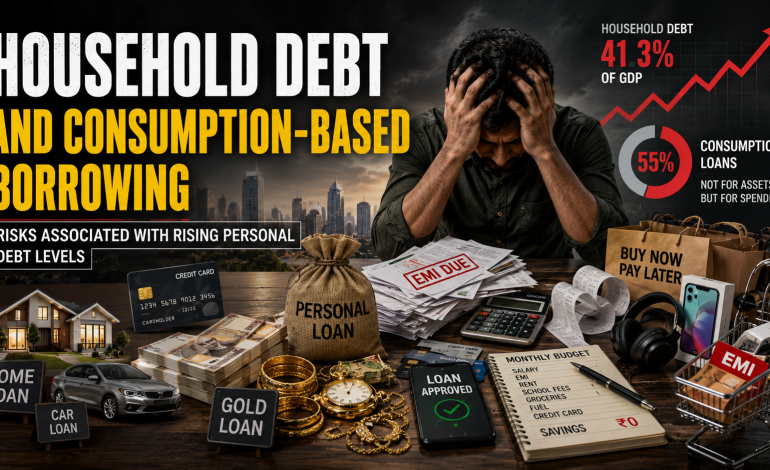
In early 2026, the Reserve Bank of India released its latest Financial Stability Report with a warning that cut through the usual economic optimism. Household debt in India had climbed to 41.3 percent of GDP as of March 2025—a sustained rise from its five-year average of around 38 percent . More concerning than the headline number was the composition of this debt: over half of all household loans were now going toward consumption rather than asset creation. Non-housing retail loans—credit card dues, personal loans, consumer durable financing—made up nearly 55 percent of total household debt .
This shift represents a fundamental change in how Indians borrow. A generation ago, taking a loan meant buying a home or starting a business. Today, EMI stands for everything from the latest smartphone to a week in Goa. Chartered Accountant Nitin Kaushik captured the precariousness of this new reality in a viral social media thread: “We are currently seeing household debt in India cross 41% of GDP, with half of those loans going toward consumption rather than assets. If you are starting a SIP without an emergency fund, you aren’t an ‘investor’; you are just one bad news cycle away from being a forced seller” .
The numbers are staggering. Household financial liabilities have climbed to 6.2 percent of GDP—a decade high—driven by rapid growth in home loans, personal credit, and credit card spending . Borrowing has expanded at a 44.6 percent compound annual growth rate in the post-pandemic period, far outpacing savings growth . Gold loans surged 50.4 percent year-on-year to ₹18.6 lakh crore, as families pledged family jewelry to bridge cash shortfalls. The Buy Now Pay Later market, offering instant credit for everyday purchases, has expanded globally to an estimated $560 billion in gross merchandise volume.
Yet the RBI and economists strike a cautious note: India’s household debt, while rising, remains relatively low compared to most emerging market peers. The real risk, they argue, is not the debt level itself but weak underwriting standards and unchecked growth in unsecured lending. As former SBI Chairman Dinesh Khara put it, “There should not be reckless lending by any institution—be it NBFCs, banks, or digital lenders” .
This article examines the anatomy of India’s household debt surge, the drivers of consumption-based borrowing, the risks to financial stability and household welfare, and the fundamental question of whether India is building resilience or accumulating vulnerability.
WHAT – Household debt refers to the total liabilities of individuals and families, including home loans, personal loans, credit card debt, vehicle loans, gold loans, and consumer durable financing. Consumption-based borrowing specifically refers to credit used for spending on goods and services—smartphones, appliances, travel, dining—rather than for asset creation (homes, investments, education) or productive purposes (business, agriculture). The risk lies in the fact that consumption debt does not generate future income to service itself.
WHO – The Reserve Bank of India monitors household debt through its Financial Stability Report and has raised concerns about consumption-led borrowing . Commercial banks, NBFCs, and digital lending platforms (including Buy Now Pay Later providers) extend this credit. Households across income brackets—from salaried middle-class families to rural borrowers pledging gold—are the debtors. Financial experts like former SBI Chairman Dinesh Khara and CA Nitin Kaushik have warned of risks from reckless lending and inadequate emergency savings . Credit information bureaus like CRIF High Mark track lending trends.
WHEN – The surge in household debt has been building over the past decade but accelerated sharply in the post-pandemic period (2022-2026). Key data points: household debt at 41.3% of GDP as of March 2025 ; net household financial savings at a near 50-year low of 5.2% of GDP in FY24 ; borrowing growing at 44.6% CAGR post-pandemic ; gold loans up 50.4% year-on-year to March 2026 . The RBI’s risk weight tightening on unsecured loans occurred in 2024-2025, and new co-lending rules took effect in January 2026.
WHERE – Across India, with metropolitan cities (Mumbai, Delhi, Bengaluru, Chennai, Hyderabad, Pune, Ahmedabad) seeing the highest concentration of personal loans and credit card debt. Gold loans are surging across both rural and urban India, with the segment growing 50.4% year-on-year nationally . Rural households are increasingly pledging jewelry for consumption needs rather than agricultural investment.
WHY – Multiple factors drive consumption-based borrowing: stagnant real wages, forcing households to borrow to maintain living standards; easy access to credit through digital platforms and pre-approved loan offers; the rise of “buy now, pay later” services that normalize debt for everyday purchases; social pressure and lifestyle aspirations in an increasingly consumption-oriented society; the inadequacy of social safety nets, which paradoxically both drives precautionary saving AND stress-induced borrowing; and the shift from asset-building mortgages to unsecured personal loans as the dominant form of household credit growth.
HOW – Through multiple channels: personal loans from banks and NBFCs (growing at 12.9% year-on-year), credit cards (25.2% CAGR over the past decade), gold loans (50.4% surge), consumer durable loans (20.8% growth), and BNPL services that embed micro-loans into e-commerce checkout processes. Digital lending platforms have made credit frictionless, often requiring only a few clicks and basic KYC. The result is a household sector increasingly defined by its liabilities rather than its assets.
SECTION 1: THE NUMBERS — HOW MUCH DEBT AND WHAT KIND
The scale of India’s household debt surge is best understood through multiple data points that paint a consistent picture of rising liabilities.
The Top-Line Figure
According to the RBI’s Financial Stability Report released in December 2025, household debt in India stood at 41.3 percent of GDP as of March 2025 . This represents a sustained rise from the five-year average of around 38 percent . While this figure remains relatively low compared to most emerging market peers, the trajectory—upward and accelerating—is what concerns economists.
The Business Standard, citing a white paper by Client Associates, reported that household financial liabilities have climbed to 6.2 percent of GDP—a decade high . To put this in perspective, the pre-pandemic average was around 4.1 percent. Net financial savings have correspondingly fallen to 5.2 percent of GDP from 7.7 percent earlier .
The Consumption Debt Share
More important than the debt level is what the debt is being used for. The RBI’s Financial Stability Report noted that non-housing retail loans—personal loans, credit card dues, consumer durable financing—made up nearly 55 percent of total household debt as of March 2025 .
This finding is reinforced by the Moneylife analysis of the same report: “Non-housing retail loans, which includes personal loans such as credit card dues, consumer durable financing and unsecured credit, now accounts for 25.7% of households’ disposable income as of March 2024. This segment has consistently outpaced housing, agriculture and business loans in terms of growth over recent years” .
In contrast, housing loans comprised only 29 percent of overall household debt by March 2025 . A generation ago, the proportions were reversed.
The Growth Rates
The Client Associates white paper, cited by Business Standard, found that household borrowing has grown at a striking 44.6 percent compound annual growth rate in the post-pandemic period, significantly outpacing the growth in savings .
Across retail lending categories, the growth has been broad-based:
-
Credit cards showed the strongest growth at 25.2 percent CAGR over the past decade
-
Other personal loans followed at 20.1 percent CAGR
-
Personal and retail lending overall expanded at a 17.6 percent CAGR from FY2016 to FY2025—nearly twice the rate of nominal GDP expansion
The CRIF High Mark report for FY26, cited by ET BFSI, shows continued momentum: India’s retail lending portfolio expanded to ₹170.2 lakh crore as of March 2026, growing 16.6 percent year-on-year . Consumption loans rose 15.3 percent to ₹118.6 lakh crore.
The Gold Loan Surge
One of the most striking trends is the explosion in gold loans. According to CRIF High Mark, gold loans surged 50.4 percent year-on-year to ₹18.6 lakh crore as of March 2026 . This segment accounted for nearly one-third of incremental secured retail lending, a sharp increase compared with the previous year.
The surge in gold loans is particularly significant because it indicates borrowing by households that may lack formal credit histories or steady incomes. Pledging family gold—often the last remaining asset for many families—to fund consumption represents a different order of financial vulnerability than taking a home loan.
Per Capita Debt
The average Indian borrower now carries significantly more debt than just a few years ago. RBI data cited by Moneylife shows that per capita debt of individual borrowers has increased from ₹3.9 lakh in March 2023 to ₹4.8 lakh by March 2025 . Much of this growth is attributed to higher-rated borrowers, but the trend is broad-based.
SECTION 2: THE CONSUMPTION DEBT EXPLOSION — BNPL, PERSONAL LOANS, AND CREDIT CARDS
Understanding the surge in consumption-based borrowing requires examining the specific instruments driving it.
The BNPL Revolution
Buy Now Pay Later services have fundamentally changed how Indians pay for everyday purchases. As a 2026 guide to BNPL in India explains, the definition has expanded significantly: “With the integration of Credit on UPI, BNPL has moved out of the ‘checkout button’ on e-commerce sites and into the consumer’s digital wallet. It now functions as a revolving credit facility that provides instant liquidity without the traditional hurdles of a credit card application” .
The global BNPL market is estimated at approximately 560billioningrossmerchandisevolumein2025,withproviderrevenueestimatedat560billioningrossmerchandisevolumein2025,withproviderrevenueestimatedat44.89 billion . Global BNPL users reached approximately 380 million in 2024 and are projected to grow toward 670 million by 2028 .
The appeal is obvious: interest-free credit for small purchases, no credit card required, instant approval at checkout. But the risks are less visible. According to global data, while BNPL default rates (charge-offs) remain relatively low at around 1.8 to 2 percent, approximately 34 to 41 percent of users report making at least one late payment . This gap between delinquency and default—the number of people who miss payments but eventually pay—suggests widespread cash flow stress among users.
Credit Card Growth
Credit cards have shown the strongest growth among all retail lending categories, at 25.2 percent CAGR over the past decade . This reflects both the formalization of credit—as more Indians build credit histories—and the normalization of credit card debt for everyday expenses.
The risk with credit cards is the interest rate. While credit cards offer an interest-free period (typically 45-50 days), balances carried forward attract annual percentage rates of 30-45 percent—levels that can quickly turn manageable debt into a spiral.
Unsecured Personal Loans
Personal loans grew at 12.9 percent year-on-year according to CRIF High Mark data . These are typically larger amounts than BNPL transactions (₹50,000 to ₹25 lakh) with longer tenors (12-60 months) and interest rates of 11 to 24 percent APR .
The concern with personal loans is twofold: they are unsecured (no collateral, so lenders have less incentive to assess borrower repayment capacity carefully), and they are often used for discretionary consumption (weddings, travel, electronics) rather than income-generating investments.
Consumer Durable Loans
Loans for consumer durables—refrigerators, washing machines, televisions, smartphones—grew 20.8 percent year-on-year . These loans are often bundled at point of sale and may carry attractive “zero percent EMI” offers. However, zero percent financing typically works by shifting costs to the product price or adding processing fees. The borrower pays either way.
SECTION 3: THE DEBT-SAVINGS DIVERGENCE — WHY NET SAVINGS ARE FALLING
The rise in household debt is not occurring in isolation. It is accompanied by a parallel decline in net household financial savings—the buffer that protects families from emergencies and finances long-term goals.
The Savings Collapse
Net household financial savings fell to about 5.2 percent of GDP in FY2024, down from nearly 7.7 percent in the pre-pandemic years . The Client Associates white paper notes that “while gross financial savings remain broadly stable, net financial savings have declined as household liabilities increased sharply” .
In other words, households are still saving—gross savings have not collapsed—but an increasing share of those savings is being consumed by debt servicing. The money that would have gone into bank deposits, PPF, or mutual funds is instead going toward EMI payments.
The Relationship Between Debt and Savings
The divergence is stark when plotted on a timeline. Household borrowing has grown at a 44.6 percent CAGR in the post-pandemic period, far outpacing the growth in savings . The result is a household sector that is adding liabilities faster than it is adding assets.
CA Nitin Kaushik captured the practical implication: “If you are starting a SIP without an emergency fund, you aren’t an ‘investor’; you are just one bad news cycle away from being a forced seller” . Without a savings buffer, even disciplined investing becomes vulnerable to shocks. A job loss, a medical emergency, or an unexpected expense forces the sale of assets—often at the worst possible time.
The Recovery Signal
There is a note of cautious optimism. The Client Associates white paper notes that net household financial savings have recovered to 7.6 percent of GDP in FY25 from 5.2 percent in FY24 . This suggests that the worst of the savings collapse may have passed. However, even this recovery level remains below pre-pandemic norms.
SECTION 4: THE “FOUNDATION OF SAND” — WHY HOUSEHOLDS ARE VULNERABLE
The combination of rising debt and falling savings creates a vulnerability that financial experts describe in stark terms.
The Emergency Fund Gap
CA Nitin Kaushik’s viral analysis focused on the inadequacy of emergency savings for most Indian households. “The math for 2026 is brutal: while general inflation is around 5.4%, medical inflation in private Indian hospitals is hitting 14% annually” .
He provides a concrete calculation: “If your monthly essential expenses—rent, groceries, and EMIs—are ₹30,000, a ₹1.8 lakh fund is no longer a ‘suggestion.’ It is the minimum survival buffer required to prevent a medical emergency from permanently derailing 10 years of compounding” .
The implication is that most households are not holding this buffer. They are building wealth on a foundation of sand—month-to-month cash flow that cannot withstand a single major shock.
The 76 Percent Statistic
Kaushik cites a striking figure: “76% of salaried Indians without an emergency fund end up in a high-interest debt trap during a crisis” . When the unexpected happens—job loss, health emergency, accident—households without savings have no choice but to borrow, often at punitive interest rates. Credit card debt, personal loans, or borrowing from informal sources can take years to repay.
Who Is Most Vulnerable
Bank of Baroda Chief Economist Madan Sabnavis flagged the specific segment at highest risk: around a third of consumption borrowers fall below the prime credit category. “They will definitely be vulnerable,” he told CNBC-TV18, “particularly if job conditions weaken or interest rates rise” .
This is the group most exposed to an economic slowdown. If inflation remains high, if wage growth stalls, if interest rates rise, these borrowers will feel the pressure first and most acutely.
SECTION 5: THE RISKS — WHAT COULD GO WRONG
The rising level of household debt, particularly consumption-focused debt, creates several categories of risk.
Household-Level Risks
Financial Precarity: The most direct risk is to households themselves. Debt service consumes income that could otherwise build savings. When a household’s debt-to-income ratio rises, its margin for error shrinks. A single unexpected expense—a medical emergency, a car repair, a period of unemployment—can trigger a cascade of defaults.
Asset Liquidation at Loss: As Kaushik warns, households without emergency funds are forced to sell assets during crises. This often means liquidating investments at market lows, locking in losses and destroying years of compounding. The problem is compounded when those assets were purchased with borrowed money.
Intergenerational Impact: Consumption debt borrowed today will be repaid by future income—including income that could have gone toward children’s education, retirement savings, or home purchases. The opportunity cost of debt service compounds over time.
Systemic Risks
Banking Sector Vulnerability: Unsecured loans still account for 53 percent of total retail slippages (defaults), according to RBI data, with a large share coming from private sector banks . While the banking sector overall remains well-capitalized, a sharp rise in consumer defaults could stress individual institutions.
Credit Crunch Risk: If defaults rise significantly, lenders may respond by tightening credit standards across the board. This could choke off credit to small businesses and productive sectors, amplifying an economic slowdown.
Social and Political Consequences: Widespread household financial distress—job losses coinciding with unpayable debt—has historically been associated with political instability. While India is far from this scenario, the rising debt levels create a vulnerability that did not exist a decade ago.
SECTION 6: THE REGULATORY RESPONSE — RISK WEIGHTS, CO-LENDING, AND TIGHTENING
The RBI has not been passive in the face of rising consumption credit. Several regulatory measures have been implemented to cool the fastest-growing segments.
Higher Risk Weights on Unsecured Loans
In 2024-2025, the RBI increased risk weights on unsecured personal loans, making it more expensive for banks to extend such credit . As CRISIL noted, “unsecured retail personal loans lost momentum” as a result, with banks shifting toward secured products .
This regulatory tightening appears to be working. The share of unsecured loans in incremental credit declined, and overall growth in this category slowed.
Co-Lending Rules
New co-lending rules effective from January 2026 require banks and non-bank lenders to retain a minimum share of every loan on their own books, aligning incentives more tightly . This prevents the practice of originating loans with the intention of immediately selling them off, which can weaken underwriting discipline.
The Expert Consensus
Former SBI Chairman Dinesh Khara offered a balanced assessment to CNBC-TV18: “So long as the debt is going up, it is not as much of a challenge if it can be repaid in good time.” However, he warned that “there should not be reckless lending by any institution—be it NBFCs, banks, or digital lenders,” stressing that lending must be linked to the borrower’s ability to repay .
Bank of Baroda Chief Economist Madan Sabnavis cautioned that “there is always a tendency that when a particular segment starts growing, there can be overextension” . He flagged the importance of RBI’s prudential measures and said banks need to be particularly cautious with new-to-bank borrowers, where repayment history is unknown.
SECTION 7: THE GOLD LOAN PHENOMENON — BORROWING AGAINST THE FAMILY’S LAST ASSET
The 50.4 percent surge in gold loans deserves separate attention because gold occupies a unique place in Indian household finances.
Gold as Collateral of Last Resort
For many Indian families, gold jewelry is the asset of last resort—the store of value that can be liquidated in crisis. Traditionally, gold loans were taken for productive purposes: agricultural inputs, business capital, education expenses. The surge in gold loans for consumption purposes represents a different order of financial distress.
When a household pledges its gold to buy a smartphone or fund a wedding, it is consuming an asset that cannot be replenished. The gold that was meant to be a daughter’s dowry, a son’s education fund, or a couple’s retirement buffer is gone. And unlike a home loan, where the asset (the house) may appreciate, the consumption good purchased with gold loan proceeds depreciates immediately.
Who Is Taking Gold Loans
CRIF High Mark data shows that gold loans accounted for nearly one-third of incremental secured retail lending . This segment has grown much faster than traditional secured lending like home loans (9.4 percent year-on-year) or auto loans (13.9-15.1 percent).
The growth suggests that gold loans are being taken not just by traditional agricultural borrowers but by a broader cross-section of households facing cash flow pressure.
SECTION 8: THE INTERNATIONAL COMPARISON — HOW INDIA STACKS UP
India’s household debt levels, while rising, remain relatively low compared to most emerging market peers.
The Context
The RBI’s Financial Stability Report notes that “while India has some of the lowest household indebtedness among its peer LMEs, it remains at a comparatively low level” . Household debt to GDP in advanced economies is typically much higher—over 70 percent in the US, over 80 percent in Canada, and over 100 percent in Australia.
The Difference in Composition
However, the composition of debt matters as much as the level. In many advanced economies, household debt is dominated by mortgages—asset-backed, long-term, and secured by property that typically appreciates. In India, the share of housing loans has been falling while the share of unsecured consumption debt has been rising.
This compositional shift makes Indian household debt riskier than the headline figure suggests, even at a lower level relative to GDP.
The Reassurance
The broader financial stability picture remains reassuring. RBI stress tests suggest that asset quality could improve from 2.2 percent to 1.9 percent by March 2027 under the baseline scenario, with capital levels remaining strong across banks, NBFCs, mutual funds, and insurers . Net household financial savings have recovered to 7.6 percent of GDP in FY25 .
SECTION 9: THE WAY FORWARD — BUILDING RESILIENCE
Addressing the risks associated with rising consumption debt requires action on multiple fronts.
For Households
CA Nitin Kaushik’s advice is clear: “Build your emergency fund before you start investing.” His rule of thumb—a ₹1.8 lakh buffer for monthly expenses of ₹30,000—provides a concrete target. He recommends keeping at least six months’ expenses in liquid, low-risk instruments (savings accounts, fixed deposits, liquid funds) before allocating anything to equity markets.
For Lenders
The regulatory shift toward secured lending and away from unsecured personal loans appears to be appropriate. Banks must resist the temptation to overextend in fast-growing segments, particularly to new-to-credit borrowers where repayment capacity is uncertain. Underwriting standards deserve closer scrutiny where slippages are high.
For Regulators
The RBI’s measures—risk weights, co-lending rules, increased monitoring—should continue. The central bank has correctly identified consumption-led borrowing as a segment requiring careful oversight. As Sabnavis put it, “Banks have to be cautious and regulators have to be alert at all times” .
For Policymakers
The ultimate solution to consumption-based borrowing is rising real wages and adequate social safety nets. Households borrow for consumption when wages do not keep pace with living costs. Strengthening MGNREGA, expanding health insurance coverage, and investing in education would reduce the need for distress borrowing.
SECTION 10: THE CENTRAL QUESTION — RESILIENCE OR VULNERABILITY?
The rise in household debt and consumption-based borrowing in India reflects a fundamental tension between two interpretations.
The Optimistic View
From one perspective, rising household debt is a sign of financial deepening and credit access. More Indians have formal credit histories. More households can smooth consumption across income shocks. The economy benefits from the multiplier effect of consumption spending. As Madan Sabnavis argued, “Consumption is one of the links to overall GDP growth” .
In this view, the debt levels remain manageable. India’s household debt-to-GDP ratio of 41.3 percent is low by international standards. The financial system remains well-capitalized. Borrower quality has improved, with a rising share of prime-rated customers. The recovery in net savings to 7.6 percent of GDP suggests the worst has passed.
The Pessimistic View
From another perspective, the surge in consumption-based borrowing represents a structural vulnerability. Half of all household loans are going to spending, not asset creation. Net savings have collapsed to near 50-year lows. Gold loans—borrowing against the family’s last asset—are growing at 50 percent. A majority of consumption borrowers are below prime category.
In this view, India’s growth model treats households as shock absorbers. When incomes lag, households borrow to maintain consumption. When public investment pauses, household debt fills the gap. Such a model can work briefly. It is a fragile foundation for long-term development.
The Unanswered Question
The central question of this topic remains unresolved: Is India’s rising household debt a sign of financial sophistication or a warning of impending stress?
The answer depends on what happens next. If real wages rise, if job creation accelerates, if social safety nets strengthen, the current debt levels will prove manageable—a temporary phase in the transition to a more credit-driven economy. If growth slows, if unemployment rises, if interest rates increase, the household sector’s thin margins will be tested.
The Client Associates white paper’s conclusion is sobering: “The reallocation toward physical assets has coincided with higher borrowing, reducing the share of investible financial surplus flowing into the formal financial system.” The money that would have funded the next generation of Indian industry is being consumed by EMIs for this generation’s smartphones and vacations.
Whether that trade-off was worth making is a question that the next economic downturn will answer.
SUMMARY TABLE: KEY INDICATORS OF HOUSEHOLD DEBT
| Indicator | Value | Source/Year | Interpretation |
|---|---|---|---|
| Household debt as % of GDP | 41.3% | RBI FSR, March 2025 | Sustained rise from 38% average |
| Non-housing retail loans as % of total debt | 55% | RBI FSR, 2025 | Majority for consumption, not assets |
| Household financial liabilities as % of GDP | 6.2% | Client Associates/Business Standard, FY24 | Decade high |
| Net household financial savings as % of GDP | 5.2% | Client Associates/Business Standard, FY24 | Near 50-year low |
| Net savings recovery | 7.6% | Client Associates/Business Standard, FY25 | Below pre-pandemic norms |
| Borrowing growth (post-pandemic CAGR) | 44.6% | Client Associates/Business Standard | Far outpacing savings |
| Credit card growth (decade CAGR) | 25.2% | Client Associates/Business Standard | Fastest-growing segment |
| Gold loan growth (YoY) | 50.4% | CRIF High Mark, March 2026 | Fastest-growing secured segment |
| Gold loan outstanding | ₹18.6 lakh crore | CRIF High Mark, March 2026 | Surge from previous year |
| Total retail lending portfolio | ₹170.2 lakh crore | CRIF High Mark, March 2026 | 16.6% YoY growth |
| Personal loan growth (YoY) | 12.9% | CRIF High Mark, March 2026 | Broad-based expansion |
| Consumer durable loan growth (YoY) | 20.8% | CRIF High Mark, March 2026 | Strong demand |
| Share of prime+ borrowers | Increasing | RBI FSR, 2025 | Positive signal |
| Share of consumption borrowers below prime | ~33% | Sabnavis/CNBC-TV18, 2025 | Vulnerable segment |
| Unsecured loans share of retail slippages | 53% | RBI FSR, 2025 | Despite regulatory tightening |