
UPI EXPANSION AND INFORMAL CASH ECONOMIES
UPI EXPANSION AND INFORMAL CASH ECONOMIES Digital Payments and Their Impact on Small-Scale Livelihoods In March 2026, the Unified Payments Interface processed an astonishing 2,264 crore transactions worth nearly ₹29.53

UPI EXPANSION AND INFORMAL CASH ECONOMIES
Digital Payments and Their Impact on Small-Scale Livelihoods
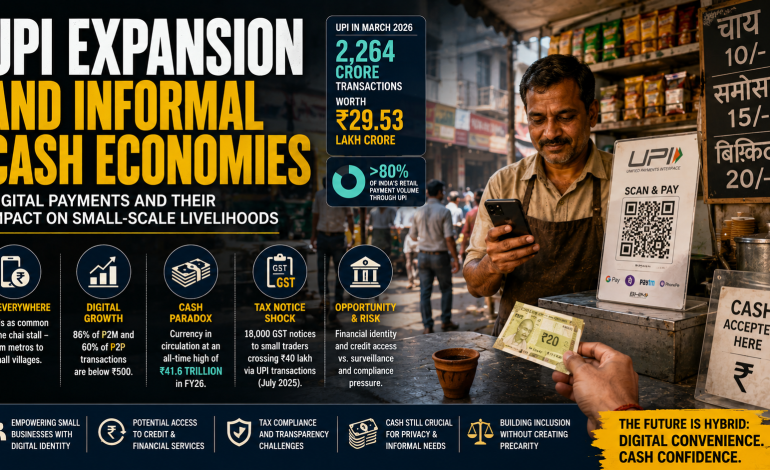
In March 2026, the Unified Payments Interface processed an astonishing 2,264 crore transactions worth nearly ₹29.53 lakh crore . More than 80 percent of India’s retail payment volume now flows through this digital rail . A decade after its launch, UPI has become as ubiquitous as the chai stall itself—its QR code a fixture on every shop counter from South Delhi’s bazaars to the smallest village kirana stores .
Yet, on that same chai stall counter, cash has not disappeared. According to an SBI research report, currency in circulation surged 11.9 percent in FY26 to an all-time high of ₹41.6 trillion—the highest growth since the post-demonetisation spike of 2016 . The report calls this the “cash paradox”: digital payments and physical currency are expanding simultaneously, not substituting for each other .
This paradox is the central reality of India’s payment landscape in 2026. Small-ticket transactions—a ₹10 chai, a ₹20 packet of biscuits—are increasingly dominated by UPI, with 86 percent of person-to-merchant and 60 percent of person-to-person transactions below ₹500 . But cash continues to serve what economists call “precautionary demand”—the money people keep on hand for emergencies, for informal expenses, for transactions they do not wish to be recorded .
For small-scale livelihoods, UPI has been both liberating and disruptive. A tea seller who once dealt entirely in cash now has a digital record of every sale—a transaction history that is, in effect, a financial identity she never had before . That digital trail could one day unlock access to formal credit, reducing her dependence on money lenders who charge punishing interest rates.
But the same system that empowers her also exposes her. In July 2025, the Karnataka Commercial Taxes Department reportedly issued 18,000 GST notices to small traders whose UPI transactions crossed the ₹40 lakh registration threshold . The “signalling effect” was immediate: merchants in affected districts began withdrawing ₹37 crore more per month in cash from ATMs than comparable districts . When digital payments attract scrutiny, small businesses retreat to the anonymity of cash.
This article examines the complex relationship between UPI expansion and India’s informal cash economies. It explores the hybrid equilibrium that has emerged, the specific challenges facing small-scale livelihoods, the sustainability crisis of the zero-MDR model, and the fundamental question of whether UPI is building financial inclusion or creating new forms of precarity.
WHAT – The tension between UPI expansion and informal cash economies refers to India’s parallel growth of digital payments and physical currency circulation. UPI has achieved massive scale—over 240 billion transactions worth ₹314 lakh crore in FY26 —yet cash in circulation has simultaneously hit record highs. The “cash paradox” describes a hybrid equilibrium where digital payments dominate small-ticket merchant transactions while cash retains its role for precautionary savings, informal sector transactions, and payments where anonymity is valued.
WHO – Small-scale livelihoods—chai stall owners, kirana shops, vegetable vendors, auto drivers, tailors, and other micro-entrepreneurs—are the primary actors in this transformation. Payment aggregators (PhonePe, Google Pay, Paytm) and banks process transactions. The National Payments Corporation of India (NPCI) operates UPI infrastructure. The RBI regulates digital payments and has proposed safeguards against fraud . State tax authorities enforce compliance, occasionally triggering cash retreats . Organizations like LocalCircles track user sentiment, finding 75% of users oppose any transaction fee on UPI .
WHEN – UPI completed its tenth anniversary in April 2026 . Key recent developments include the SBI “cash paradox” report (April 2026) , RBI’s draft proposal for one-hour delays on transfers above ₹10,000 (April 2026) , the Karnataka GST notice episode (July 2025) , and ongoing Budget debates about zero-MDR sustainability (January 2026) .
WHERE – Across India, with significant variation between metropolitan areas and smaller towns. Nearly one-third of India’s pin codes have fewer than 100 active UPI merchants, and 70 percent have fewer than 500, despite each pin code averaging over 2,500 merchants . This geographic disparity—the gap between UPI’s urban penetration and its rural footprint—is a key dimension of the informal economy challenge.
WHY – The coexistence of UPI and cash arises from several structural factors: the zero-cost appeal of UPI has driven unprecedented adoption but created sustainability challenges for the ecosystem ; tax enforcement anxieties push merchants back toward cash ; rural households with low deposit interest rates prefer holding cash for precautionary reasons ; and the absence of robust credit access means UPI’s data-rich transaction history has not yet translated into affordable formal lending for many small businesses .
HOW – Through QR-code-based payments that require no point-of-sale machine—just a printed code costing ten rupees . Settlement is instant and goes directly to the merchant’s bank account. The zero-MDR (Merchant Discount Rate) policy keeps transactions free for users but shifts costs to banks and payment service providers, who absorb an estimated ₹2 per transaction . The RBI’s proposed one-hour delay on transfers above ₹10,000, if implemented, could disrupt liquidity for small merchants who rely on real-time settlements .
SECTION 1: THE CASH PARADOX — WHEN DIGITAL AND PHYSICAL GROW TOGETHER
The most striking finding of the SBI research report, flagged by news outlets in April 2026, is what it terms the “cash paradox” . India’s payment landscape is not witnessing a substitution of cash by digital—it is witnessing a hybrid equilibrium where both modes are expanding simultaneously.
The Numbers
Currency in circulation surged 11.9 percent in FY26 to an all-time high of ₹41.6 trillion . This is the highest growth since the post-demonetisation spike in 2016. The Financial Express report highlights that in January 2026 alone, UPI transactions touched a record ₹28.3 lakh crore in value while cash in circulation simultaneously hit nearly ₹40 lakh crore .
At the same time, digital payments scaled new peaks: transaction value rising 20.6 percent to ₹314 trillion and volumes jumping 30 percent to 241.6 billion . The PIB backgrounder confirms that UPI now accounts for nearly 81 percent of total retail payment volume in India .
The Denominational Story
The composition of cash in circulation reveals an important shift. The ₹500 note now accounts for approximately 86 percent of total currency value . Following the withdrawal of the ₹2,000 note, the ₹500 note has become the backbone of India’s cash system.
Smaller denominations are behaving differently. Following an RBI directive to improve availability of smaller notes, the share of ₹100 notes increased from 6.2 percent in March 2025 to 8.2 percent in March 2026, indicating faster circulation of lower denominations . This suggests that while larger notes are being hoarded for precautionary purposes, smaller notes are actively circulating for day-to-day transactions.
The Precautionary Motive
The SBI report identifies a widening gap between currency holding and ATM withdrawals as evidence of rising precautionary demand. The difference between per capita currency in circulation and ATM withdrawals jumped from ₹1,804 in FY24 to ₹9,127 in FY26—a five-fold increase . “We believe this gap is primarily because of the precautionary motive of using cash by individuals,” the report states, attributing it partly to “heightened uncertainty” and amplified perceptions through social media .
The Financial Express analysis adds that rural households, facing relatively low deposit interest rates, prefer to hold cash for everyday spending rather than park savings in accounts that offer unattractive returns . Bank deposit growth slowed to about 10.6 percent as of January 2026, reinforcing this preference .
The Relative Decline of Cash
Despite absolute increases, cash is losing ground relative to the economy. India’s cash-to-GDP ratio has fallen from 14.4 percent in FY21 to about 11 percent in FY26 . This means that while the economy needs more cash as it grows, new economic activity is increasingly being driven by digital payments rather than paper currency.
The SBI report’s conclusion captures the paradox precisely: “cash is still the king… though UPI is gaining traction,” and both modes are likely to grow in tandem as the economy formalises further .
SECTION 2: UPI AND SMALL MERCHANTS — THE ADOPTION STORY
The success of UPI among small merchants is often cited as its greatest achievement. But the numbers reveal a more complex picture of uneven adoption.
The Low Barrier to Entry
Harsh Vardhan Masta, Head of Payments at Policybazaar, explains UPI’s merchant appeal succinctly: “No expensive POS machine needed, just a printed QR code that costs ten rupees. No separate merchant account, payments go straight into the shopkeeper’s existing bank account. No waiting for settlement, money arrives instantly. No technical knowledge needed, if you can use WhatsApp, you can accept UPI payments” .
This stands in stark contrast to the card ecosystem, where merchants had to rent or buy a terminal, sign contracts, pay transaction fees, and wait a day or two for settlement . The QR code democratised digital payments.
The Adoption Gap
Yet merchant adoption remains uneven. According to industry data cited by The Economic Times, the active merchant QR network has grown at only about 5 percent CAGR over the last three years, despite massive under-penetration across the country . Only around 45 percent of India’s merchants accept UPI payments on a monthly basis.
Geographic spread reveals even sharper disparities: nearly one-third of India’s pin codes have fewer than 100 active UPI merchants, and about 70 percent have fewer than 500, even though each pin code hosts, on average, more than 2,500 merchants . The gap between potential and reality underscores mounting strain in the system.
The Merchant Friction Signal
The LocalCircles survey, which gathered over 39,000 responses across 376 districts, found early signs of merchant discomfort with the current model. Around 57 percent of surveyed users said they had at least one experience in the past 12 months where a business declined to accept UPI and insisted on cash—a situation that 19 percent said happened frequently .
This merchant friction, occurring even before any formal fee regime, points to strains within the ecosystem. The reasons vary: some merchants dislike the settlement lag for larger amounts; others worry about technical failures; and a significant portion—as the Karnataka episode revealed—fear the tax visibility that digital payments bring.
SECTION 3: THE TAX VISIBILITY PROBLEM — WHEN DIGITAL ATTRACTS SCRUTINY
The most significant threat to UPI adoption among small merchants is not technical or financial—it is regulatory. The Karnataka GST notice episode of July 2025 provides a stark case study.
The 18,000 Notices
According to The Financial Express report, the Karnataka Commercial Taxes Department reportedly issued around 18,000 GST notices to small traders and vendors whose UPI transactions crossed the ₹40 lakh registration threshold . For many small merchants, operating just below formal tax registration limits, this was a wake-up call.
The report suggests that this created a “signalling effect”, discouraging some merchants from accepting digital payments and pushing them toward cash transactions instead .
The Behavioural Response
Data analysis in the SBI report showed the impact quantitatively. After the notices, districts in Karnataka saw an additional rise of about ₹37 crore per month in ATM withdrawals, compared with districts with lower withdrawal activity .
“In simple terms, this means that when digital payments start attracting scrutiny, some businesses go back to the anonymity of cash” .
This is not an isolated Karnataka phenomenon. The lesson has spread across India’s informal economy: digital payments create a trail, and trails can be followed. For a small business operating on thin margins, the risk of tax assessment outweighs the convenience of digital payments.
The Policy Dilemma
The tax visibility problem presents a genuine policy dilemma. On one hand, formalisation of the economy—bringing informal transactions into the tax net—is a stated policy goal. On the other hand, aggressive enforcement can trigger a retreat to cash, undermining the very digitisation that enables formalisation.
The challenge is calibration: how to encourage voluntary formalisation without provoking a defensive cash retreat.
SECTION 4: THE ZERO-MDR SUSTAINABILITY CRISIS
Behind UPI’s seamless user experience lies a growing financial crisis. The zero Merchant Discount Rate (MDR) policy—which keeps transactions free for users—shifts costs entirely onto banks and payment service providers.
The Cost of Free
According to discussions referenced by the Reserve Bank of India, each UPI transaction costs about ₹2 to process—a cost fully borne by banks and fintech firms . With monthly transactions exceeding 2,200 crore , the cumulative cost is staggering.
PhonePe, India’s largest UPI platform, has been blunt: the zero-MDR mandate in its current form is economically unviable. According to the company, the ecosystem urgently needs a predictable cost-recovery mechanism, either through MDR or adequate government subsidies, to survive at scale .
The Subsidy Rollercoaster
Government incentives for digital payments have swung dramatically in recent years—rising from ₹1,500 crore in FY22 to ₹3,500 crore in FY24, before falling to ₹2,000 crore in FY25 and collapsing to ₹427 crore in the FY26 budget estimates .
This unpredictability creates a vicious cycle. PhonePe warned that the FY23-24 incentive disbursal of ₹3,900 crore was itself insufficient to cover operational costs, and the sharp decline to ₹1,500 crore in FY24-25 has made matters worse .
The Payments Council of India has flagged that while government incentives were crucial in driving early adoption, the current framework offers no viable long-term revenue model for the companies that build, maintain, and secure the payments infrastructure .
The True Cost Estimate
Based on growth trajectory and using the FY23-24 subsidy as a benchmark, PhonePe estimates that the true cost of maintaining zero-MDR through government subsidies would be anywhere between ₹8,000-10,000 crore over the next two years—and this figure will only grow as UPI adoption expands .
“The government cannot realistically continue to bear this cost through annual budgetary allocations,” the fintech firm added. More importantly, “the unpredictability of these incentives creates a vicious cycle which in turn constrains ecosystem growth and innovation” .
The RBI Governor’s Warning
RBI Governor Sanjay Malhotra has underlined that while UPI has delivered enormous public value, its long-term viability hinges on someone paying the underlying costs. “I never said that UPI can stay free forever. What I said was there are costs (associated with UPI transactions), and they need to be paid for by someone. Who pays is important but not as important as someone footing the bill” .
The proposed solutions vary. Some advocate a controlled MDR of 25-30 basis points on payments made to large merchants (annual turnover exceeding ₹10 crore), arguing that high-volume businesses can absorb a nominal fee . Others warn that any transaction fee would trigger a mass exodus of users—the LocalCircles survey found that 75 percent of users would stop using UPI if any charge were introduced .
SECTION 5: THE FRAUD PROBLEM — PROPOSED SAFEGUARDS AND THEIR TRADE-OFFS
As UPI has grown, so have frauds. The RBI’s discussion paper “Exploring safeguards in digital payments to curb frauds” reveals alarming statistics: frauds related to digital payments have risen from 2.6 lakh reported cases worth ₹551 crore in 2021 to 28 lakh cases worth ₹22,931 crore in 2025 .
The One-Hour Delay Proposal
The RBI’s draft proposal to introduce a mandatory one-hour delay for UPI transfers above ₹10,000 has sparked intense debate. The central bank notes that transactions above ₹10,000 make up around 45 percent of reported fraud cases by volume but account for approximately 98.5 percent of total fraud value, justifying the threshold as a targeted safeguard .
The Impact on Small Merchants
Eshita Singh, head of Payments Propositions at IDfy, warns that the proposal could have unintended consequences for small-scale livelihoods. “A blanket delay on payments above a certain threshold risks disrupting this core value proposition” of instant payments, she told Deccan Chronicle .
According to Singh, introducing delays could impact liquidity for small merchants operating in the unorganised sector such as local garages or second-hand sellers who “typically rely on real-time payments despite lower transaction volumes” .
Raj P Narayanam, Founder and Executive Chairman of Zaggle, suggests a more nuanced approach: “Safeguards should be risk-based and selectively applied, ensuring that everyday transactions remain seamless” .
The Alternative Approach
Industry experts advocate a triangulated risk-scoring mechanism leveraging device biometrics, location intelligence, and behavioural patterns to identify and pause only high-risk transactions . This would preserve the instant nature of UPI for legitimate transactions while adding friction only where suspicious activity is detected.
Abhinav Parashar, Co-founder and CEO of Digio, suggests combining structural delays with out-of-band friction like voice-authenticated OTPs or face liveness checks: “If intent is hijacked, human oversight intervenes; if the device is hijacked, voice-level verification acts as an insurmountable barrier” .
The challenge for policymakers is balancing security with the instant, frictionless experience that has made UPI so widely adopted.
SECTION 6: THE CREDIT OPPORTUNITY — TURNING TRANSACTIONS INTO LOANS
The most hopeful narrative around UPI’s impact on small-scale livelihoods concerns credit access. As Masta notes, “UPI has solved payments. Sending, receiving, and paying is effortless for hundreds of millions of Indians. But the harder and more important problem of getting affordable credit to people who need it remains largely unaddressed through UPI” .
The Financial Identity Argument
A tea seller who used to deal entirely in cash now has a digital record of every sale through UPI. “That transaction history is essentially a financial identity, something he never had before,” Masta explains. “A kirana store owner who could never walk into a bank and get a loan because he had no documents now has his UPI history speaking for him” .
This is not merely theoretical. The PIB backgrounder on AI-powered financial inclusion notes that AI-powered solutions are moving beyond conventional credit scoring models, leveraging alternative data such as digital payment transactions, GST filings, bank statements, and utility payments to assess creditworthiness .
The Credit Gap
AI-driven credit models have the potential to unlock an estimated credit gap of USD 130-170 billion in economic value, reducing reliance on informal lending by MSMEs . For the millions of Indians without a CIBIL score, AI can serve as the new gatekeeper to credit.
The Unfinished Chapter
However, Masta notes that UPI’s credit line feature, launched in 2023, has seen slow adoption as lenders stay cautious amid tighter digital lending regulations .
“If we can turn UPI payment data into credit access for the millions of small merchants and self-employed Indians who are locked out of formal lending today, that would be genuinely transformative,” he says. “The infrastructure is ready. The data is flowing. What needs to catch up is the institutional willingness to trust that data and lend responsibly against it. That is the work of the next decade” .
SECTION 7: RURAL INDIA AND THE PRECAUTIONARY CASH DEMAND
The “cash paradox” is not uniform across India. Rural households exhibit distinct cash-holding behaviour.
The Interest Rate Connection
According to the SBI report cited by The Financial Express, demand to hold cash has increased in rural areas because interest rates are relatively low. When savings accounts or deposits don’t offer attractive returns, people may prefer to keep money in cash for everyday spending rather than park it in bank accounts .
This is rational economic behaviour. For a rural household with modest savings, the difference between a 3-4 percent savings account interest rate and holding physical cash is negligible—especially when weighed against the convenience of having cash immediately available.
The ULI and Digital ShramSetu Initiatives
The government has recognised the need to bring informal workers into the formal financial fold. Mission Digital ShramSetu, announced in October 2025, is a proposed national initiative to create an AI-driven ecosystem for India’s 490 million informal workers . The mission harnesses AI, blockchain, and immersive learning to dismantle structural constraints such as financial insecurity, limited market access, and lack of formal skilling .
The Unified Lending Interface (ULI) functions as a Digital Public Infrastructure in the lending space, integrating financial institutions and data providers through a standardised, API-based framework . Combined with UPI’s payment data, these initiatives could eventually reduce rural cash dependence.
The BHASHINI Language Initiative
Language remains a barrier to digital adoption in rural India. In February 2026, the Digital India BHASHINI Division and the RBI signed an MoU to collaborate on integrating BHASHINI’s language AI models to enhance multilingual access to banking and financial services . The initiative aims to provide access to banking services in all 22 scheduled Indian languages .
For the rural household that does not read English or Hindi script, this could be transformative. But the initiative remains nascent.
SECTION 8: THE USER RESISTANCE PROBLEM — WHY FEES ARE A NON-STARTER
The LocalCircles survey results are unequivocal: 75 percent of UPI users would stop using the platform if any transaction fee were introduced .
The Entrenched Zero-Cost Expectation
The report notes that “while users have fully embraced the convenience, speed and reliability of UPI, their adoption has been deeply anchored in its zero-cost nature” . Even modest transaction charges could disrupt entrenched habits and drive users back to cash or alternative means.
When asked about preferred pricing formats, only 9 percent favoured a fixed fee per transaction, 3 percent opted for a percentage-based charge, and 13 percent supported a hybrid structure. The remaining 75 percent rejected any form of charge outright .
The Demographic Breakdown
The survey’s demographic shows broad geographic representation: 41 percent of respondents were from tier 1 cities, 30 percent from tier 2 cities, and 29 percent from tier 3, 4, 5, and rural districts . Opposition to fees cuts across urban-rural divides.
The Policy Implications
For policymakers and payments players, the findings present a stark choice: preserve the zero-cost appeal that has driven UPI’s rapid growth and risk ongoing economic pressure on ecosystem participants, or explore monetisation avenues that could provoke user backlash.
The LocalCircles report concludes that willingness to pay for UPI transactions is low and that transaction fees remain a “non-negotiable” for most users, underscoring the sensitivity of any future pricing changes .
SECTION 9: THE BUDGET 2026 MOMENT
The Union Budget 2026, presented on February 1, 2026, was expected to address the sustainability crisis. Industry leaders had prepared to press for a substantial increase in subsidies or a controlled MDR framework .
The Industry Ask
PhonePe, along with other industry leaders, argued that the only way to break the current cycle is to introduce a controlled MDR framework, allowing the ecosystem to become self-sustaining while enabling the government to redirect public funds toward strategic priorities such as infrastructure development and digital literacy .
“A sustainable, market-based monetisation model will enable the ecosystem to be self-sufficient while allowing government support to be directed toward truly strategic interventions,” the company stated .
The Outcome
The Budget outcome on digital payments—whether it increased subsidies, introduced MDR, or maintained the status quo—will determine the trajectory of UPI’s next decade. As The Economic Times noted ahead of the Budget, “For the consumer, the QR code has become a symbol of freedom. But for the ecosystem, it is becoming a question of survival” .
SECTION 10: THE CENTRAL QUESTION — INCLUSION WITHOUT EXCLUSION
The politics of UPI expansion in India’s informal economy reflects a fundamental tension between two competing imperatives: financial inclusion and financial formalisation.
The Inclusion Argument
UPI has brought millions of small merchants into the formal financial system for the first time. A chai wallah who never had a bank account now receives payments directly into his account. A vegetable vendor who never had a financial identity now has a transaction history. A kirana store owner who could never get a loan now has data that could unlock credit .
From this perspective, UPI is not a threat to small-scale livelihoods—it is their pathway to economic citizenship.
The Exclusion Argument
But the same system that includes also exposes. The Karnataka GST notices triggered a cash retreat precisely because formalisation carries costs that small businesses cannot bear. The zero-MDR policy, while beneficial for users, is financially unsustainable—and if fees are introduced, 75 percent of users say they will abandon the platform .
The proposed one-hour delay on large transfers, while intended to reduce fraud, could disrupt the real-time liquidity that small merchants depend on .
From this perspective, UPI’s very design—instant, frictionless, transparent—creates vulnerabilities for those with the thinnest margins.
The Unanswered Question
The central question of this topic remains unresolved: Is UPI building financial inclusion, or is it creating new forms of precarity?
The cash paradox suggests that India’s payment landscape is not headed for a digital-only future. Cash and digital are likely to coexist for the foreseeable future, each serving distinct functions: UPI for small-ticket merchant transactions, cash for precautionary savings and anonymity-preserving payments .
For small-scale livelihoods, this hybrid equilibrium may be the best outcome. Digital payments provide a trail that can unlock credit. Cash provides a refuge when that trail becomes a liability. The challenge for policymakers is to ensure that the formalisation that UPI enables does not come at the cost of the informality that sustains millions of livelihoods.
As the SBI report concluded: “cash is still the king… though UPI is gaining traction” . In India’s informal economy, both will need to coexist for the foreseeable future. The question is not which will win—but how the balance between them will be managed.
SUMMARY TABLE: KEY INDICATORS OF UPI-CASH DYNAMICS
| Indicator | Value | Source | Interpretation |
|---|---|---|---|
| Currency in circulation (FY26) | ₹41.6 trillion | SBI Research/ANI | All-time high; 11.9% growth |
| UPI transaction value (FY26) | ₹314 trillion | SBI Research/ANI | 20.6% year-on-year growth |
| UPI transaction volume (FY26) | 241.6 billion | SBI Research/ANI | 30% year-on-year growth |
| UPI share of retail payment volume | 81% | PIB | Primary digital rail |
| Cash-to-GDP ratio (FY26 vs FY21) | 11% vs 14.4% | SBI Research/Financial Express | Cash declining relative to economy |
| ₹500 note share of total value | 86% | SBI Research/ANI | Dominant denomination |
| Precautionary cash gap (per capita CiC – ATM withdrawals) | ₹9,127 (FY26) vs ₹1,804 (FY24) | SBI Research/ANI | 5-fold increase |
| Active monthly UPI merchants | ~45% of merchants | Industry data/ET | Significant under-penetration |
| Pin codes with <500 active UPI merchants | 70% | Industry data/ET | Geographic concentration of adoption |
| Users who have faced merchant UPI refusal | 57% | LocalCircles/BW | Merchant friction signal |
| Users opposed to any UPI transaction fee | 75% | LocalCircles/BW | Zero-cost expectation entrenched |
| Transaction cost per UPI payment | ~₹2 | RBI discussions/ET | Borne by banks/fintechs |
| Estimated 2-year zero-MDR cost | ₹8,000-10,000 crore | PhonePe/ET | Unsustainable at current subsidy levels |
| Digital payment fraud value (2025 vs 2021) | ₹22,931 crore vs ₹551 crore | RBI discussion paper/Deccan Chronicle | 40x increase |
| Transactions >₹10,000 share of fraud value | 98.5% | RBI discussion paper/Deccan Chronicle | Rationale for proposed delay |
| AI-addressable MSME credit gap | $130-170 billion | PIB | UPI data as lending input |