
Urban Expansion and Wetland Destruction: The Hidden Environmental Cost of India’s Infrastructure Boom
URBAN EXPANSION AND WETLAND DESTRUCTION Environmental Costs of Infrastructure-Driven Development On a humid afternoon in Kozhikode, Kerala, the boundary between land and water has become almost impossible to discern. A
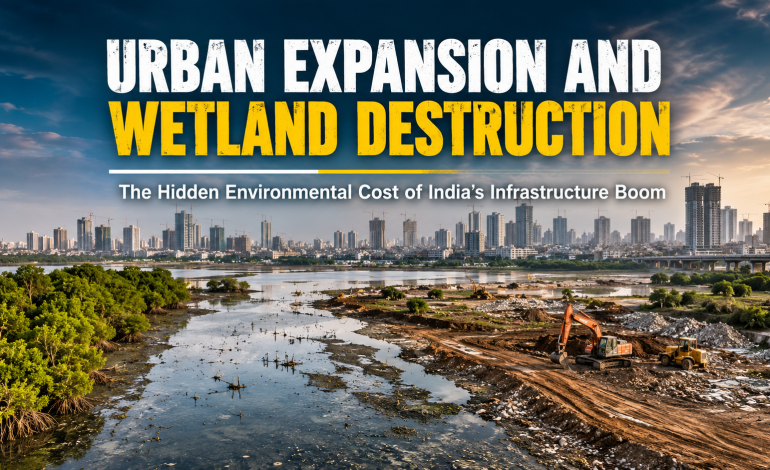

URBAN EXPANSION AND WETLAND DESTRUCTION
Environmental Costs of Infrastructure-Driven Development
On a humid afternoon in Kozhikode, Kerala, the boundary between land and water has become almost impossible to discern. A patch of mangroves thins rather than ends, its exposed roots marking where the wetland once extended further. Nearby, a football field has been carved directly out of what was recently mangrove forest—the ground filled with red earth, compacted enough to support regular play. But during the monsoon, the same field floods, revealing that the underlying wetland system remains active, its water absorption capacity only temporarily overlaid by human use .
This quiet, incremental transformation is unfolding across India’s cities, often unnoticed until the damage is irreversible. In Delhi, satellite imagery shows that the capital lost 8.2 percent of its total wetlands between 1991 and 2021, with south Delhi alone losing nearly 97 percent of its wetland area . The National Highways Authority of India constructed highway pillars inside a protected pond in Goyla Khurd village, encroaching upon 2.36 square metres of the water body without disclosing this impact in its environmental clearance application . In Mumbai, the Union Environment Ministry has sought a formal response on concerns about large-scale mangrove loss along the Versova–Dahisar coastal road alignment .
Against this backdrop, the new BJP government in West Bengal has launched a survey to identify “illegal encroachment of water bodies everywhere,” with Urban Development Minister Agnimitra Paul declaring that “it is criminal that [the previous government] allowed this to happen” . The Kerala High Court has halted all new construction in the Kottooli wetlands, ordering authorities to expedite their designation as a protected Ramsar site within three months .
The numbers are staggering. Tamil Nadu’s economy loses an estimated ₹19,910 crore annually due to unrealized ecosystem services from degraded wetlands . A 2025 study by Delhi University researchers found a near-perfect correlation between population growth and built-up area (+0.99), and a strong negative correlation with wetlands (-0.88) . The message is clear: India’s infrastructure-driven development model is systematically destroying the natural systems that protect its cities from flooding, heat, and climate disaster. This article examines the environmental costs of urban expansion on wetlands and mangroves, the legal and governance failures that enable destruction, and the fundamental question of whether India’s growth can be sustained without the ecological infrastructure that silently supports it.
WHAT – Wetland destruction refers to the loss of marshes, mangroves, lakes, ponds, and other water-saturated ecosystems due to urban expansion, infrastructure projects (roads, highways, metro rail), real estate development, and garbage dumping. Wetlands in India are protected under the Wetlands (Conservation and Management) Rules, 2017, and the Environment Impact Assessment Notification, 2006, yet violations are widespread. The environmental costs include increased flooding (as wetlands are natural sponges), groundwater depletion, biodiversity loss, urban heat island effects, and reduced climate resilience.
WHO – Key actors include the National Highways Authority of India (NHAI), which has constructed highway pillars inside protected ponds without proper clearances ; the Union Ministry of Environment, Forest and Climate Change (MoEF&CC), which grants environmental clearances; state wetland authorities (Delhi, Maharashtra, Kerala, Tamil Nadu, etc.) responsible for enforcement; the National Green Tribunal (NGT) and High Courts, which adjudicate violations; urban local bodies that issue construction permits; real estate developers and land-grabbers who fill wetlands for construction; and environmental activists and citizen groups who document encroachments and file petitions.
WHEN – The destruction is ongoing, with key developments in 2025-2026 including: NGT action on NHAI’s Goyla pond violation (April 2026) ; Mumbai coastal road mangrove review (January 2026) ; Bengaluru’s Ulsoor Lake desilting halted (May 2026) ; Kerala High Court order on Kottooli wetlands (March 2026) ; West Bengal’s new government announcing wetland encroachment survey (May 2026) ; and Tamil Nadu’s State Planning Commission report on wetland economic valuation (2025) .
WHERE – Across India, with specific hotspots in Delhi (Goyla pond, overall loss of 8.2% of wetlands 1991-2021) ; Mumbai (Versova-Dahisar coastal road mangrove impact) ; Kerala (Kottooli wetlands, Chelembra mangroves) ; Bengaluru (Ulsoor Lake) ; Tamil Nadu (141 prioritized wetlands losing ₹19,910 crore in ecosystem value annually) ; and West Bengal (East Kolkata Wetlands, a protected Ramsar site facing encroachment) .
WHY – Multiple drivers fuel wetland destruction: the demand for land in rapidly expanding cities; the economic value of filled land (much higher than protected wetlands); weak enforcement of environmental laws; corruption and administrative inaction (a “nexus involving real estate agents, builders, and officials” identified by Kerala’s Vigilance and Anti-Corruption Bureau) ; fragmented governance across multiple agencies; delayed judicial responses that allow irreversible damage before intervention; and the perception that wetlands are “wastelands” rather than critical ecological assets.
HOW – Through incremental encroachment: land is acquired at low cost, gradually filled with soil (often under cover of darkness or during weekends), and later legitimized through administrative processes. The Kerala Vigilance and Anti-Corruption Bureau’s 2025 investigation “identified a recurring nexus involving real estate agents, builders, and officials, where wetlands are gradually filled, reclassified, and converted for commercial use” . Construction proceeds without environmental clearance, or with clearances obtained through non-disclosure of wetland impact—as in the NHAI’s Goyla pond case, where “the NHAI did not disclose that it would be constructing the pillars inside the pond” when applying for environmental clearance .
SECTION 1: THE SCALE OF DESTRUCTION — NUMBERS THAT CANNOT BE IGNORED
The loss of wetlands in urban India is not anecdotal—it is systematic, measurable, and accelerating.
Delhi: A Case Study in Urban Wetland Loss
A 2025 study by Delhi University researchers titled “The Impact of Urbanisation on Wetland Ecology in Delhi Using AWEI and GIS” used satellite imagery and the Automated Water Extraction Index to map changes in the capital’s surface water bodies between 1991 and 2021 . The findings are devastating:
-
Overall loss: Delhi lost 8.2 percent of its total wetlands over the 30-year period
-
South Delhi: Lost nearly 97 percent of its wetland area
-
Correlation: Population growth showed a near-perfect correlation with built-up area (+0.99) and a strong negative correlation with wetlands (-0.88)
The study attributes the decline to “Delhi’s explosive, often unregulated, urban growth.” The city’s urban population rose from 52.7 percent in 1901 to 97.4 percent in 2011, driving intense demand for land and infrastructure. “As concrete replaced natural basins and farmland, Delhi’s hydrological balance was disrupted” .
The ecological fallout has been severe: reduced groundwater recharge, frequent urban flooding, and worsening heat island effects. The 2024 flooding in Delhi—which paralyzed the city—was not merely a rain event; it was a consequence of the city having lost the natural sponges that once absorbed excess water.
Tamil Nadu: The Economic Cost of Degradation
The Tamil Nadu State Planning Commission’s second-phase report on wetland economic valuation, released in 2025, attempted to quantify what the state loses when wetlands are destroyed .
The combined ecosystem value of 141 prioritized wetlands at 2024 prices stands at ₹8,303.8 crore, while their potential value is ₹28,214.37 crore. The state economy loses ₹19,910.6 crore annually due to unrealized ecosystem services from degraded wetlands .
These are not abstract environmental figures—they are real economic losses. Wetlands provide water purification, flood regulation, groundwater recharge, fisheries, and tourism value. When a wetland is filled for a housing complex, the state gains land value but loses these services forever. The Tamil Nadu report’s calculation shows that the loss far outweighs the gain.
The report highlighted that “current wetland loss rates – three times faster than forest loss – threaten the foundational resources necessary for sustainable development.” It also noted that “unilateral water transfers to cities, without compensating traditional users, triggers a cycle of displacement, increased urban demand, and ecosystem degradation” .
The Global Context
A United Nations Environment Programme report, released at the Convention on Biological Diversity and cited by the Kerala ENVIS centre, noted that “in 100 years, we have managed to destroy about 50 per cent of the world’s wetlands, which is a stunning figure” . The report’s message is simple: “drain it, lose it.”
Inland wetlands cover at least 9.5 million square kilometres of the earth’s surface, and together with coastal wetlands, 12.8 million square kilometres. Yet restoration of this ecosystem type is the most expensive of all. The perception that wetlands are “not essential to the functioning of societies and economies” contributes to their destruction .
India, a signatory to the Ramsar Convention on Wetlands, has 25 wetlands listed under the covenant (such as Chilika Lake) and about 150 identified wetlands of national importance. International monitors have been “persuading” India to put in place management plans for protected sites, with progress described as “partial” .
SECTION 2: INFRASTRUCTURE PROJECTS AS WETLAND DESTROYERS
Infrastructure development—roads, highways, coastal roads, metro rail—is among the primary drivers of wetland loss in urban India.
Mumbai Coastal Road: Mangroves at Risk
The Versova–Dahisar coastal road in Mumbai, part of the city’s broader plan to ease north–south vehicular congestion, has come under scrutiny after the Union Environment Ministry sought a formal response from state authorities on concerns related to large-scale mangrove loss .
Environmental specialists argue that the Versova–Dahisar belt is “among the city’s most sensitive coastal zones, where mangrove forests act as natural buffers against tidal flooding, storm surges, and shoreline erosion.” Urban ecologists point out that mangroves serve multiple functions beyond flood protection: “they stabilise soil, support fisheries, store significant amounts of carbon, and moderate coastal microclimates” .
While project proponents have proposed compensatory plantations elsewhere, experts note that “relocated mangroves cannot replicate the site-specific protection offered by mature ecosystems already embedded within local hydrology.” Mumbai’s repeated flooding episodes over the past decade have sharpened this debate, “linking environmental clearances directly to urban safety and economic disruption” .
The Centre’s request for a detailed response does not halt construction, but it introduces “a new layer of accountability.” How state authorities respond—and whether mitigation measures are strengthened—will be closely watched .
NHAI and the Goyla Pond Encroachment
The most blatant example of infrastructure-led wetland destruction is the National Highways Authority of India’s construction of the Urban Extension Road-II over a protected pond in Delhi’s Goyla Khurd village. The NGT, taking suo motu cognizance based on a newspaper report, found that the NHAI had constructed eight pillars inside the water body, encroaching upon 2.36 square metres of the pond .
The tribunal noted that “there is nothing on record to show NHAI’s disclosure that the water body will be encroached upon and pillars will be constructed inside the water body.” The Environmental Clearance issued by the MoEF&CC in December 2021 “clearly mentioning that the alleviated structure was proposed on the pond without any mention about the erection of pillars on the pond” .
The NGT held that this constituted a violation of Rule 4 of the Wetlands Rules, which “does not permit any kind of encroachment on the wetland” and “does not permit the construction of a permanent nature in the wetland.” The tribunal observed that “even though the encroachment/reduction in the area is small, the law should have been followed and the requisite permission from the Environment Impact Assessment Authority in terms of the EIA Notification, 2006, ought to have been taken” .
An earlier report by Urban Acres noted that satellite imagery revealed a stark reality: “since construction began in 2022, over 80% of the pond has disappeared” . The pond was on a list of over 1,000 ponds identified for protection due to its ecological significance as a natural wetland.
The NGT directed the MoEF&CC to consider the violation and take appropriate action. It also ordered a joint inspection by the Delhi Pollution Control Committee and NHAI to ascertain damage and required restorative measures .
The Development-Environment Balance
The NGT acknowledged the tension at the heart of these disputes. It noted the NHAI’s submissions about sustainable development—that “construction of the road was necessary for the development of infrastructure, public interest and convenience.” The tribunal responded: “There is no dispute to the proposition that a balance is required to be struck between environmental protection and development, but even for attracting the said principle, an agency involved in the developmental project is required to follow the law and take necessary applicable environmental clearances by disclosing full facts” .
This is the crux of the issue. The problem is not infrastructure per se—it is infrastructure built without transparency, without disclosure, without the environmental impact assessment that the law requires.
SECTION 3: THE INCREMENTAL ENCROACHMENT PROBLEM
Not all wetland destruction happens through large infrastructure projects. Much of it occurs quietly, incrementally, and often with the complicity of local authorities.
Kerala’s Vanishing Mangroves
A detailed investigation by the Asia Media Centre documented how mangrove destruction is unfolding across Kerala’s coast . The pattern is not one of sudden, dramatic clearance but of “quiet, incremental loss” that “weakens natural flood protection, livelihoods, and climate resilience in ways most people notice only when it’s too late.”
In Chelembra village near Calicut, a football ground has been carved directly out of what was recently mangrove forest. “The edges of the field still carry signs of clearing, with stumps and disturbed soil interrupting the surface.” During the dry season, children play there. But during the monsoon, “the same field floods, revealing that the underlying wetland system remains active” .
Around the field, new buildings are beginning to appear. “They do not dominate the landscape yet, but their presence narrows the remaining wetland space. Each structure reduces the area available for water absorption and wildlife, fragmenting what was once a continuous ecosystem into smaller, disconnected patches.”
The fragmentation is already affecting bird behavior. “Egrets, which would typically gather deeper within mangrove habitats, are now observed congregating in open, altered spaces”—in one case, near a roadside shop where waste is discarded along the water’s edge .
The Kottooli Wetlands: A Documented Pattern
What is happening informally in Chelembra has been formally documented in the nearby Kottooli wetlands, where environmental groups and residents have tracked encroachment more systematically.
“There were 37 unauthorised constructions in Kottooli wetland area, and several private parties continued to carry out construction work by destroying mangroves and filling the wetlands,” said K. Ajaylal, an activist involved in documenting violations. Residents described how these changes often occur in ways that are difficult to detect in real time. “It took us time to realise that attempts to cut out a road through the mangrove forest… were all part of some diversion tactics,” said P.M. Jeeja Bai, noting that landfilling was taking place simultaneously in another part of the wetland .
The Enforcement Gap and “Encroachment by Stealth”
Activists argue that this process is enabled not only by individual actors but by “systemic failures in enforcement.” Sandeep Pandey, an activist, stated: “The buildings on the wetland would not have materialised without the authorities allowing it” .
While direct evidence of bribery in specific Kottooli cases has not been publicly established, “the pattern aligns with a wider network of wetland conversion practices documented across Kerala.” Investigations by the state’s Vigilance and Anti-Corruption Bureau in 2025 “identified a recurring nexus involving real estate agents, builders, and officials, where wetlands are gradually filled, reclassified, and converted for commercial use.” The method is consistent: “land is acquired at low cost, incrementally filled with soil, and later legitimized through administrative processes” .
This is “encroachment by stealth”—a process where “small, dispersed actions collectively transform the landscape while avoiding immediate scrutiny.” Over time, such practices “create conditions for more permanent conversion of wetland areas into buildable land” .
SECTION 4: THE LEGAL FRAMEWORK — STRONG ON PAPER, WEAK IN PRACTICE
India has a robust legal framework for wetland protection—on paper. The gap between law and enforcement is where wetlands die.
The Wetlands (Conservation and Management) Rules, 2017
These rules, issued under the Environment (Protection) Act, 1986, prohibit “any kind of encroachment on the wetland” and forbid “the construction of a permanent nature in the wetland” . They require states to identify and notify wetlands, prepare integrated management plans, and constitute State Wetland Authorities to oversee implementation.
Yet as the Kerala High Court noted in its March 2026 order on Kottooli wetlands, the rules are only as effective as the enforcement mechanisms behind them. The court directed authorities to “prevent any construction in prohibited areas” and expedite the Ramsar Site designation process .
The Role of the National Green Tribunal
The NGT has emerged as a crucial—if overburdened—enforcer of environmental law. In the Goyla pond case, the tribunal acted suo motu (on its own motion) based on a newspaper report, demonstrating the proactive role the judiciary can play .
However, the NGT’s orders often come after irreversible damage has occurred. The tribunal directed restorative measures and compensation assessment, but the eight pillars remain in the pond. The highway is built. The wetland area has been permanently reduced.
The Kerala High Court’s Kottooli Order
On March 12, 2026, a Division Bench of the Kerala High Court comprising Chief Justice Soumen Sen and Justice Syam Kumar V.M. directed local authorities to “halt all new construction activities within the Kottooli wetlands, as steps to designate it a Ramsar Site are underway” .
The court emphasized that “any new constructions within the prohibited area would not only violate the Wetlands (Conservation and Management) Rules, 2017 but also potentially render the Ramsar Site designation efforts futile.” It ordered authorities to “ensure compliance with the prohibition on new constructions in the protected area” and directed that “the procedures for the Ramsar Site designation be completed within three months” .
The court also mandated “adequate publicity of these restrictions to inform the public, ensuring no unauthorized constructions occur.” The case was scheduled for review on May 21, 2026, to assess compliance .
The Problem of Timing
The Kottooli order, while significant, illustrates a persistent problem: legal intervention occurs after damage has already begun. As the Asia Media Centre report noted, “these orders primarily address future activity, not reversing changes that have already occurred. Land that has been filled remains elevated. Structures that have been built continue to stand. The legal process, while significant, operates more slowly than the physical transformation of the landscape” .
This “mismatch between the pace of environmental change and the pace of legal response is central to the current situation. By the time a case is heard, violations have often progressed beyond easy reversal” .
SECTION 5: GOVERNANCE FAILURES — WHO IS RESPONSIBLE?
The destruction of urban wetlands is not a natural disaster—it is a governance failure, enabled by multiple actors across multiple levels.
Fragmented Authority
Wetland management in India is fragmented across multiple agencies: the MoEF&CC at the Centre, State Wetland Authorities, State Pollution Control Boards, urban local bodies, Public Works Departments, irrigation departments, and revenue departments. The Tamil Nadu State Planning Commission report noted that “most waterbodies and wetlands in the study are owned and managed by the Public Works Department (PWD) and are mainly used for irrigation. However, declining agricultural activities have reduced the demand for irrigation, shifting to diverse activities like recreational opportunities, local fisheries, biodiversity conservation, groundwater recharge and climate regulation.” The report called for “a multi-agency governance structure – including local communities, environmental departments, tourism boards, and fisheries authorities” .
But multi-agency governance, in practice, often means no one is accountable.
The Delhi Wetland Authority’s Failure
The Delhi Wetland Authority, established in 2019 to protect the capital’s water bodies, “appears to have failed in its mandate, allowing such an egregious violation to occur” at Goyla pond, according to Urban Acres . A recent survey indicated that “out of 1,367 registered waterbodies, only 656 remain intact, highlighting a significant loss of nearly 50%” .
Political Will and Administrative Inertia
In West Bengal, the newly-formed BJP government has made wetland protection a political issue, with Urban Development Minister Agnimitra Paul stating that she was “against the level of encroachment of water bodies everywhere” and that “it is criminal that [the previous government] allowed this to happen” .
A survey is being carried out to identify illegal encroachment of wetlands and subsequent construction on them, with particular attention to the East Kolkata Wetlands, “a protected Ramsar site where permanent constructions are not allowed” .
This political shift—from one government accusing another of environmental negligence—reflects the growing salience of wetland protection as a public issue. But it also raises questions: if the previous government failed to act, and the current government is only now acting, how many wetlands were lost in the interim?
SECTION 6: ECOLOGICAL CONSEQUENCES — WHAT INDIA IS LOSING
The destruction of wetlands is not merely a loss of “green space”—it is the systematic dismantling of the natural infrastructure that sustains urban life.
Flooding and Waterlogging
Wetlands function as natural sponges, absorbing excess rainwater and releasing it slowly. When wetlands are filled, this absorption capacity is lost. The result is flooding—even from moderate rainfall.
Mumbai’s repeated flooding episodes over the past decade have been directly linked to the loss of mangroves and wetlands along its coastline . Chennai’s 2015 floods, which killed over 500 people, were exacerbated by the city having lost much of its wetland buffer. The Tamil Nadu State Planning Commission report’s economic valuation of wetlands is, in part, a quantification of the flood protection services that wetlands provide—and that are lost when they are destroyed.
Groundwater Depletion
Wetlands recharge groundwater aquifers. When they are destroyed, the water that once percolated into the ground instead runs off—into drains, into rivers, or simply evaporates. In cities already facing groundwater depletion, wetland destruction accelerates the crisis.
The Delhi University study’s finding of a strong negative correlation between built-up area and wetlands is directly relevant to the capital’s groundwater crisis .
Urban Heat Islands
Wetlands moderate local microclimates. The evaporation of water from their surfaces cools the surrounding air. When wetlands are replaced by concrete and asphalt, urban heat island effects intensify—temperatures rise, energy consumption for cooling increases, and public health suffers.
Biodiversity Loss
The Kottooli wetlands and Chelembra mangroves in Kerala support a range of species—birds, fish, crabs, and other wildlife. The fragmentation of these habitats is already affecting bird behavior, with egrets observed congregating in altered spaces rather than within the mangroves .
A 2025 study noted that “wetland loss rates – three times faster than forest loss – threaten the foundational resources necessary for sustainable development” .
Carbon Storage
Mangroves are among the most carbon-dense ecosystems on Earth, storing significant amounts of carbon in their biomass and in the soil beneath them. When mangroves are cleared, this carbon is released—contributing to climate change.
SECTION 7: THE ECONOMICS OF WETLAND DESTRUCTION
The Tamil Nadu State Planning Commission’s report provides a framework for understanding what is at stake economically.
The Valuation Methodology
The report, “Economic Valuation of Ecosystem Services – A study of 61 prioritized wetlands/waterbodies in Tamil Nadu” (second phase, following an initial phase covering 80 waterbodies), attempted to calculate the economic value of the services that wetlands provide .
The findings: the combined ecosystem value of 141 wetlands at 2024 prices stands at ₹8,303.8 crore, while their potential value is ₹28,214.37 crore. The state economy loses ₹19,910.6 crore annually due to unrealized ecosystem services from degraded wetlands .
The total restoration cost for all 61 inland wetlands is estimated at just ₹5.4 crore (at 2024 prices). This spending could help avert losses up to ₹13,081 crore per annum which arise due to wetland degradation .
In other words, every rupee spent on wetland restoration returns thousands of rupees in avoided losses.
The “False Economy” of Urban Water Transfers
The Tamil Nadu report highlighted a specific policy failure: “unilateral water transfers to cities, without compensating traditional users, triggers a cycle of displacement, increased urban demand, and ecosystem degradation, undermining sustainability.” It concluded that “prioritizing urban water use over rural livelihoods is a false economy with hidden social and environmental costs” .
This finding has implications beyond Tamil Nadu. Across India, cities are drawing water from rural areas—often from wetland-dependent ecosystems—without accounting for the ecological and social costs.
SECTION 8: JUDICIAL RESPONSES — A MIXED RECORD
Indian courts have played an active role in wetland protection, but the record is mixed.
The NGT’s Goyla Pond Order
The NGT’s April 2026 order in the Goyla pond case was significant for several reasons: it acted suo motu, it explicitly found violations of the Wetlands Rules, and it directed both restorative measures and compensation assessment. However, the order came after the pillars had already been constructed and the pond area reduced .
The Kerala High Court’s Kottooli Order
The March 2026 Kottooli order, halting construction and directing expedited Ramsar designation, represents proactive judicial intervention. But as noted, the order primarily addresses future construction, not the reversal of existing encroachments .
The Punjab Ground-Truthing Initiative
Punjab has emerged as a positive example. The state government completed “ground truthing” of 1,143 potential wetlands in 2025—a process of comparing satellite images with what is observed on the ground—and recommended 72 water bodies for notification . This is the kind of systematic, data-driven approach that other states could emulate.
The Supreme Court’s Role
The Supreme Court has issued directions to all state and union territory wetland authorities to complete ground-truthing and demarcation of wetland boundaries. The timeline set was three months—a recognition of the urgency of the issue .
SECTION 9: THE WAY FORWARD — RESTORATION AND PROTECTION
Addressing the wetland crisis requires action on multiple fronts.
Strengthening Enforcement
The “nexus involving real estate agents, builders, and officials” that the Kerala Vigilance and Anti-Corruption Bureau identified must be broken. This requires criminal prosecution of willful violators, not just administrative penalties .
The NGT’s direction to the MoEF&CC to consider violations and take action is a step, but the central government must demonstrate that violations have consequences.
Community-Based Management
The Tamil Nadu State Planning Commission report recommended “community-based management as a long-term strategy for sustainable waterbody governance, as local communities possess traditional ecological knowledge accumulated over generations” .
In Punjab, the “Seechewal model” of cleaning ponds—named after environmentalist Balbir Singh Seechewal—has been implemented in nearly 250 villages across the state . This model, which involves community-led restoration of traditional water bodies, offers a replicable template.
Expedited Notification and Ramsar Designation
The Kerala High Court’s order to expedite Kottooli’s Ramsar designation within three months recognizes that international recognition can provide a layer of protection. States should prioritize the identification and notification of wetlands under the 2017 Rules.
Transparency in Infrastructure Planning
The NGT’s direction that the NHAI “make full disclosure in future about the natural water resources, ponds, lakes, streams and the like which might be affected in the construction activity while applying for environmental clearances” should apply to all infrastructure agencies .
Economic Valuation as a Policy Tool
The Tamil Nadu report’s economic valuation of wetland ecosystem services provides a powerful tool for advocacy. When policymakers see that wetland degradation costs the state ₹19,910 crore annually, the case for protection becomes harder to ignore.
SECTION 10: THE CENTRAL QUESTION — DEVELOPMENT OR SURVIVAL?
The destruction of urban wetlands for infrastructure development reflects a fundamental tension between two competing visions of India’s future.
The Development Imperative
India needs infrastructure. The country’s cities are overcrowded, its roads congested, its public transport inadequate. Highways, coastal roads, and metro rail are not luxuries—they are necessities for a growing economy.
From this perspective, the loss of a few hectares of wetland is an acceptable trade-off for improved connectivity. Compensatory plantations can replace lost mangroves. New lakes can be excavated elsewhere. The economic benefits of infrastructure outweigh the environmental costs.
The Ecological Imperative
But the Tamil Nadu report’s numbers suggest otherwise. The annual loss from degraded wetlands—₹19,910 crore—is not a hypothetical; it is the value of services that wetlands provide for free. When they are destroyed, the costs are borne by society: in flood damage, in water scarcity, in heat-related illness, in lost fisheries, in reduced biodiversity .
Moreover, compensatory plantations cannot replicate the functions of mature ecosystems. “Relocated mangroves cannot replicate the site-specific protection offered by mature ecosystems already embedded within local hydrology” . The wetland that is destroyed is irreplaceable.
The Unanswered Question
The central question of this topic remains unresolved: Can India achieve its infrastructure goals without destroying the natural systems that make its cities livable?
The NGT’s formulation—that “a balance is required to be struck between environmental protection and development, but even for attracting the said principle, an agency involved in the developmental project is required to follow the law” —is legally correct but politically contested. The law exists. The problem is enforcement.
The Kerala Vigilance and Anti-Corruption Bureau’s investigation has identified “a recurring nexus” that enables wetland destruction . Until that nexus is broken—until officials who allow illegal construction face consequences, until developers who fill wetlands are prosecuted, until infrastructure agencies disclose full environmental impacts—the destruction will continue.
The football field built on mangrove forest in Chelembra will flood every monsoon, a seasonal reminder of the wetland that once stood there. The highway pillars in Delhi’s Goyla pond stand as monuments to a clearance process that failed. The 97 percent loss of south Delhi’s wetlands is not reversible .
But other wetlands can still be saved. The Kerala High Court’s Kottooli order, the NGT’s Goyla direction, Punjab’s ground-truthing initiative, Tamil Nadu’s economic valuation—these are steps in the right direction. Whether they are enough, and whether they will be implemented, remains to be seen.
As the UNEP Executive Director noted: “In 100 years, we have managed to destroy about 50 per cent of the world’s wetlands, which is a stunning figure” . India’s cities are part of that global story. Whether they will become part of the solution—or continue driving the destruction—is a choice that policymakers, courts, and citizens must make.
SUMMARY TABLE: KEY WETLAND DESTRUCTION INCIDENTS AND RESPONSES
| Location | Wetland Type | Threat | Status/Response | Source |
|---|---|---|---|---|
| Goyla Khurd, Delhi | Protected pond | NHAI highway pillars inside water body | NGT found violations; restorative measures ordered | |
| Versova-Dahisar, Mumbai | Mangroves | Coastal road construction | MoEF&CC sought response; compensatory plantations proposed | |
| Kottooli, Kozhikode, Kerala | Freshwater wetlands | 37+ unauthorized constructions | Kerala HC halted new construction; expedited Ramsar designation | |
| Chelembra, Kozhikode, Kerala | Mangroves | Football ground, buildings, incremental encroachment | Documented by activists; limited enforcement | |
| South Delhi | General wetlands | Urbanization | 97% loss 1991-2021 documented by DU study | |
| Ulsoor Lake, Bengaluru | Urban lake | Desilting activity | Temporarily halted due to ecological concerns | |
| East Kolkata Wetlands | Ramsar site | Encroachment | New WB govt announced survey | |
| Tamil Nadu (141 wetlands) | General wetlands | Degradation | ₹19,910 cr annual economic loss documented |