The Gen-Z Challenge for Indian Politics — Beyond Memes, Towards a Governable Future
Editorial: The Gen-Z Challenge for Indian Politics — Beyond Memes, Towards a Governable Future Introduction: The Cockroach as a Wake-Up Call In May 2026, a satirical social media entity called

Editorial:
The Gen-Z Challenge for Indian Politics — Beyond Memes, Towards a Governable Future
Introduction: The Cockroach as a Wake-Up Call
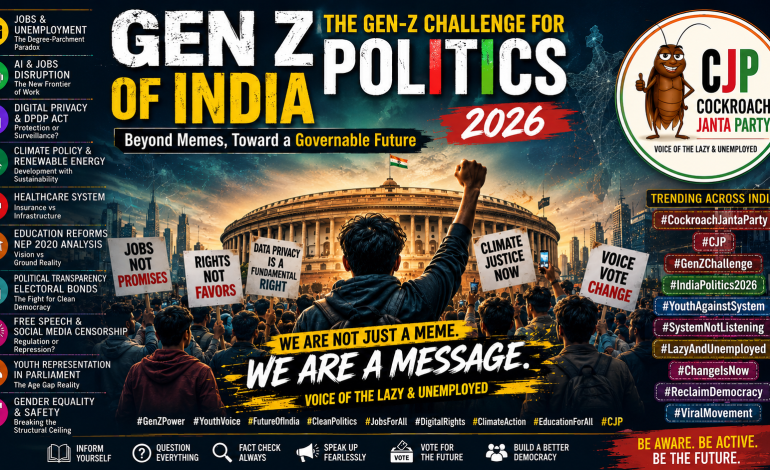
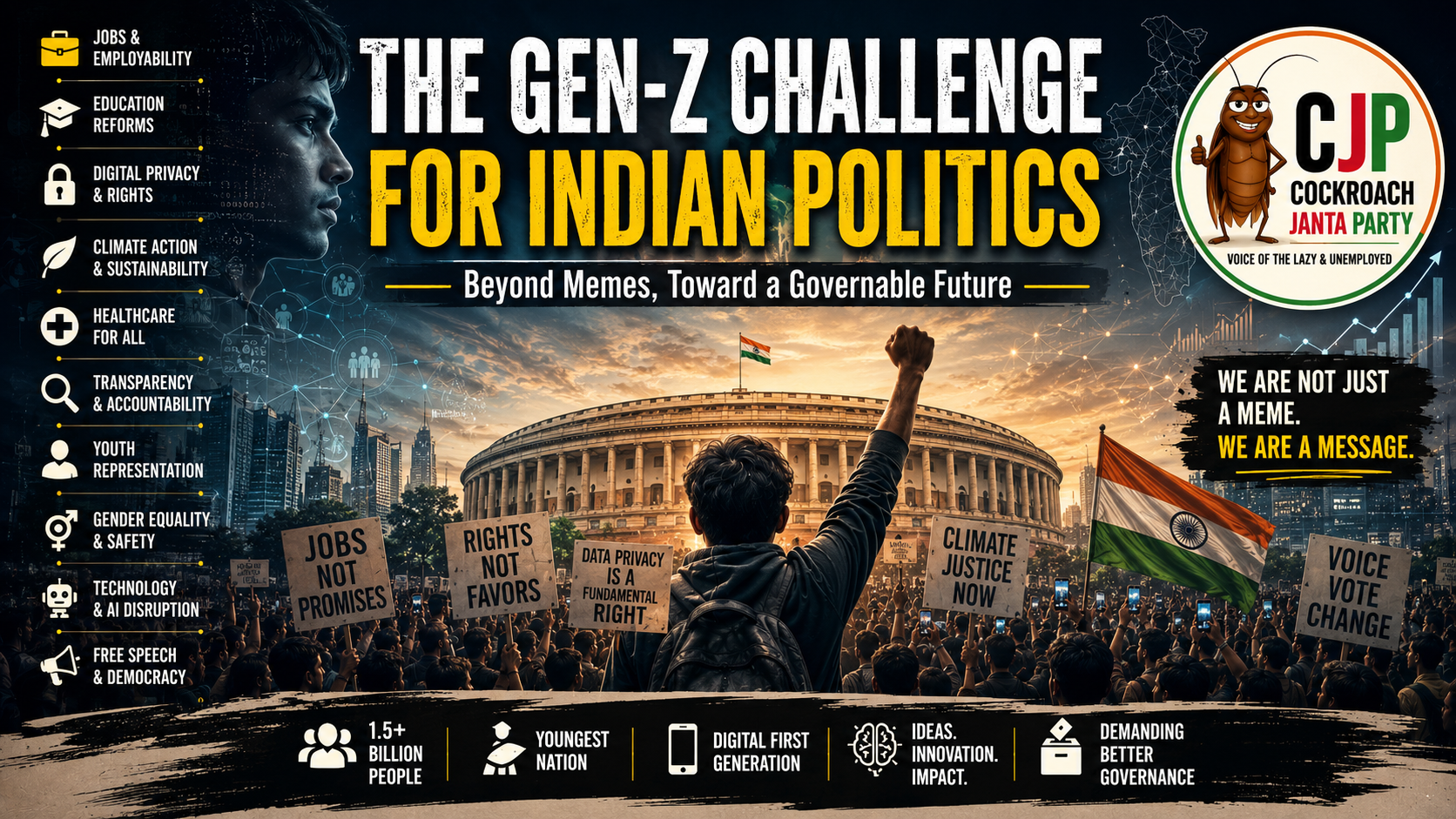
In May 2026, a satirical social media entity called the “Cockroach Janta Party” (CJP) achieved what no traditional political outfit could: its Instagram follower count eclipsed that of the ruling BJP, amassing over 18 million followers within days of its launch. It was neither a political party nor a formal organization but a digital protest. Born from a controversial remark by Chief Justice Surya Kant, who reportedly compared some unemployed youth to cockroaches, the movement adopted the insect as a symbol of resilience. Its founder, Abhijeet Dipke, declared the CJP the “Voice of the Lazy and Unemployed,” channeling years of frustration over unemployment, inflation, and a system that feels unresponsive. The CJP’s official X (formerly Twitter) account was blocked by the Indian government, but it promptly reappeared with the defiant handle @Cockroachisback.
This parody party is not a solution; it is a symptom. It signals a deep, silent discontent that has been fermenting among India’s 1.5 billion people, particularly its Gen-Z population. This editorial analyzes ten fundamental challenges facing Indian democracy, moving past speculation to data-driven, evidence-based analysis. The question is no longer if the system must change, but how.
1. Employment & Skills: The ‘Degree-Parchment’ Paradox
Gen-Z’s primary grievance is the collapse of the traditional education-to-employment pipeline. Despite possessing degrees, a staggering number of young Indians are either unemployed or underemployed.
The Data Landscape
Official data presents a confusing picture. The Periodic Labour Force Survey (PLFS) 2025 data cited by an SBI report shows India’s youth (15-29) unemployment rate gradually declining from 10.9% in 2022 to 9.9% in 2025. The Ministry of Statistics claimed the overall unemployment rate was just 3.1% for the same year.
However, these aggregate figures mask a brutal reality. The Centre for Monitoring Indian Economy (CMIE) reports far grimmer numbers, with the all-India unemployment rate touching 8.1% in December 2024. A deeper dive reveals that youth make up nearly 83% of India’s unemployed population. The crisis is most acute among the educated: as many as 44.5% of Indians aged 20-24 are unemployed, despite holding graduate or postgraduate degrees, according to CMIE and other analyses.
The Employability Gap
The problem is not just the number of jobs but a massive skill mismatch. The India Skills Report 2025 offers a grim assessment: only 54.81% of Indian graduates are considered employable by industry standards. The soft skills gap—communication, adaptability, and workplace readiness—is the primary culprit, not a lack of theoretical knowledge. The report notes a stark disparity, with MBA graduates topping the employability charts at 78%, followed by B.Tech (71.5%), while a vast majority of graduates in other streams are left behind.
A Deeper Analysis
This is the “Degree-Parchment Paradox”: a degree is no longer a ticket to a job but a minimum requirement for low-paying or “formal” informal work. The rural-urban divide is also significant, with rural youth unemployment rising from 12.6% to 14.1% between December 2025 and April 2026. Official PLFS and CMIE data diverge widely; the truth likely lies in the vast informal economy where many young graduates work in precarious, low-wage jobs, a condition not captured as ‘unemployment’ but which constitutes severe underemployment.
Policy Implications
The rise of the CJP is a direct consequence of this gap. To address this, the government must move beyond ‘skill development’ rhetoric. A serious consideration of a ‘Right to Employment’ guarantee, akin to MGNREGA but for urban youth, may be necessary. Moreover, a radical overhaul of the education system, aligning it with dynamic market needs and focusing on critical thinking and digital literacy, is no longer optional.
2. Digital Privacy: Protection or Surveillance?
The Digital Personal Data Protection (DPDP) Act, 2023, was hailed as a landmark for privacy. However, its implementation has been slow, phased, and riddled with concerns.
The Current Status
The DPDP Act came into force in phases, with the final compliance timeline extended to May 2027. The DPDP Rules, 2025, were notified to operationalize the law, mandating companies to appoint data protection officers, implement consent management, and report data breaches within 72 hours.
A Major Legal and Structural Concern
Despite the fanfare, the law has been criticized for structural inconsistency. Legal experts and institutions, including the National Law School of India University (NLSIU), have pointed out that the act gives the government vast, unchecked exemption powers. Rule 15 allows for the transfer of personal data outside India, a provision that could be misused. The Data Protection Board of India (DPBI), which is tasked with enforcement, operates under the government’s executive direction, raising questions about its independence.
The Gen-Z Perspective
For a generation that has grown up on social media and digital payments, data is not just information but an identity. The lack of transparency and the slow rollout of rights like data portability and the right to be forgotten have created a trust deficit. The government’s simultaneous push for a digital identity and surveillance capabilities has created a structural conflict: the same state that promises to protect privacy also possesses the tools and legal loopholes to erode it.
The Fundamental Question
If the government can grant itself blanket exemptions, is the DPDP Act a shield for citizens or a sword for the state? The answer to this question will define the relationship between the Gen-Z digital native and the Indian state for decades.
3. Climate vs. Development: A False Dichotomy?
India stands at a paradoxical crossroads. On one hand, it has achieved a remarkable milestone: as of January 2026, non-fossil fuel sources accounted for a record 52.3% of total installed power capacity (520 GW), meeting its Paris Agreement target years ahead of schedule. Solar power alone surged to over 150 GW, making it the second-largest source of installed capacity.
The Persistent Reality
However, installed capacity is not the same as actual power generation. Despite the green push, coal-fired thermal power still accounts for nearly 70-79% of India’s total electricity generation. Coal’s installed capacity remains at over 220 GW and is expected to grow in absolute terms, even as its share declines. The Central Electricity Authority’s (CEA) projections for 2035-36 show a total installed capacity of 1,121 GW, with coal remaining a significant base of 315 GW, second only to solar.
The Grid Instability Challenge
The rapid addition of renewable energy has exposed a major vulnerability: grid instability. Solar and wind power are intermittent; they are not available 24/7. Battery energy storage systems, essential for grid stability, are still nascent, with a paltry 505 MWh of capacity. Without massive storage investment, renewable energy will remain an unreliable “peak-time” supplement to baseload coal power.
Policy Implications for Gen-Z
Gen-Z does not see climate and development as opposing forces. They demand Green Jobs in solar installation, battery manufacturing, grid management, and carbon markets. The policy focus must shift from just increasing renewable capacity to building a resilient, decentralized grid with massive storage. The future of work for this generation depends on it.
4. Political Representation: The Age Gap
India is one of the world’s youngest nations, with a median age of around 28 years. Its Parliament, however, is one of the world’s oldest.
The Numbers
The average age of a Member of Parliament (MP) in the 18th Lok Sabha is approximately 56 years. Over half of the members are above the age of 55, while less than 1% of MPs are under the age of 30. Only a handful of MPs are in their 20s. The PRS Legislative Research points out that while the 25-40 age group constitutes nearly a quarter of the population, it holds just 10.68% of Lok Sabha seats.
A Historical Perspective
This is a stark reversal of historical trends. In the first Lok Sabha (1952), the average age of an MP was just 46.5 years. As the population has gotten younger, its political representatives have become significantly older.
The Gen-Z Disconnect
This demographic imbalance has real-world consequences. A parliament of septuagenarians cannot be expected to intuitively understand issues like AI regulation, climate anxiety, or the gig economy. They legislate on digital futures from a pre-digital past. Gen-Z is not just demanding representation; it is demanding authentic, informed, and relatable representation.
Potential Solutions
A mandatory youth quota in Parliament and state legislatures for candidates under 35 could be a constitutional reform worth debating. Lowering the minimum age for contesting elections from 25 to 21 could also inject young blood into the system.
5. Education Policy (NEP 2020): Vision vs. Ground Reality
Five years after its launch, the National Education Policy (NEP) 2020 remains a document of grand ambition facing the gritty reality of implementation. The first-ever independent review by QS I-GAUGE provides a sobering progress report.
Key Findings
The report, based on 165 institutions across 21 states, reveals a deeply uneven implementation:
-
Multiple Entry-Exit (MEES): Only 36% of Higher Education Institutions (HEIs) have implemented this core reform.
-
Autonomous Status: A mere 22% of HEIs enjoy autonomous status, with over 153 institutions citing financial dependence on affiliating universities and 143 pointing to bureaucratic delays as major barriers.
-
Professors of Practice (PoP): Just 14% of HEIs have appointed industry experts as ‘Professors of Practice’ to bridge the industry-academia gap.
-
Indian Knowledge Systems (IKS): Only 38% of institutions offer IKS electives, and 92% have yet to appoint traditional ‘Kala Gurus’.
The Gen-Z Verdict
For Gen-Z, NEP 2020’s goal of flexibility and multidisciplinary learning is a promise that remains largely unfulfilled. The ambitious ’10+2′ system is still the norm, and rigid curricular structures persist. The knowledge they gain is often unmoored from the skills employers demand. The QS I-GAUGE report indicates that the main obstacles are not a lack of will but an overabundance of bureaucracy.
The Way Forward
The government must accelerate the process of granting ‘Autonomous’ status to more colleges and delink them from the administrative control of traditional universities. This will allow for the rapid adoption of MEES, credit-based transfers, and industry-linked courses.
6. Healthcare: Between Insurance and Infrastructure
India’s flagship health insurance scheme, Ayushman Bharat, has been expanded to cover over 500 million citizens. However, the core challenge of public health financing remains unmet.
The Funding Gap
The National Health Policy (NHP) 2017 set a clear target: raise government health expenditure (GHE) to 2.5% of GDP by 2025. The reality is far from this goal. The most recent data shows GHE hovering around 1.84% of GDP, a significant shortfall. In the Union Budget 2025-26, despite a 191% increase from 2014-15 levels, the allocation of ~₹99,858 crore represented only about 0.5% of GDP.
Beyond the Numbers
This chronic underfunding manifests as a crisis of quality and accessibility. The majority of government health centers (PHCs) lack adequate staff, essential medicines, and diagnostic equipment. Consequently, a WHO report cited that over 53% of healthcare costs are still borne out-of-pocket (OOP) by Indian families, a primary driver of poverty. The Ayushman Bharat scheme, while beneficial, primarily covers secondary and tertiary care (hospitalization) and does not address primary healthcare needs.
A Gen-Z Health Crisis
This generation faces unique mental health challenges, lifestyle diseases, and the financial stress of healthcare. A system that provides insurance for catastrophic events but fails on preventive and primary care is an incomplete safety net. The government must not only meet the 2.5% of GDP target but also shift its focus from being a ‘financer’ to a direct ‘provider’ of quality healthcare.
7. Electoral Funding Transparency: An Uncertain Dawn
The Supreme Court’s landmark judgment of February 15, 2024, striking down the Electoral Bond Scheme as unconstitutional, was a seismic blow to opaque political funding. The scheme, introduced in 2018, allowed unlimited, anonymous corporate donations, which the court ruled violated the voter’s right to information.
A Continuing Struggle for Transparency
Despite the court’s order directing the State Bank of India (SBI) to disclose all donor details, implementation has been a struggle. In 2025, the court rejected an SBI plea for an extension and ordered the disclosure of unique alphanumeric codes linking donors to beneficiary parties. By March 2026, SBI had reportedly provided the full data to the Election Commission (ECI), but the fight for making this data public and usable is still ongoing. A fresh set of pleas seeking enhanced transparency was heard by the Supreme Court in September 2025.
The New Reality
The data that has emerged has already revealed that a handful of corporates have contributed the vast majority of funds, raising serious questions about quid-pro-quo in policy-making. However, the sheer volume of money funneled through the scheme remains staggering; a plea to confiscate over ₹16,518 crore received under the scheme was dismissed by the court, highlighting the limits of judicial intervention.
Gen-Z’s Demand
For a generation raised on blockchain, traceability, and financial transparency, this is insufficient. They demand a real-time, fully transparent, and auditable digital system for political funding. The system must be designed to prevent future back-door opacity. This is not just a reform; it is a requirement for preserving democratic integrity.
8. Technological Unemployment & AI: The New Frontier
The rapid adoption of Artificial Intelligence (AI) is reshaping India’s labor market, presenting a mix of disruption and opportunity.
The Changing Landscape
An OpenAI-backed ICRIER study (2026) surveying 650 IT companies offers a nuanced picture. It concludes that AI is not causing mass job losses but is fundamentally changing roles and productivity. Companies are increasingly seeking ‘hybrid’ workers, those who can leverage AI as a tool. However, hiring for entry-level positions has slowed, creating a barrier for fresh graduates. A Bloomberg report highlights the emergence of a “prompt engineering gap,” where a lack of AI skills is leaving many computer science graduates unemployable.
The Uneven Transition
The Centre of Policy Research and Governance (CPRG) report emphasizes that the transition is uneven. While old roles are being automated, new roles are emerging in data centers, AI governance, training, and deployment systems. The challenge is that the speed of job destruction in some sectors may outpace the creation of new ones, leading to frictional unemployment.
The Bigger Debate
This has reignited the debate on Universal Basic Income (UBI) in India. The idea, which featured in the 2016-17 Economic Survey, is gaining traction as a potential safety net in an AI-driven future. Proponents argue that a modest UBI could be fiscally feasible by replacing several inefficient, targeted welfare schemes. Opponents counter that it’s an unaffordable fantasy for a country of India’s size.
Policy Implications for Gen-Z
Gen-Z must navigate this new world. The government needs to launch an urgent, large-scale reskilling program focused on AI literacy, data analytics, and creative problem-solving—skills that complement, rather than compete with, AI. The UBI debate must move from academic journals to legislative assembly floors.
9. Social Media Censorship & Free Speech
The line between regulating fake news and curbing free speech is becoming increasingly blurred, with the government proposing major amendments to the IT Rules, 2021.
The New Proposals
On March 30, 2026, the MeitY published draft amendments with a mere 15-day window for public consultation, sparking widespread criticism for the lack of due process. The most controversial changes seek to:
-
Bring individual social media users and influencers under the same regulatory framework as established news publishers, making them potentially liable for user-generated content.
-
Give the government direct, real-time powers to block not just fake news but any content it deems ‘malicious’—a term left dangerously undefined.
The Free Speech Crisis
Critics argue this is an unprecedented expansion of executive power. The amendment would effectively eliminate the crucial distinction between a political meme shared by a citizen and an editorial published by a media house. This would likely lead to widespread self-censorship and could be used to stifle political dissent and satirical content, such as the CJP itself.
The Gen-Z Speech
Gen-Z communicates through memes, micro-videos, and sarcastic posts. These are their primary forms of political and social commentary. The proposed rules threaten to criminalize the very language of their discourse. The fear is that the government’s fight against “fake news” could be weaponized to silence any voice of opposition.
The Need for a ‘Safe Harbor’
A “Decriminalization of Speech” framework is needed, one that protects parody and satire as legitimate forms of expression. The IT rules must be amended to provide a clear exemption for parody and satire and to establish an independent, judicial-led body for content takedown orders, free from executive whims.
10. Gender Equality & Safety: The Structural Ceiling
Despite constitutional guarantees and progressive laws, gender inequality in India remains a deep structural crisis. India ranked 131st out of 148 countries in the WEF Global Gender Gap Report 2025, a slight drop from the previous year, underscoring the stagnation.
The Data of Disparity
-
Health & Survival: India ranks a shocking 146th on the health and survival subindex, dragged down by a persistently low sex ratio at birth and high maternal mortality rates.
-
Economic Participation: Women’s labor force participation, though improving, is still abysmally low. NFHS-5 data shows nearly 57% of women aged 15-49 are anemic, a condition that severely impacts their work and learning capacity.
-
Violence: An estimated 30% of women have experienced physical or sexual violence, according to NFHS-5. The actual number is likely much higher, given the culture of underreporting.
The Representation Paradox
The Nari Shakti Vandanam Adhiniyam (Women’s Reservation Act), passed in 2023, promises to reserve one-third of all Lok Sabha and state assembly seats for women. However, it will come into effect only after a delimitation exercise, which is delayed until at least 2029. This means a full decade will have passed between the bill’s passage and its implementation—a generation’s worth of political exclusion.
The Gen-Z Male’s Role
The conversation on gender cannot be one-sided. It is critical that Gen-Z men become active participants in dismantling patriarchal structures. They need to demand equal participation in household chores, advocate for safe workplaces, and call out harassment in public spaces. The Women’s Reservation Act must be implemented through a time-bound, constitutionally mandated framework without further delay.
Conclusion: From Prompt Politics to Prompt Governance
The “Cockroach Janta Party” is not an aberration; it is a digital alarm bell. It is the sound of 1.5 billion citizens, frustrated not with democracy but with its current malfunctioning implementation. The ten questions raised in this editorial touch upon the fundamental pillars of the state: jobs, privacy, climate, representation, education, health, finance, technology, speech, and equality.
The traditional model of politics—mass rallies, slogans, one-way communication, and delayed action—is obsolete for a Gen-Z population that lives in real-time. The future of successful governance in India will be defined by three principles: Policy + Proof + Prompt.
-
Policy: Clear, bold, and evidence-based policy.
-
Proof: Measurable outcomes and accessible data for every promise made.
-
Prompt: Real-time, responsive, and transparent communication using the very digital tools that Gen-Z inhabits.
Ignoring these demands is not an option. As the CJP’s ‘resurrected’ account @Cockroachisback shows, this generation is resilient and will keep coming back until the system listens and reforms itself. The question is not whether Gen-Z will enter politics; it is whether the current political system will evolve to include them or crumble under the weight of its own obsolescence.