GERMANY’S AGING POPULATION CRISIS: THE SILENT DEMOGRAPHIC EMERGENCY THREATENING EUROPE’S LARGEST ECONOMY
GERMANY’S AGING POPULATION CRISIS: THE SILENT DEMOGRAPHIC EMERGENCY THREATENING EUROPE’S LARGEST ECONOMY For decades, Germany was viewed as the economic engine of Europe — a country known for industrial discipline,
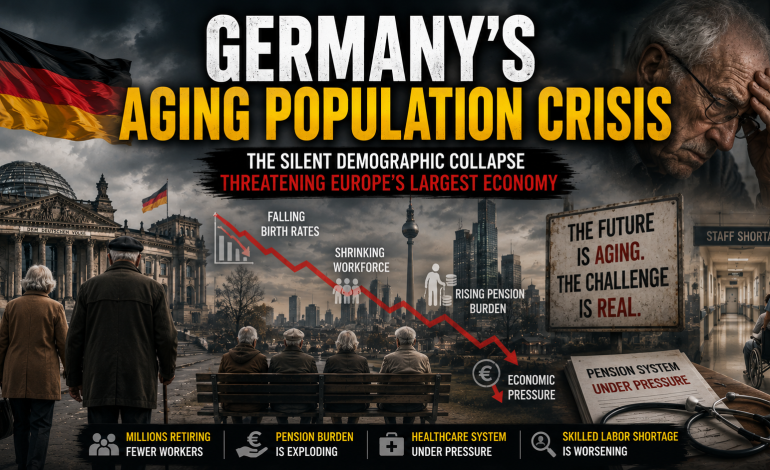

GERMANY’S AGING POPULATION CRISIS: THE SILENT DEMOGRAPHIC EMERGENCY THREATENING EUROPE’S LARGEST ECONOMY
For decades, Germany was viewed as the economic engine of Europe — a country known for industrial discipline, engineering excellence, social welfare stability, and a powerful manufacturing base. But beneath the image of prosperity, economists, demographic researchers, labor analysts, and policy institutes increasingly warn that Germany is entering one of the most dangerous demographic transitions in its modern history.
The crisis is not dramatic like a financial collapse or war. It is slower, quieter, and structural.
Germany is aging rapidly.
Millions of workers are approaching retirement while birth rates remain too low to replace them. Entire regions are shrinking. Schools are closing in some communities. Pension burdens are rising. Hospitals are struggling to find staff. Industries face growing shortages of skilled labor. And experts increasingly fear that Germany’s post-war economic model may not survive long-term demographic decline without major transformation.
Many researchers now describe demographic aging as Germany’s “invisible national emergency.”
THE FOUNDATION OF GERMANY’S POST-WAR SUCCESS
After World War II, West Germany experienced one of the most remarkable economic recoveries in modern history. During the Wirtschaftswunder (“economic miracle”) era, Germany rebuilt itself through:
- Rapid industrial growth
- Expanding manufacturing
- Rising exports
- Strong labor participation
- Stable family structures
- High birth rates
Germany’s welfare state, pension system, healthcare model, and industrial economy were all designed during decades when the country had:
- A younger population
- Growing workforce numbers
- Expanding tax bases
- Large working-age demographics
This demographic balance allowed Germany to build one of Europe’s strongest social protection systems.
But today, that demographic structure is collapsing.
Sources:
https://www.bpb.de/themen/wirtschaft/wirtschaftspolitik/
https://www.destatis.de/EN/Home/_node.html
GERMANY IS BECOMING ONE OF THE WORLD’S OLDEST SOCIETIES
Germany now has one of the oldest populations among major economies.
According to demographic projections:
- Birth rates remain below replacement level
- The median age continues rising
- Millions of baby boomers are retiring
- The working-age population is shrinking
Research from German demographic institutes warns that Germany could lose several million workers by the 2030s unless migration and workforce participation increase significantly.
The Federal Statistical Office projects major demographic imbalances in coming decades as elderly populations expand faster than younger generations entering the labor market.
Sources:
https://www.destatis.de/EN/Themes/Society-Environment/Population/Current-Population/_node.html
https://www.bib.bund.de/EN/Home/home_node.html
THE LABOR SHORTAGE CRISIS HAS ALREADY BEGUN
Germany’s labor shortages are no longer theoretical.
Industries across the country increasingly report difficulty finding workers in:
- Engineering
- Manufacturing
- Healthcare
- Transportation
- Construction
- Elder care
- Information technology
German economic institutes warn that labor scarcity may become one of the country’s largest growth constraints.
The country already faces severe shortages in skilled professions, especially in technical and healthcare sectors. Hospitals, nursing homes, and elderly care systems are under growing pressure because the aging population simultaneously increases demand for healthcare while reducing the number of available workers.
Some economists warn Germany may face a permanent “worker deficit economy.”
Sources:
https://www.iab.de/en/
https://www.kofa.de/en/
THE PENSION SYSTEM IS UNDER EXTREME PRESSURE
Germany’s pension system relies heavily on current workers financing retirees through taxation and social contributions.
But demographic aging is destabilizing this balance.
As retirees increase and the workforce shrinks:
- Pension costs rise
- Tax burdens increase
- Social security pressures intensify
- Younger generations face heavier financial obligations
German economists increasingly debate whether the pension system can remain sustainable without:
- Higher retirement ages
- Increased immigration
- Pension reforms
- Greater labor force participation
Several policy studies warn that pension expenditure could place major pressure on public finances in future decades.
Sources:
https://www.bundesbank.de/en/publications/research/research-brief
https://www.diw.de/en/
RURAL GERMANY IS QUIETLY SHRINKING
One of the least internationally discussed aspects of Germany’s demographic crisis is the decline of many rural communities.
Large cities such as:
- Berlin
- Munich
- Hamburg
- Frankfurt
continue attracting younger workers and immigrants.
But many smaller towns and rural regions face:
- Population decline
- School closures
- Aging residents
- Healthcare shortages
- Economic stagnation
Some eastern and rural regions are experiencing long-term demographic contraction as younger generations relocate toward urban economic centers.
Demographic researchers warn that entire local economies may become unsustainable if population decline accelerates further.
Sources:
https://www.demografie-portal.de/EN/Home/home_node.html
https://www.bbsr.bund.de/BBSR/EN/home/
GERMANY’S INDUSTRIAL MODEL IS COLLIDING WITH DEMOGRAPHIC REALITY
Germany’s economic strength historically depended on:
- Industrial productivity
- Skilled technical labor
- Manufacturing expertise
- Precision engineering
But demographic decline threatens all of these foundations.
Factories increasingly struggle to recruit younger skilled workers. Apprenticeship systems face enrollment pressures. Technical sectors report growing talent shortages.
The challenge is especially dangerous because Germany simultaneously faces:
- AI disruption
- Energy transition costs
- Global manufacturing competition
- Digital transformation pressures
Many analysts now believe Germany’s demographic crisis may become an industrial competitiveness crisis.
Sources:
https://www.ifo.de/en
https://www.iwkoeln.de/en.html
IMMIGRATION HAS BECOME AN ECONOMIC NECESSITY
Germany increasingly depends on immigration to stabilize:
- Workforce numbers
- Tax revenues
- Healthcare staffing
- Industrial labor supply
Government officials and business leaders openly acknowledge that Germany cannot sustain its economy long-term without migrant labor and skilled international workers.
Yet immigration remains politically sensitive.
This creates one of Germany’s biggest contradictions:
- Economically, the country needs migration
- Politically, migration debates remain highly polarizing
This tension intensified after:
- The 2015 refugee crisis
- Housing shortages
- Integration debates
- Rising populist movements
Researchers increasingly describe immigration not simply as a humanitarian issue, but as a demographic survival strategy for Germany’s economy.
Sources:
https://www.bamf.de/EN/
https://www.oecd.org/germany/
THE HIDDEN FEAR: ECONOMIC STAGNATION
Some German economists warn that demographic aging could push Germany toward long-term economic stagnation.
Key concerns include:
- Slower productivity growth
- Reduced consumer demand
- Lower innovation rates
- Shrinking tax bases
- Rising welfare costs
An aging society often spends differently than younger populations:
- Less investment
- Less entrepreneurship
- Lower housing demand growth
- Reduced workforce dynamism
Germany’s challenge is especially difficult because its economy was built around expansion, industrial output, and export competitiveness.
Demographic decline directly threatens these foundations.
THE PSYCHOLOGICAL IMPACT OF AN AGING SOCIETY
Beyond economics, demographic aging is also reshaping German society psychologically.
Researchers observe growing anxiety around:
- Retirement security
- Healthcare access
- Workforce exhaustion
- Intergenerational inequality
- Future economic stability
Younger Germans increasingly fear they will carry heavier pension and tax burdens than previous generations.
Meanwhile, elderly populations fear declining social services and healthcare pressures.
This creates quiet but growing generational tension beneath Germany’s stable public image.
GERMANY’S DEMOGRAPHIC FUTURE MAY DEFINE EUROPE’S FUTURE
Because Germany is Europe’s largest economy, its demographic crisis has continental consequences.
Germany plays a central role in:
- European manufacturing
- EU economic stability
- Industrial supply chains
- Export markets
- Financial systems
If demographic decline weakens Germany significantly, the effects could spread across Europe’s economy.
This is why demographic researchers increasingly describe Germany not as facing a temporary labor shortage — but a historic structural transformation.
A SILENT CRISIS THAT MAY RESHAPE MODERN GERMANY
Germany’s aging population crisis rarely dominates international headlines because it unfolds slowly.
There are no sudden crashes or dramatic collapses.
Instead, the crisis appears gradually through:
- Worker shortages
- School closures
- Empty rural towns
- Pension debates
- Hospital staffing crises
- Economic slowdown fears
Yet many experts believe this demographic transition may become one of the defining challenges of Germany’s 21st-century future.
The country that rebuilt itself after World War II through youthful labor, industrial growth, and demographic strength is now confronting the opposite reality:
an aging society struggling to sustain the very system that once made Germany Europe’s economic powerhouse.