GERMANY’S INDUSTRIAL MODEL IS ENTERING STRUCTURAL DECLINE: THE HIDDEN CRISIS INSIDE EUROPE’S ECONOMIC ENGINE
GERMANY’S INDUSTRIAL MODEL IS ENTERING STRUCTURAL DECLINE: THE HIDDEN CRISIS INSIDE EUROPE’S ECONOMIC ENGINE For decades, Germany was considered the industrial heart of Europe — a nation admired for precision

GERMANY’S INDUSTRIAL MODEL IS ENTERING STRUCTURAL DECLINE: THE HIDDEN CRISIS INSIDE EUROPE’S ECONOMIC ENGINE
For decades, Germany was considered the industrial heart of Europe — a nation admired for precision engineering, export dominance, automotive manufacturing, and industrial efficiency. After World War II, Germany rebuilt itself into one of the world’s strongest economies through factories, heavy industry, chemical production, and globally respected manufacturing systems.
The country became synonymous with:
- Mercedes-Benz
- BMW
- Volkswagen
- Siemens
- BASF
- Bosch
Germany’s post-war success story was built on industrial power.
But today, economists, industrial researchers, business leaders, and policy institutes increasingly warn that the very model that created Germany’s prosperity is beginning to weaken structurally.
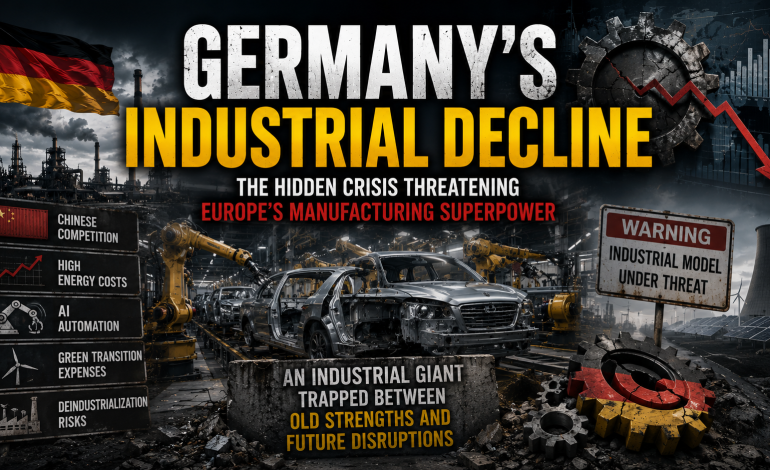
Behind Germany’s image of economic stability lies growing anxiety over:
- Rising energy costs
- Deindustrialization risks
- Chinese competition
- Digital weakness
- AI disruption
- Export dependency
- Manufacturing slowdown
Some analysts now describe Germany as:
“An industrial giant trapped between old strengths and future disruptions.”
The concern is no longer about temporary economic slowdown. Many researchers believe Germany is facing a historic transformation of its industrial foundation itself.
THE POST-WAR MODEL THAT BUILT MODERN GERMANY
After WWII, West Germany experienced rapid industrial recovery during the Wirtschaftswunder (“economic miracle”). The country rebuilt its economy through:
- Manufacturing exports
- Industrial specialization
- Skilled labor systems
- Engineering excellence
- Energy-intensive industries
- Global trade integration
Germany became heavily dependent on:
- Automotive production
- Machinery exports
- Chemical manufacturing
- Industrial supply chains
Its economic model relied on a powerful combination:
- Cheap imported energy
- Strong global export demand
- Stable industrial labor
- International manufacturing dominance
For decades, this system made Germany Europe’s strongest economy.
Sources:
https://www.bpb.de/themen/wirtschaft/
https://www.destatis.de/EN/Home/_node.html
CHEAP RUSSIAN ENERGY WAS A HIDDEN FOUNDATION OF GERMAN INDUSTRY
One of the least publicly acknowledged realities of Germany’s industrial success was its dependence on relatively cheap Russian natural gas.
German industries — especially chemicals, steel, and manufacturing — benefited for years from affordable energy imports that supported industrial competitiveness.
But geopolitical tensions and the energy crisis following the Russia–Ukraine conflict fundamentally disrupted this model.
Suddenly, Germany faced:
- Exploding energy prices
- Industrial uncertainty
- Supply chain disruption
- Production cost increases
Energy-intensive industries became especially vulnerable.
German industrial associations warned that some factories were becoming internationally uncompetitive because of energy costs.
Several companies began considering:
- Relocation
- Production cuts
- Overseas investment shifts
Sources:
https://www.ifo.de/en
https://www.bundesbank.de/en/
https://www.iwkoeln.de/en.html
GERMANY IS LOSING ITS GLOBAL INDUSTRIAL ADVANTAGE
Germany’s export-driven economy now faces growing pressure from global competition — especially from China.
For years, Germany dominated high-quality industrial manufacturing. But Chinese companies increasingly compete in:
- Electric vehicles
- Green technology
- Industrial machinery
- Batteries
- Advanced manufacturing
At the same time:
- Chinese production costs remain lower
- State-supported industrial expansion is accelerating
- Global supply chains are shifting toward Asia
German economists warn that the country’s traditional industrial strengths are no longer guaranteed advantages.
Industries that once seemed untouchable now face structural competition.
Sources:
https://www.imf.org/en/Countries/DEU
https://www.oecd.org/germany/
THE AUTOMOTIVE INDUSTRY IS ENTERING ITS MOST DANGEROUS TRANSITION
Germany’s automotive sector is central to its economy.
Entire regions depend on:
- Car factories
- Auto suppliers
- Industrial exports
- Engineering employment
The automotive industry supports millions of jobs directly and indirectly.
But the transition toward:
- Electric vehicles
- AI-assisted manufacturing
- Autonomous driving
- Battery technology
is disrupting Germany’s traditional strengths.
German car manufacturers were historically dominant in combustion-engine engineering. But the electric vehicle revolution reduced some of those advantages because EV production depends more heavily on:
- Software
- Batteries
- Electronics
- AI integration
China has rapidly expanded in these sectors.
Some analysts warn Germany risks losing leadership in the next generation of automotive technology if adaptation remains slow.
Sources:
https://www.vda.de/en
https://www.bertelsmann-stiftung.de/en
GERMANY’S DIGITAL WEAKNESS HAS BECOME A STRATEGIC PROBLEM
One of the biggest hidden weaknesses inside Germany’s industrial system is its slower digital transformation compared to the United States and parts of Asia.
Germany remains globally respected for:
- Mechanical engineering
- Industrial precision
- Manufacturing systems
But it lags in:
- AI innovation
- Semiconductor leadership
- Tech platform development
- Software ecosystems
- Digital infrastructure
Critics argue Germany remained too dependent on traditional industrial models while underestimating the importance of digital technological dominance.
Unlike the United States or China, Germany produced few globally dominant digital platforms.
This created growing dependence on foreign technologies in areas increasingly critical for future industrial competitiveness.
Sources:
https://www.acatech.de/en/
https://www.stiftung-nv.de/en
THE AI REVOLUTION THREATENS GERMANY’S TRADITIONAL LABOR MODEL
Artificial intelligence and automation are transforming global manufacturing.
Germany’s industrial economy depends heavily on skilled technical labor and mid-level manufacturing employment. But AI-driven automation could restructure entire sectors.
Researchers warn that:
- Traditional factory employment may decline
- Automation could reduce workforce demand
- Industrial retraining pressures may intensify
- Mid-skilled workers may face growing insecurity
This creates tension because Germany’s social stability historically relied on:
- Strong industrial employment
- Stable middle-class manufacturing jobs
- Vocational labor systems
If AI transformation accelerates faster than workforce adaptation, Germany could face growing economic anxiety inside regions dependent on traditional industry.
THE GREEN TRANSITION IS CREATING MASSIVE INDUSTRIAL COSTS
Germany is simultaneously attempting one of the world’s largest industrial energy transitions.
The country is investing heavily in:
- Renewable energy
- Decarbonization
- Climate policies
- Green manufacturing systems
But the transition is expensive.
Industries now face:
- Carbon regulations
- Energy restructuring costs
- Infrastructure adaptation expenses
- Environmental compliance pressure
Some industrial leaders fear Germany may be trying to transition too quickly while already facing:
- Global competition
- Energy instability
- Economic slowdown
Critics argue excessive industrial costs could accelerate deindustrialization.
Supporters argue modernization is necessary for long-term survival.
This debate has become one of Germany’s most important economic conflicts.
Sources:
https://www.cleanenergywire.org/
https://www.agora-energiewende.de/en/
DEINDUSTRIALIZATION FEARS ARE GROWING
The word “deindustrialization” has become increasingly common in German economic discussions.
Some researchers warn Germany could gradually lose industrial capacity due to:
- High energy costs
- International competition
- Aging workforce
- Digital lag
- Regulatory pressure
Several companies have already reduced domestic investment while expanding production abroad.
Industrial regions worry about:
- Factory closures
- Job losses
- Supply chain erosion
- Declining economic security
For Germany, this issue is especially dangerous because industrial manufacturing is deeply connected to national identity and social stability.
THE MIDDLE CLASS FEARS LOSING ECONOMIC SECURITY
Germany’s post-war stability relied heavily on a strong industrial middle class.
Factory employment, engineering professions, and export industries created decades of:
- Social mobility
- Economic stability
- Regional prosperity
- Political moderation
But structural industrial decline threatens this balance.
If manufacturing weakens significantly:
- Middle-class insecurity may rise
- Regional inequality could worsen
- Political anger may increase
- Social polarization could deepen
Some economists warn that industrial decline is not only an economic issue — it is also a democratic stability issue.
GERMANY’S ECONOMIC MODEL IS ENTERING A HISTORIC TRANSITION
Germany still remains one of the world’s largest industrial economies. Its engineering expertise, industrial infrastructure, and technical workforce remain globally respected.
But research institutions increasingly warn that the old German model is no longer fully compatible with the emerging global economy.
The country now faces simultaneous pressure from:
- AI disruption
- Green transition costs
- Chinese industrial competition
- Digital transformation
- Energy instability
- Demographic decline
The challenge is no longer simply maintaining industrial production.
It is whether Germany can reinvent its industrial system fast enough to survive the next era of global economic competition.
Many experts believe the answer to that question may determine not only Germany’s future — but the future economic stability of Europe itself.