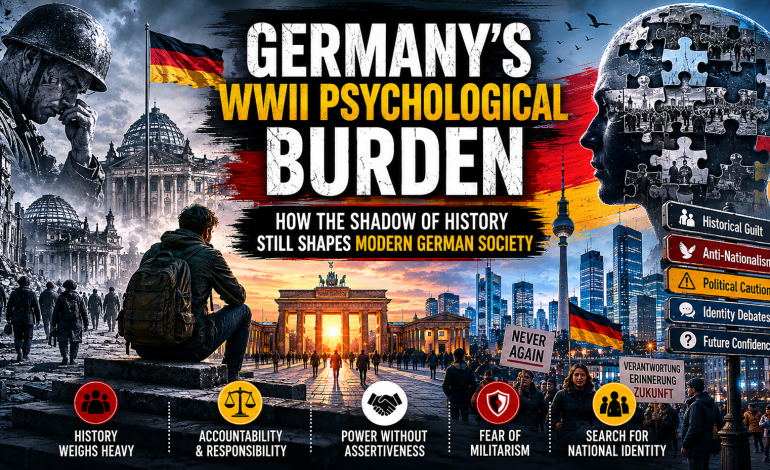
GERMANY’S PSYCHOLOGICAL BURDEN FROM WWII: HOW THE SHADOW OF HISTORY STILL SHAPES MODERN GERMANY
GERMANY’S PSYCHOLOGICAL BURDEN FROM WWII: HOW THE SHADOW OF HISTORY STILL SHAPES MODERN GERMANY Germany’s rise after World War II is often described as one of the most remarkable national

GERMANY’S PSYCHOLOGICAL BURDEN FROM WWII: HOW THE SHADOW OF HISTORY STILL SHAPES MODERN GERMANY
Germany’s rise after World War II is often described as one of the most remarkable national recoveries in modern history. A country devastated by war, dictatorship, genocide, and destruction transformed itself into:
- Europe’s largest economy
- A leading democratic state
- A model of historical accountability
- One of the world’s most stable societies
Modern Germany became internationally respected for openly confronting the crimes of the Nazi era rather than hiding them. Unlike many nations that avoid darker chapters of history, post-war Germany institutionalized remembrance through:
- Education systems
- Memorials
- Historical museums
- Public discourse
- Constitutional safeguards
But beneath this globally praised model of accountability lies a deeper and more complicated reality rarely discussed outside academic, psychological, and historical circles.
Many historians, sociologists, and political researchers argue that Germany’s post-war identity was built not only on democracy and responsibility — but also on collective historical trauma, political caution, and deep discomfort with nationalism itself.
The psychological consequences of World War II still quietly shape modern Germany’s:
- Political culture
- National identity
- Foreign policy
- Military decisions
- Immigration debates
- Public speech
- Relationship with power
Some scholars describe Germany as:
“A powerful country psychologically constrained by its own history.”
THE TOTAL COLLAPSE OF GERMAN NATIONAL IDENTITY AFTER WWII
When Nazi Germany collapsed in 1945, the defeat was not only military.
Germany experienced:
- Territorial destruction
- Political collapse
- Moral catastrophe
- International humiliation
- Exposure of genocide
- National identity breakdown
The revelations of the Holocaust fundamentally transformed how Germans viewed nationalism, patriotism, military power, and state authority.
After WWII, Germany faced a unique historical burden:
the responsibility of rebuilding a democratic identity while carrying the memory of one of history’s worst atrocities.
Unlike traditional post-war recovery, Germany’s reconstruction involved moral reconstruction as well.
Sources:
https://www.bpb.de/en/topics/national-socialism-dossier/
https://encyclopedia.ushmm.org/
POST-WAR GERMANY BUILT A CULTURE OF HISTORICAL GUILT AND RESPONSIBILITY
West Germany gradually developed a political culture centered around:
- Historical accountability
- Anti-authoritarianism
- Constitutional restraint
- Human rights
- Skepticism toward nationalism
Schools taught Holocaust history extensively. Public memory became institutionalized. National symbols and patriotic expression were approached cautiously compared to many countries.
This process helped Germany rebuild international trust after WWII.
Many scholars view modern Germany as one of the world’s strongest examples of democratic self-correction.
But historians also argue that decades of historical guilt created long-term psychological effects on national identity and political behavior.
Sources:
https://www.goethe.de/en/kul/ges/20817024.html
https://www.dw.com/en/germanys-culture-of-remembrance/a-66788374
THE FEAR OF NATIONALISM STILL SHAPES GERMAN POLITICS
One of the deepest psychological consequences of WWII in Germany is discomfort with nationalism itself.
In many countries:
- National pride
- Flags
- Patriotic rhetoric
- Military symbolism
are politically normal.
In Germany, these subjects remain far more sensitive because of their historical association with Nazism and militarism.
Researchers note that post-war Germany intentionally developed a restrained national culture to prevent extremist revival.
This created:
- Political caution
- Institutional restraint
- Suspicion of aggressive patriotism
- Fear of authoritarian tendencies
Some political theorists argue modern Germany developed a “post-national identity” more focused on:
- European integration
- Constitutional values
- Economic stability
- International cooperation
than traditional nationalism.
Sources:
https://www.bpb.de/shop/zeitschriften/apuz/
https://www.deutschland.de/en/topic/politics
GERMANY BECAME ECONOMICALLY POWERFUL — BUT POLITICALLY HESITANT
One of modern Germany’s biggest contradictions is that it became an economic superpower while often remaining politically cautious on the global stage.
Germany dominates Europe economically through:
- Manufacturing
- Exports
- Industrial production
- Financial influence
Yet critics frequently describe Germany as strategically hesitant in:
- Military affairs
- Geopolitical leadership
- Defense spending
- Foreign intervention
For decades after WWII, Germany avoided projecting military power aggressively because of historical fears associated with militarism.
Even discussions about military expansion often trigger intense public debate inside Germany.
This psychological caution shaped German foreign policy for generations.
Sources:
https://www.swp-berlin.org/en/
https://www.bundeswehr.de/en
THE MILITARY DEBATE EXPOSED GERMANY’S HISTORICAL ANXIETY
Germany’s long-standing reluctance toward military assertiveness became especially visible during debates over:
- NATO spending
- European defense
- Ukraine support
- Rearmament policies
For years, Germany maintained relatively restrained military policies compared to its economic size.
Critics argued:
- Germany relied heavily on U.S. security protection
- Defense investment remained insufficient
- Strategic leadership was hesitant
Supporters argued Germany’s restraint reflected lessons learned from history.
After Russia’s invasion of Ukraine, Germany announced a major military modernization plan called the “Zeitenwende” (“historic turning point”).
But even this shift revealed internal tensions:
- Fear of militarization
- Historical sensitivity
- Public uncertainty about military identity
The WWII legacy still heavily influences how Germans discuss force, security, and national power.
Sources:
https://www.bundesregierung.de/breg-en
https://www.ifw-kiel.de/topics/war-against-ukraine/
IMMIGRATION AND IDENTITY DEBATES ARE DEEPLY CONNECTED TO HISTORY
Germany’s historical burden also shapes modern immigration debates.
Because of Nazi history, German political culture became extremely sensitive around:
- Ethnic identity
- National belonging
- Minority rights
- Xenophobia
- Cultural nationalism
This often makes immigration discussions emotionally and politically complex.
Germany simultaneously faces:
- Economic need for migration
- Humanitarian commitments
- Cultural integration concerns
- Rising political polarization
Critics from multiple sides argue Germany sometimes struggles balancing:
- Historical responsibility
- National identity
- Social cohesion
- Security concerns
Some scholars believe Germany’s historical trauma contributes to unusually cautious political discourse surrounding identity-related topics.
Sources:
https://www.dezim-institut.de/en/
https://www.bamf.de/EN/
THE HIDDEN PSYCHOLOGICAL TENSION INSIDE MODERN GERMANY
Historians increasingly describe post-war Germany as psychologically divided between:
- Historical responsibility
- Desire for normal national identity
Many Germans strongly support remembrance culture and democratic accountability. At the same time, some researchers argue parts of society feel exhausted by permanent historical guilt narratives.
This creates difficult public tensions around:
- Patriotism
- Historical memory
- Immigration
- National confidence
- Cultural identity
Some scholars warn that unresolved identity anxiety can contribute to:
- Political fragmentation
- Populist reactions
- Anti-establishment movements
especially during periods of economic or social instability.
GERMANY’S CULTURE OF REMEMBRANCE IS BOTH A STRENGTH AND A BURDEN
Germany’s willingness to confront its past remains globally respected.
The country created:
- Holocaust education systems
- Memorial institutions
- Anti-extremism laws
- Constitutional protections
that became international examples of democratic accountability.
But this same culture also produced long-term psychological caution that still influences German society today.
Germany often appears internationally as:
- Careful
- Risk-averse
- Consensus-driven
- Strategically restrained
Some analysts argue these traits emerged directly from post-war political psychology.
EUROPEAN LEADERSHIP CREATED NEW PRESSURES ON GERMANY
As Europe’s largest economy, Germany increasingly faces pressure to take stronger leadership roles in:
- European security
- Economic policy
- Foreign affairs
- Defense coordination
But Germany’s historical caution sometimes conflicts with expectations for geopolitical leadership.
This creates a recurring contradiction:
Germany is powerful enough to lead Europe economically, yet historically uncomfortable exercising overt political or military dominance.
The shadow of WWII still influences how Germany sees itself — and how Europe sees Germany.
THE INVISIBLE SHADOW OF HISTORY STILL REMAINS
Modern Germany is no longer Nazi Germany.
It became one of the world’s strongest democracies and one of history’s clearest examples of national transformation after dictatorship.
But historians and sociologists increasingly argue that the psychological legacy of WWII never fully disappeared.
Instead, it evolved into:
- Political caution
- Historical sensitivity
- National restraint
- Fear of militarism
- Complex identity debates
Germany rebuilt its economy after WWII faster than it rebuilt a fully comfortable relationship with national identity itself.
And even today, nearly eighty years later, the shadow of history still quietly shapes the political psychology of modern Germany.